March 6, 2026
The roofing industry is growing in 2026. U.S. roofing contractors generated roughly $76.4 billion in 2025.
Even small roofing contractors are busier than ever, as storms and home renovations increase the demand. But growth in the roofing business brings new challenges.
This means manual spreadsheets and scattered tools can’t keep up with the sales process. For example, relying on Excel for estimates often leads to simple errors, misplaced formulas, or typos that can cause delays and cost overruns. Even old CRMs and tracking systems leave information on hold.
Without timely updates on roofing projects, teams waste time on the job site, and opportunities slip through the broken workflow.
Roofing Software in 2026: How Fast-Growing Roofing Businesses Scale Smarter
Roofing companies that want to scale smoothly in 2026 are ditching those old approaches. They need modern, all-in-one software built for roofs. This next-generation roofing CRM serves as an operating system for the business, connecting sales, estimating, scheduling, project management, and payment processing in one place.
Automating workflows with roofing business software helps roofing contractors grow profitably even if there is costs rise. For example, a ServiceTitan industry report notes that 75% of contractors expect revenue growth in 2026, but margins are tight; they must “do more with less” by using tech to cut waste.
Now, in this blog, we’ll understand how a 2026-ready roofing software combines CRM, roofing estimating software, project tracking, and accounting software into one platform.
Key Takeaways
- All the tools, like separate apps, spreadsheets, and disjointed CRMs, slow growth, cause errors, and leak revenue.
- An all-in-one roofing platform brings data together. This streamlines operations, reduces mistakes, and speeds up roofing projects.
- Automated workflows from lead capture to invoicing keep jobs moving smoothly with minimal manual work.
- Data-driven dashboards and analytics let leaders see projects, schedules, and finances in real time.
- RooferBase helps roofing businesses to grow efficiently in 2026: one system for roofing jobs, estimating, scheduling, and more, with built-in automation and reporting.
RooferBase was built for the modern roofer, with the best roofing apps for field teams and dashboards for leaders that help you scale high profits. Book a demo now.
The Roofing Companies Growing Fast in 2026 Don’t “Feel Busy”
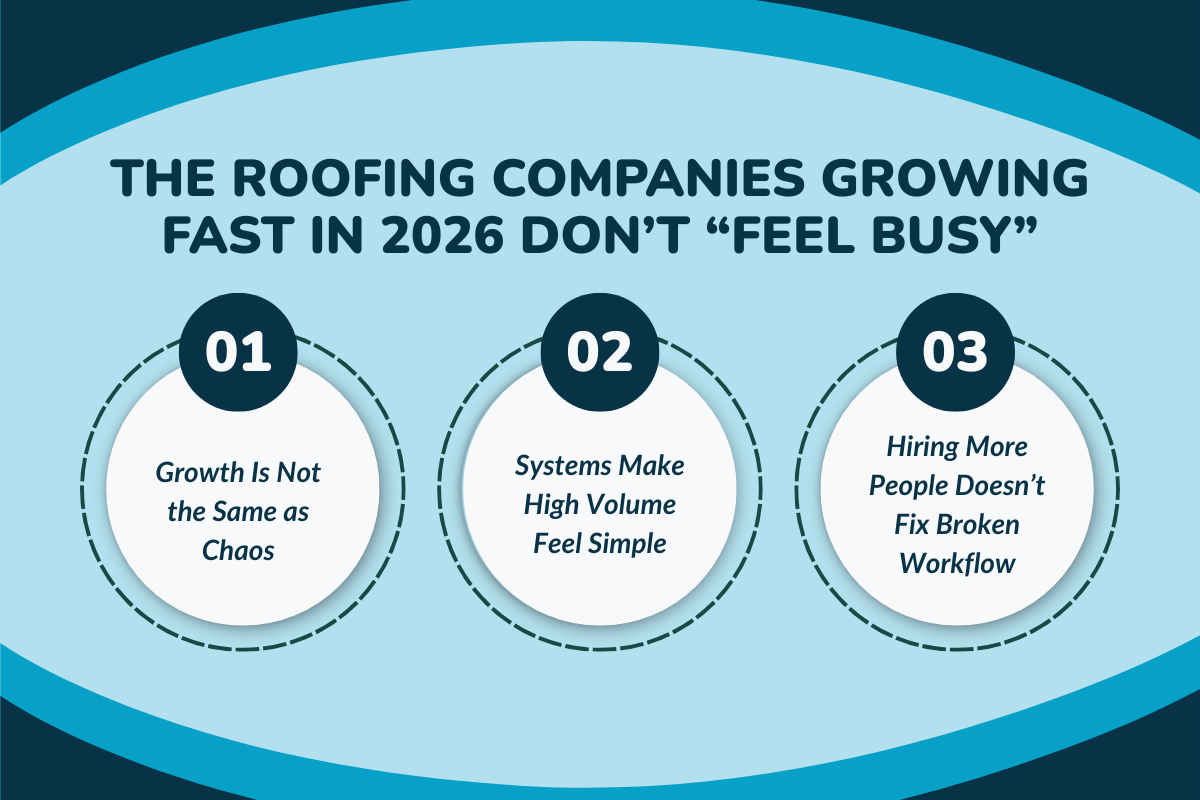
A. Growth Is Not the Same as Chaos
In roofing, it’s easy to assume that a packed calendar and constantly busy sales reps signal a healthy business- more calls, more measurements, more materials moving. But high-growth roofing companies in 2026 have learned a different lesson.
Some of the fastest-growing teams actually feel calmer than smaller operations. The difference is not workload; it’s structure. These companies build strong systems, like roofing business software, before piling on more jobs. Instead of pushing people harder, they rely on clear processes to guide work forward.
When jobs move through a defined flow, and decisions are based on real-time data, teams stay in control even as schedules fill up. Growth becomes predictable instead of overwhelming.
B. Systems Make High Volume Feel Simple
High-growth roofing companies focus on streamlining workflows, not individual tasks. From the first phone call to the final invoice, every step is tracked. Teams know what to do next without wasting time.
Office staff sees which estimates need follow-up. The whole team starts their day with a proper schedule that is updated regularly. The order materials are recorded with precise measurements.
This indicates that when work moves in a known sequence of business operations, mistakes drop, and speed improves. Roofers take on more jobs without adding pressure to the team. The business grows, but the workday feels lighter, not heavier.
C. Hiring More People Doesn’t Fix Broken Workflow
When things feel out of control, many roofing companies try to solve the problem by adding more staff, but headcount doesn’t fix disorganized processes.
Without clean workflows, even larger teams struggle to keep up. You need fast and accurate measurements, and job details with correct customer information, regardless of commercial roofing or residential roofing sites.
Modern roofing businesses rely on automation to handle follow-ups, scheduling, and data entry. Everyone works from a single platform instead of email and spreadsheets.
Technology lets roofers save time by generating professional estimates and measuring roofs instantly.
What Slows Roofing Companies Down More Than Competition?
The biggest threat to roofing growth rarely comes from the company down the street. It comes from inside the business. Outdated tools create small delays that cost every job. Here is what really holds roofers back in 2026.
| Bottleneck | What Happens in Daily Operations | Real Business Impact |
|---|---|---|
| Disconnected tools | Teams switch between apps, emails, and spreadsheets to manage leads, jobs, and updates | Lost hours per job, data mismatches, and shrinking profit margins |
| No real-time visibility | Crews and office staff rely on calls and texts for job status | Delayed decisions, schedule drift, and missed follow-ups |
| Profit leakage | Material and labor cost changes never sync back to the estimates | Revenue grows, but margins quietly erode |
| Manual scheduling | Managers rebuild calendars by hand when jobs shift | Idle crews, overtime costs, and team burnout |
| Delayed billing | Paperwork waits before invoices are sent | Slower cash flow and stalled growth |
How Modern Roofing Software Supports Growth at Every Stage?
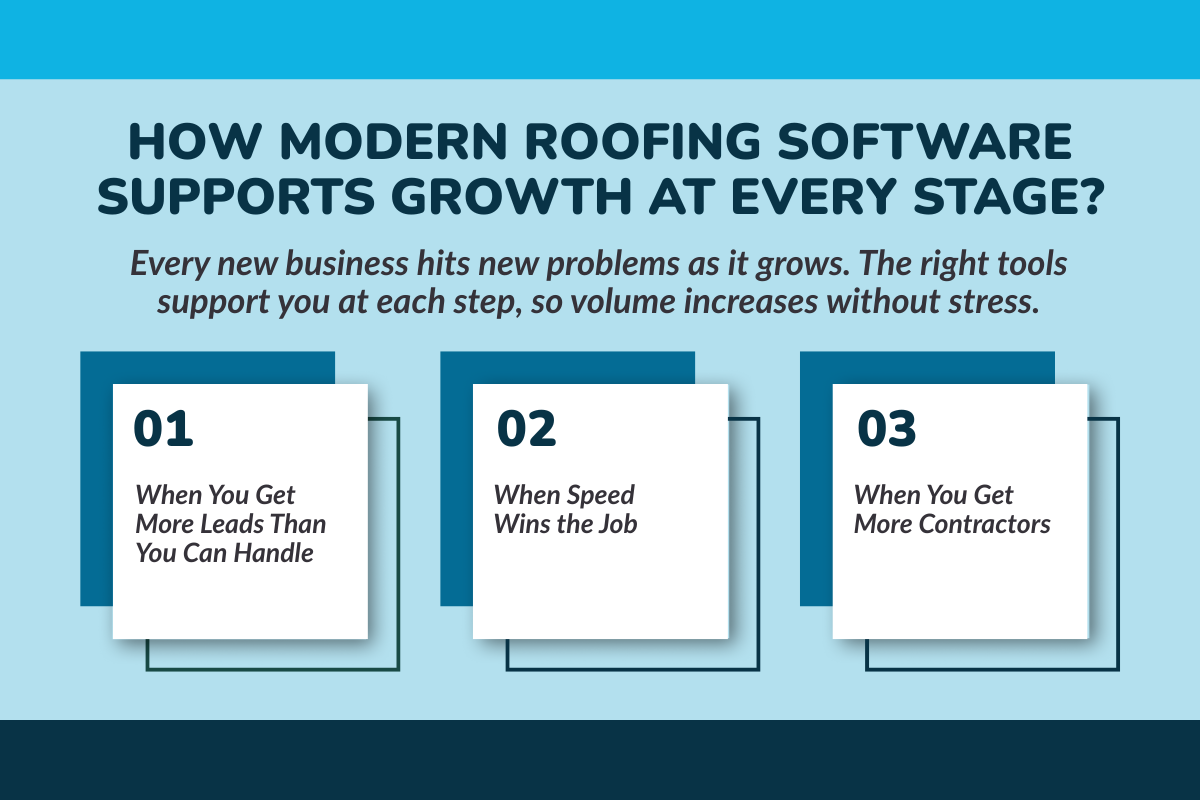
Every new business hits new problems as it grows. The right tools support you at each step, so volume increases without stress.
I. When You Get More Leads Than You Can Handle
More leads are a good problem to have until some start falling through the cracks. Modern roofing software captures every inquiry from calls, ads, and your website and places them into a single CRM pipeline.
Sales reps can immediately see who needs a follow-up and what stage each lead is in. Nothing relies on memory or scattered notes. Modern roofing software captures every inquiry from ads, calls, and your website, then drops them into one CRM pipeline. Sales reps always know who to call next.
Did you know? About 47 % of roofing businesses now use CRM to manage sales, customer data, and internal processes.
Follow-ups are tracked through reminders and simple automation, which means faster responses, better consistency, and fewer missed opportunities during busy periods.
It’s one of the reasons nearly half of roofing businesses now rely on CRM systems to manage sales and customer data.
II. When Speed Wins the Job
Homeowners expect fast quotes, but old takeoffs and spreadsheets slow everything down. Best software lets reps build clean, accurate estimates from the field in minutes.
Quick professional proposals build trust and help you win work before customers choose competitors. At the same time, your pricing stays consistent, so profit margins stay protected.
III. When You Get More Contractors
Adding crews creates confusion if scheduling stays manual. Roofing software gives you a live dispatch board with every job, crew, and deadline in one view.
Teams see their assignments on their mobile apps. Managers see progress in real time, so there are no overlaps, no idle crews. Even after storms, you know exactly who is free and where to send them.
Watch how roofing software handles your business: Roofing Software that Handles Estimates, Measurements & Install Tracking
A Day in the Life of a Roofing Company Using 2026-Ready Software
Step 1: Morning Starts With Clarity, Not Confusion
In a growing roofing company, early morning starts with the manager opening one app on the tablet instead of sorting through emails and spreadsheets.
Today’s commercial roofing project jobs are already lined up. Crews are assigned, and every roof measurement approved overnight has turned into a live work order.
Material orders are already placed, without anyone having to follow up. A homeowner requested to shift their installation to tomorrow, and the schedule was updated instantly across the system. The day begins with certainty, not catch-up.
Step 2: Field Teams Work While the Office Stays in Sync
Team members see multiple locations, scope of work, photo apps, and timelines in one place. As work moves forward, they upload progress pictures, log hours, and note any changes on the spot.
The office sees everything live. Nobody calls asking, “Where are we on this job?” The dashboard shows progress in real time with aerial measurements, proposal templates, and insurance adjusters.
Step 3: Sales and Billing Move Without Waiting
Later in the day, a sales rep meets a homeowner. Using a tablet, they build a clean, accurate roofing estimate and send it immediately. The customer signs digitally, and the job is created on the spot.
Back at the office, finance reviews which projects are ready to be billed. Invoices are sent with a click. Cash flow moves forward without waiting for paperwork or manual handoffs. By the time crews finish for the day, the business side has already progressed.
Step 4: Leadership Sees the Whole Business at a Glance
At the end of the day, the owner opens the dashboard. Every job shows its timeline, budget, and profit margin. If something is off, it’s visible immediately.
There’s no guessing, no chasing updates, and no delayed reports. Decisions are made based on real data, not assumptions.
Step 5: When Software Runs the Background, Teams Run the Business
The biggest change is simple. The software runs quietly in the background while the team focuses on real work. Nobody jumps between emails, texts, and spreadsheets.
Leads move into accurate estimates, estimates turn into installs, and installs become invoices. Everything connects. The company feels calmer, faster, and more in control, even as volume grows.
What High-Growth Roofing Companies Expect From Software in 2026?
1. Built for Storm Surges and Busy Seasons
In 2026, roofing software must handle more projects without breaking. After storms, the new leads hit at once. The system should help mark high-priority neighborhoods and schedule jobs without slowing teams down.
2. Made for the Roof
Roofers work in the field, and good software travels with them. Crews need mobile access to update jobs, capture photos, enter measurements, and collect signatures on-site. Real-time sync is necessary.
3. Easy for New Hires to Learn
Teams change fast, which is why software must stay simple. When tools feel natural, new staff get productive in days, not weeks, and customer retention stays high across the company.
4. Software That Feels Like a Partner
In the end, roofers want a system that adapts to their business. It handles volume quietly, follows the team everywhere, and keeps growth steady rather than missing leads.
Looking for CRM essentials? Here is the list: Roofing CRM Essentials: How to Keep Track of Clients and Jobs
Know The Hidden Costs of Using “Good Enough” Roofing Software
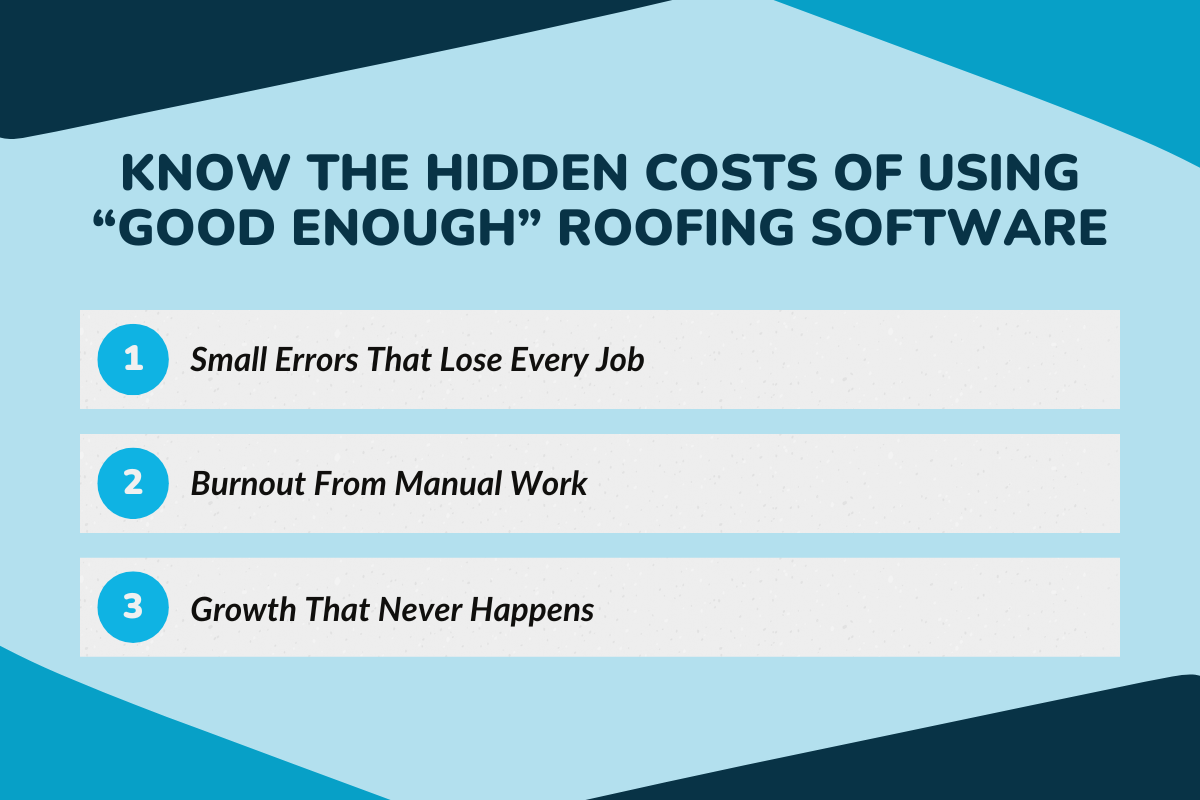
A. Small Errors That Lose Every Job
Different tools create tiny mistakes in estimates, hours, and materials. One wrong number here and there slowly eats into profit margins. Over a couple of jobs, that “small” loss becomes serious money.
B. Burnout From Manual Work
Without automation, managers chase updates and fix schedules all day. Admin teams spend time reconciling files instead of helping the company grow. Many roofers end up hiring extra people just to handle paperwork.
Did you know? Nearly half of roofing firms (49 %) invest in digital tools because inefficient manual methods slow growth and increase operational costs.
C. Growth That Never Happens
The highest cost is lost opportunity. Roofers with basic tools hesitate to take on more work because they fear losing control. Modern software gives confidence to expand, add services, and handle more jobs with the same team.
Top 3 Roofing Software High-Growth Companies Rely
High-growth roofing companies don’t choose software based on feature lists alone. They choose platforms that remove operational friction, connect teams end to end, and keep work moving as volume increases.
The tools below are used by roofing businesses that have outgrown spreadsheets, disconnected apps, and manual workflows, and need systems built to support speed, accuracy, and scale in 2026.
1. RooferBase — Unified Measurement-to-Execution Platform
RooferBase is built as a connected roofing operating system rather than a single-purpose tool. Measurements, estimates, sales workflows, and job execution all run on the same data layer.
Best suited for: Fast-growing small to mid-sized roofing companies that want fewer tools, tighter workflows, and faster handoffs between sales and operations.
Features:
- State-based workflow automation: Jobs automatically transition from lead → estimate → contract → production without manual status updates, replacing spreadsheet-driven handoffs that break at scale.
- Single-source-of-truth job architecture: Measurements, pricing logic, scope, and customer data live in one record, eliminating version conflicts caused by emailing PDFs and copying values between tools.
- Event-driven updates across teams: When an estimate is approved or a schedule changes, updates propagate instantly to sales, ops, and field teams—removing the need for calls, texts, and follow-up emails.
- Growth-resilient system design: Adding users or jobs doesn’t increase coordination overhead, unlike older tools that require more admin effort as workload grows.
Pricing: Generally positioned as flexible and scalable, with pricing based on team size and feature needs rather than per-report fees.
2. AccuLynx — CRM-Centric Roofing Operations Platform
AccuLynx functions primarily as a roofing-specific CRM and production management system, with external measurement tools integrated into its workflows.
Best suited for: Established roofing contractors with mature CRM processes who want structured production tracking and supplier coordination.
Features:
- Roofing-specific CRM architecture: Data models are tailored to roofing workflows, supporting lead intake, estimating, production, and close-out without generic CRM compromises.
- End-to-end job lifecycle tracking: Jobs move through defined stages from lead creation to completion, providing managers with real-time production visibility.
- Estimate-to-material ordering linkage: Pricing and scope data connect directly to supplier ordering workflows, reducing manual coordination and procurement delays.
- Third-party measurement ingestion: Measurement reports from external providers are imported and mapped into job records for estimating and production planning.
Pricing: Higher-tier pricing reflecting enterprise CRM depth; commonly scales into four figures monthly for multi-user teams.
3. JobNimbus — Modular System for Evolving Workflows
High-growth roofing companies rarely operate the same way year to year. JobNimbus is used by teams that have outgrown rigid software and need systems that adapt as operations mature.
Best suited for: Roofing businesses transitioning from founder-led processes to structured teams.
Features:
- Configurable workflow logic: Pipelines and rules evolve as the business grows, replacing static processes that force workarounds and side spreadsheets.
- Data-layer integrations instead of file transfers: Measurement and estimating tools connect directly into records, eliminating copy-paste workflows that break under pressure.
- Real-time workload visibility: Managers see pipeline congestion early, rather than discovering delays after jobs slip.
- Role-based access control: Different teams interact with the same data without overwriting or misusing it, solving common multi-user spreadsheet issues.
Pricing: Scales by usage and complexity rather than a fixed one-size plan.
Why Feature Lists Don’t Predict Success Anymore?
Long feature lists look impressive, but they rarely show how software performs in real roofing work. What matters is how everything runs together.
| Common Trap | What It Looks Like | What Actually Matters |
|---|---|---|
| Too many promises | Platforms advertise dozens of tools and options. | How smoothly sales, jobs, crews, and billing stay connected during real volume. |
| Perfect demos | Vendors show clean sample data and simple workflows. | How the system handles messy, real-world jobs, changes, and handoffs. |
| Isolated features | Each feature works alone in a demo screen. | How features work together across the entire job lifecycle. |
| Ignoring workflows | Buyers compare checklists instead of processes. | Mapping how leads move to estimates, crews, and invoices in your business. |
| Office-only testing | Only managers review the platform. | Involving field crews and running real job scenarios before choosing. |
How High-Growth Roofing Companies Actually Choose Software?
Successful roofing companies do not buy software on impulse. They follow a simple, hands-on process to make sure the platform fits the way they really work.
Step 1: Map the Business Before Shopping
Before looking at tools, they write down every step of their workflow. From the first call to the final invoice, they see how leads, estimates, crews, and payments move today.
This shows what the software must support and where data needs to flow automatically. Instead of chasing features, they look for a system that matches their roofing operation.
Step 2: Bring the Field Team Into the Decision
Roofing software lives in the field, not just the office. That is why foremen and installers test the platform early.
If the mobile app feels slow or confusing, it becomes a problem later. From day one, high-growth companies choose tools that crews actually like using.
Step 3: Test With Real Jobs
Demos look perfect, real work does not. Smart roofers upload real leads, jobs, and invoices into the trial system.
They watch how the software handles changes, delays, and volume. Can it manage 50 jobs at once? Can it carry data from old tools? Real testing exposes what sales demos hide.
Step 4: Choose the Company You Are Becoming
High-growth roofers think ahead. They do not buy for three users but buy for thirty.
They ask whether the system can scale when revenue doubles. That usually means cloud software that adds users easily and connects with other tools as the business expands.
Step 5: Pick a System That Grows With You
In the end, the best roofing software fits today and tomorrow. Instead of chasing flashy features, high-growth companies choose platforms that support real workflows and keep working as volume rises. That is how software becomes a growth engine, not just another tool.
Key Roofing Software Trends Shaping High-Growth Companies in 2026
1. Shift From Reactive Operations to Predictable Workflows
High-growth roofing companies are moving away from reacting to daily firefighting issues. Modern roofing software is increasingly designed to standardize workflows, so scheduling, job tracking, and invoicing follow repeatable processes rather than ad-hoc decisions.
2. Greater Emphasis on Real-Time Visibility Across Teams
As teams expand across locations and service areas, delayed reporting becomes a major bottleneck. Roofing software trends in 2026 show a clear shift toward real-time dashboards and live job visibility, allowing managers to track progress, workloads, and issues without waiting for end-of-day updates
3. Software Designed Around Scalability, Not Just Daily Use
In 2026, roofing software will no longer be evaluated only on how well it works today, but on how well it can support growth tomorrow. High-growth companies are favoring platforms that can handle more users, more jobs, and more complexity without requiring frequent system changes or process overhauls.
Why RooferBase is the Choice for High-Growth Roofers?
RooferBase is an all-in-one software for roofers that runs your entire operation in one place. Instead of jumping between CRMs, schedulers, and spreadsheets, roofers use RooferBase as their business system.
Sales, estimating, projects, field updates, and billing stay connected so work flows without confusion. It helps roofing companies sell faster, manage crews more effectively, protect margins, and grow through residential and commercial projects.
Key Features of RooferBase:
- Unified CRM to capture and manage every lead. RooferBase keeps all leads in one place, whether they come from phone calls, website forms, ads, or referrals.
- Fast Estimating and Proposals with instant estimates and e-signatures. Proposals are clean, professional, and easy for homeowners to understand.
- Job Scheduling and Dispatching for crews with live updates. Scheduling is handled from a single dispatch view that shows all active jobs, crews, and timelines. Managers can assign work, adjust schedules, and respond to changes in real time.
- Workflow Automation to move jobs through stages automatically. RooferBase automates routine steps that usually slow teams down. When an estimate is approved, the job can automatically move to scheduling.
- Real-Time Dashboards for revenue, margins, and crew performance. Dashboards provide a live view of how the business is performing. Owners and managers can see active jobs, revenue, profit margins, and crew productivity at a glance.
- Integrated Billing and Invoicing to speed up cash flow. Billing is directly connected to completed work and approved change orders. Invoices can be generated and sent without re-entering information, reducing errors and delays.
- Mobile Access so office and field teams stay in sync. Field crews can update job status, upload photos, log hours, and capture signatures directly from the job site.
Together, RooferBase gives roofing companies the leverage they need to grow faster while keeping operations simple and profitable.
Final Thought: The Best Roofing Companies Out-Operate and Not Outwork the Market
In 2026, top roofing companies grow not by working longer hours, but by running smarter. Every lead, estimate, and project flows smoothly because their operations are built to scale.
With an all-in-one platform like RooferBase, contractors focus on winning jobs while the system handles the busywork. Crew schedules, financials, and homeowner communications stay in sync, enabling companies to take on more work with confidence.
Take the Next Step: Schedule a RooferBase Demo
See how RooferBase makes your business 2026-ready:
- Save time: Automate estimates, follow-ups, and routine admin work.
- Capture more leads: Integrate marketing, sales, and service in one system to close more jobs.
- Boost efficiency: Manage crews, materials, and tasks from a single dashboard.
- Gain control: Live reports and alerts keep margins and schedules in check.
Experience how RooferBase turns your operation into a growth engine. Schedule a demo today and start running your roofing business smarter, not harder.
FAQs
Q.1 What’s the first sign a roofing company has outgrown its tools?
When teams feel busy all the time, but jobs still feel delayed, margins feel tight, and owners lack visibility—that’s usually a sign that outdated tools are limiting growth.
Q.2 How much does a roof CRM cost?
There are many factors that affect the cost of a roof CRM, including the feature set and the number of users. Small companies may pay a relatively small monthly subscription rate, while larger companies typically require enterprise-level subscription rates.
Q.3 Is roofing software worth the investment in 2026?
For growing roofing companies, yes. Software reduces manual work, prevents revenue leakage, speeds up billing, and allows teams to scale without burning out or losing control.
Q. 4. How long does it take to implement roofing software?
Most modern platforms can be set up within days or a few weeks, depending on data migration and team size. The fastest ROI comes when teams start using the software on real jobs immediately.
Q.5. What is the biggest operational bottleneck for growing roofing companies?
The biggest bottleneck is disconnected systems. When CRM, estimating, scheduling, and billing live in separate tools, teams waste time re-entering data, miss updates, and lose control as job volume rises.