March 11, 2026
Anyone who has been in the roofing business for a while has lived through this at least once. You send a roof estimate that feels right, the homeowner approves it, and the job looks locked in.
Once the work begins, reality sets in. Labor runs longer than expected, material costs climb, and the profit you counted on starts to disappear.
In tougher situations, change orders pile up, phone calls get tense, and a project that should have been straightforward becomes a daily source of stress on the job site.
A roof estimate is more than a price on paper. It shows how organized your roofing business is, how well you control costs, and how clearly you set expectations with homeowners. When done right, it protects your margins, builds trust, and keeps the entire roof replacement process running smoothly.
Roof Estimate Best Practices for Professional Contractors
Roof estimates can make or break a roofing job long before the first shingle is removed. Every contractor has felt the pressure of trying to price a job accurately while moving fast enough to win it.
One missed detail, one wrong assumption, and suddenly a profitable roof replacement turns into a headache. A strong roof estimate is not about being the lowest bid. It is about being clear, prepared, and in control from day one.
In this guide, we will break down practical, real-world best practices that help professional contractors estimate smarter, protect margins, and avoid costly surprises.
Key Takeaways
- Process beats experience every time: Most estimating issues are not about skill or years in the trade. They come from broken or inconsistent processes that let small details slip through and turn into costly mistakes later.
- Accuracy protects your margins: Precise roof measurements and clearly defined line items keep your roof replacement cost under control and prevent profits from quietly leaking out of the job.
- Clarity avoids conflict: When estimates clearly explain what is included, homeowners are less likely to question pricing, delay payments, or push back once the work is underway.
- Fast is good, accurate is better: Quick estimates help win jobs, but rushing without solid data often leads to rework, delays, and uncomfortable conversations down the line.
- The right tools create consistency: Technology helps professional roofers repeat what works, price with confidence, and stay profitable without relying on memory or guesswork.
Ready to turn your roof estimates into a competitive advantage?
Tighten your process, protect your margins, and start sending estimates with RooferBase so you can stand behind every job with confidence.
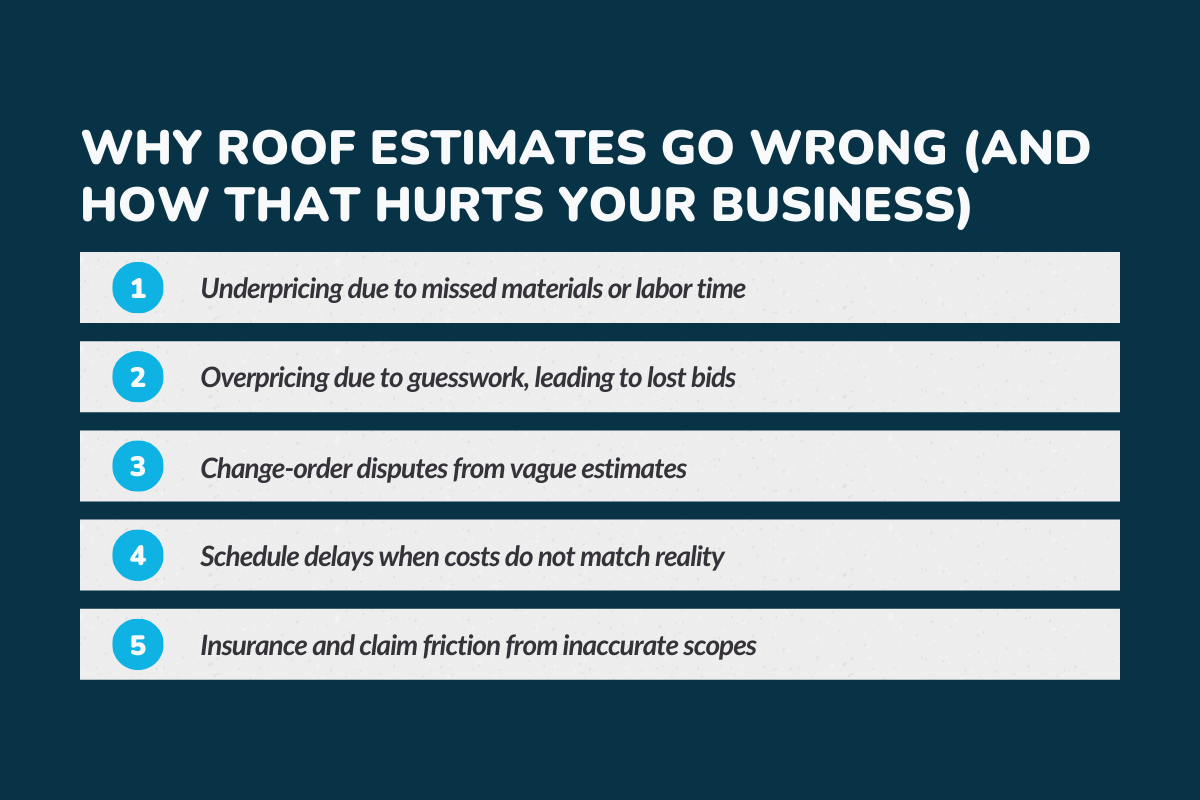
Why Roof Estimates Go Wrong (And How That Hurts Your Business)?
Most roofing companies do not lose money because they are bad at roofing. They lose money because their estimating process leaves too much room for guesswork. These issues show up quietly at first, then snowball into lost profit, stressed crews, and unhappy homeowners. Let’s break down where things usually go wrong and what that looks like in the real world.
Underpricing due to missed materials or labor time
This is one of the most common ways good roofing contractors lose money without realizing it. A few small misses in the estimate can quietly wipe out your margin.
- A section of roof decking gets overlooked, or ridge vents and pipe boots are assumed instead of counted.
- Labor time is underestimated on steep slopes or complex roof layouts, especially when multiple layers are involved.
- What looks like a small square footage error turns into hours of unpaid labor by the time the roof installation is finished.
Overpricing due to guesswork, leading to lost bids
Overpricing often stems from trying to “play it safe” when the data are unclear. Unfortunately, defensive pricing usually costs you the job.
- Roof size, pitch, or roof type is estimated visually instead of being measured accurately.
- An extra buffer is added to cover uncertainty, pushing the price beyond what homeowners expect.
- When compared side by side, your estimate feels inflated, and the homeowner never calls back.
Change-order disputes from vague estimates
Vague estimates create tension the moment something unexpected comes up on the job.
- Homeowners are unsure what is included or excluded in the original scope of work.
- Items like roof flashing, underlayment, or old shingle removal were not clearly explained upfront.
- Mid-project change orders feel like surprises instead of planned contingencies, leading to arguments and delays.
Schedule delays when costs do not match reality
When an estimate does not reflect the real job, the entire schedule suffers.
- Materials run short because the total roof area or waste factor was miscalculated.
- Labor takes longer than planned due to overlooked complexity or weather conditions.
- Crews get pushed into overtime or rescheduled jobs, disrupting cash flow and future projects.
Insurance and claim friction from inaccurate scopes
Insurance-driven roof replacement work leaves very little room for error.
- Scopes lack clear dimensions, photos, or notes about vulnerable areas and water damage.
- Adjusters question the estimate, slowing approvals and payments.
- Homeowners get frustrated when timelines stretch out due to documentation issues.
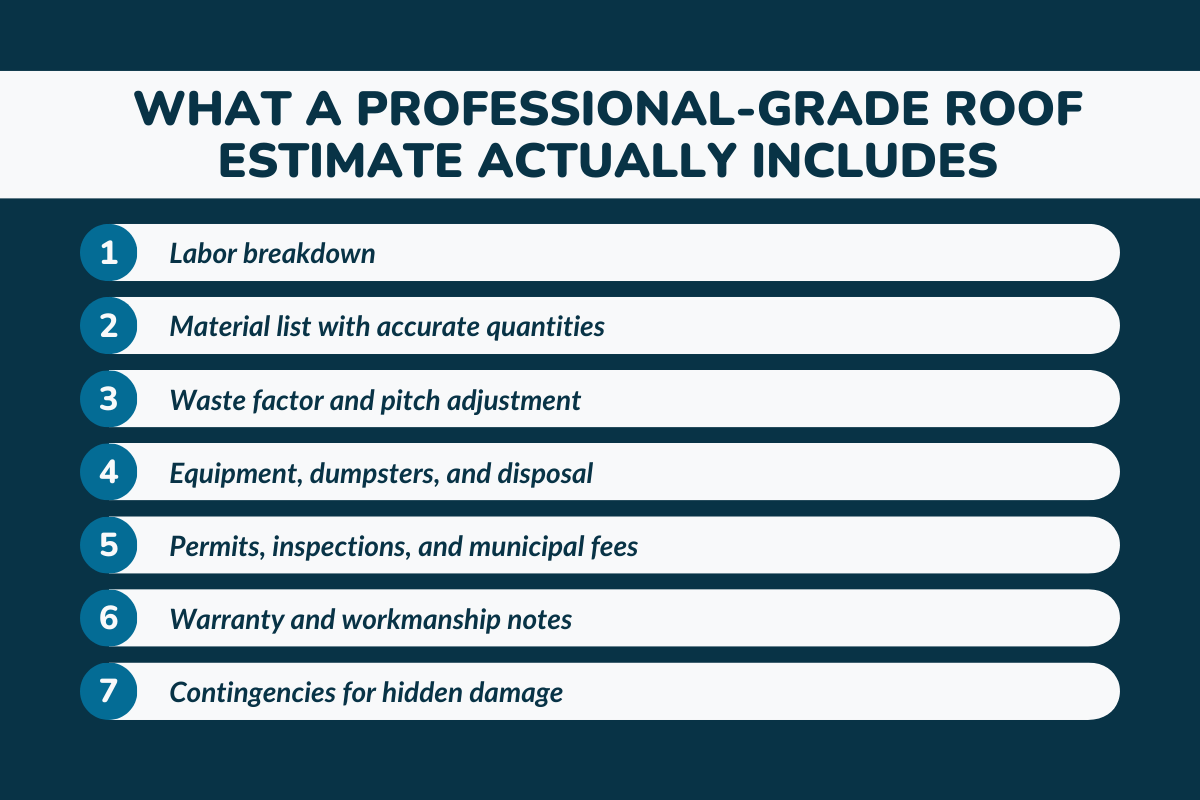
What a Professional-Grade Roof Estimate Actually Includes?
A strong roof estimate should read like a clear plan, not something the homeowner has to decode. It shows that you understand their house, their roof, and exactly what the job involves.
When every piece is spelled out, it builds confidence and reduces back-and-forth once the work begins.
Labor breakdown
Labor is often the biggest variable in a roof estimate, which is why it needs to be clearly explained, not bundled into a single number.
- Outline crew size and estimated hours, so homeowners understand the scale of the job.
- Separate tear-off time from roof installation time, especially when multiple layers are involved.
- Account for roof pitch and complexity, since steeper slopes naturally require more time and effort.
Material list with accurate quantities
Homeowners feel more comfortable when they can clearly see what they are paying for. A detailed material list shows that the price is built on real components, not rough guesses or hidden costs.
- List all major roofing material items, including asphalt shingles, underlayment, flashing, ridge vents, and pipe boots.
- Base quantities on accurate square footage and roof dimensions, not rough estimates.
- Include accessories and edge materials that are often forgotten but essential to the system.
Waste factor and pitch adjustment
Waste should never feel like a surprise that shows up after the job starts. When it is explained upfront, homeowners understand it as part of the plan, not an afterthought.
- Calculate waste based on roof pitch, total roof area, and overall layout.
- Factor in valleys, hips, and edges that increase cutting and material loss.
- Show homeowners that waste is planned, not guessed, which builds trust in your numbers.
Equipment, dumpsters, and disposal
Cleanup and removal are just as much a part of the job as the installation itself. Homeowners expect their property to be left clean once the last shingle goes on, not treated as an extra.
- Include dumpster rental and disposal costs for the old roof and old shingles.
- Account for extra handling when dealing with multiple layers or heavy materials.
- Make it clear that cleanup is covered so there are no surprises at the end.
Permits, inspections, and municipal fees
Professional roofing work is not just about getting the job done; it is about doing it the right way. When permits and local requirements are included in the estimate, homeowners know nothing is being skipped or rushed.
- Call out permit costs required by the city or municipality.
- Include any inspection fees tied to the roof replacement.
- Reassure homeowners that the job will be completed to code, not cut corners.
Warranty and workmanship notes
Homeowners think beyond installation day and want peace of mind after the crew packs up. Clear warranty and workmanship details reassure them that the roof is protected long after the job is finished.
- Clearly explain workmanship warranty coverage and duration.
- Reference manufacturer warranties for roofing materials when applicable.
- Put expectations in writing so both sides are protected long term.
Contingencies for hidden damage
Not everything reveals itself until the old roof comes off. Setting expectations upfront helps homeowners understand that some issues are part of the process, not unexpected problems.
- Explain how roof decking repairs will be handled if damage is found.
- Address potential water damage or attic issues that could affect the job.
- Outline the change-order process so adjustments feel planned, not reactive.
Detail in an estimate is not about inflating the price. It is about being prepared, professional, and clear from the start, which leads to smoother jobs and fewer headaches for everyone involved.
Why are accurate roof measurements essential for a roof estimate, & How Technology Improves It?
Accurate roof measurements form the foundation of every profitable estimate, and modern technology ensures those numbers are precise, consistent, and reliable from day one.
1. Every Cost Starts With Square Footage
Material quantities, labor hours, waste percentage, disposal volume, and even equipment planning all depend on correct square footage.
If the base dimensions are wrong, every calculation that follows will be wrong. A small error in area can quietly reduce margin or force last-minute material orders that disrupt the schedule.
2. Complex Roof Designs Hide Extra Costs
Hips, valleys, dormers, intersecting slopes, and overhangs add more than just visual complexity. They increase cutting time, material waste, and labor effort.
When these elements are not measured precisely, contractors either underprice the job or overcompensate with inflated buffers that cost them the bid. Accurate measuring ensures these hidden areas are fully accounted for before pricing is finalized.
3. Roof Pitch Directly Impacts Labor and Safety
Pitch changes how crews move, how materials are handled, and how long installation takes. Steeper roofs require more safety setup, slower movement, and greater physical effort.
If pitch is estimated instead of measured properly, labor assumptions break down, and profit disappears. Correct pitch data allows contractors to price labor realistically and protect their crews from rushed timelines.
4. Waste Percentage Must Be Calculated, Not Assumed
Waste is often treated as a flat percentage, but it should reflect the roof layout and design. Cut-heavy roofs with multiple valleys generate more material loss than simple gable designs.
Accurate measurements allow waste to be calculated based on real geometry rather than habit. This keeps material counts tight and prevents both shortages and unnecessary overordering.
5. Manual Measuring Leaves Room for Costly Gaps
Ladder-only measuring can work, but it depends heavily on visibility, estimator consistency, and field conditions. Missed sections, incorrect slope assumptions, and rough sketches often lead to rework.
Revisions cost time, time affects scheduling, and scheduling affects profit. Even experienced contractors benefit from removing measurement variability wherever possible.
> How Technology Improves Measurement Accuracy?
Modern tools eliminate much of this variability. Aerial reports, drone imagery, and digital takeoff software generate scaled roof diagrams with exact ridge lengths, valleys, penetrations, and total area.
Digital takeoff tools calculate dimensions automatically and reduce estimator-to-estimator differences. When measurements connect directly to pricing templates, material and labor assumptions are applied consistently across every job.
Mobile estimating apps further improve accuracy by allowing measurements, notes, and photos to sync instantly from the field. This shortens turnaround time without sacrificing precision.
When your measurements are precise and your tools are aligned, your estimates become more accurate, more defensible, and far more profitable.
How to Price Like a Pro: Best Practices for Building a Roof Estimate
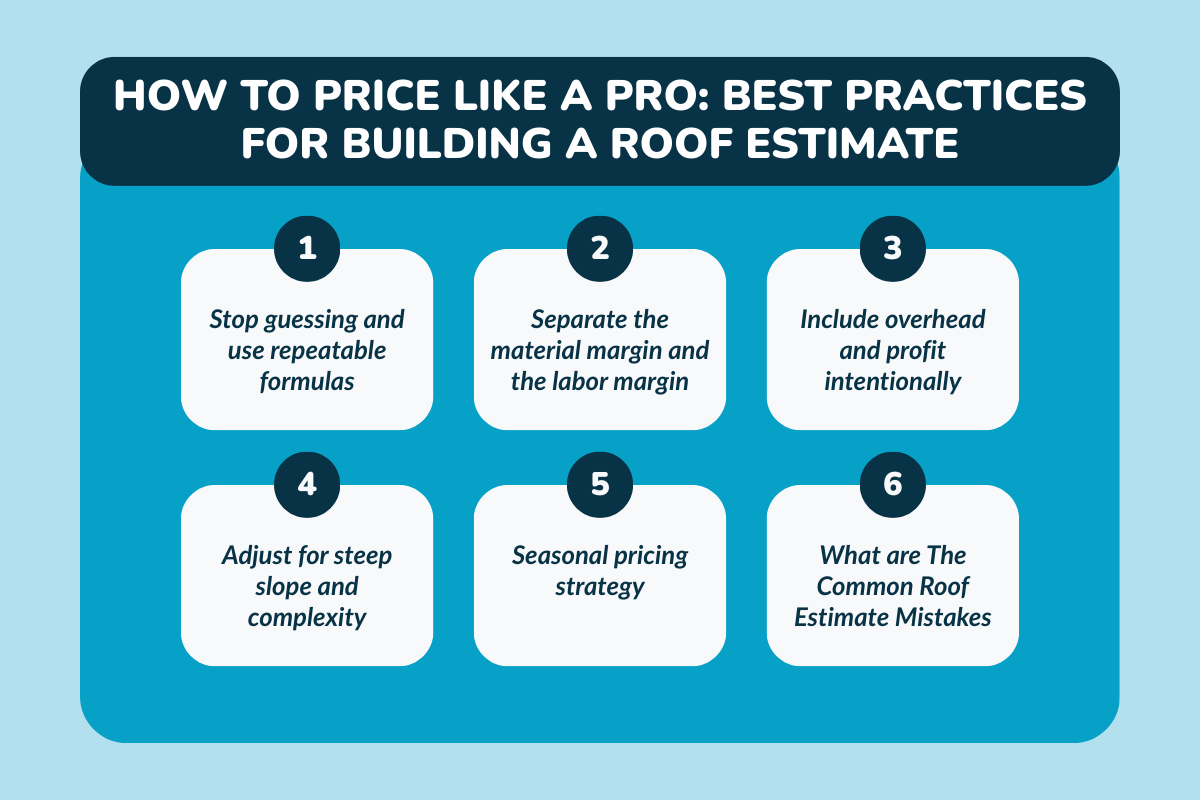
Racing to the bottom on price might win attention, but it rarely builds a sustainable business. Smart contractors focus on understanding their real costs, setting healthy margins, and quoting with clarity, so every completed job strengthens cash flow instead of creating financial pressure later.
Stop guessing and use repeatable formulas
Guessing might work once or twice, but it breaks down fast as volume increases. Repeatable formulas for labor, materials, and overhead keep your estimates consistent and prevent small misses from turning into big losses.
When every estimate follows the same framework, your team works faster, and your pricing becomes easier to defend. Consistency builds confidence, both internally and with homeowners reviewing your proposal.
Separate the material margin and the labor margin
Combining everything into one number hides where problems start. Separating material margin from labor margin shows exactly where money is being made and where it is slipping away.
This clarity helps you adjust pricing with purpose instead of blanket increases. You can correct labor assumptions or material markups without disrupting the entire estimate.
Include overhead and profit intentionally
Overhead exists whether a job goes smoothly or not. Fuel, insurance, office support, and equipment wear need to be planned into every roof estimate.
When overhead is ignored, profit disappears silently. Building it in upfront ensures each job contributes to the long-term health of your roofing business.
Adjust for steep slope and complexity
Not all roofs are created equal, and pricing them the same leads to frustration. Steep slopes, complex layouts, and multiple levels increase labor time and safety requirements.
Recognizing these factors in your estimate protects crews from being rushed and protects margins from being eaten by underestimated effort.
Seasonal pricing strategy
Busy seasons stretch crews thin and increase scheduling pressure. Pricing should reflect higher labor demand and tighter timelines during peak months.
Slower seasons offer more flexibility, but pricing should still protect margins. Realistic seasonal adjustments keep work steady without undercutting your value.
Protecting profit is not about charging more. It is about pricing smarter so your business can grow without constant stress or burnout.
Line-Item Clarity: What is The Secret to Fewer Customer Disputes
Most disputes do not start because of price. They start because expectations were never fully aligned. When an estimate is clear and easy to understand, homeowners feel confident, informed, and far less likely to push back once the job is underway.
Break down what is included versus excluded
Homeowners should never have to guess what is part of the job. Clearly stating what is included and what is not, such as gutters, attic work, or additional repairs, prevents confusion later.
This transparency sets boundaries upfront and avoids uncomfortable conversations once the project has already started.
Use homeowner-friendly wording
Technical terms can overwhelm or confuse homeowners when they are not explained. Using simple, everyday language helps them understand the work without feeling talked down to.
When people understand what they are paying for, they are far more comfortable approving the estimate.
Call out decking repair contingencies
Roof decking issues are common, especially on older homes, but they should never feel like a surprise. Explaining how repairs will be handled and priced prepares homeowners for what may come up. This approach turns a potential conflict into a planned scenario that feels fair and professional.
Show upgrade options transparently
Upgrades like metal roofing, premium underlayment, or higher-end shingles should be clearly presented as choices. Homeowners appreciate seeing options instead of discovering add-ons later.
Put the change-order process in writing
Changes happen, even on well-planned jobs. Outlining the change-order process upfront shows how adjustments will be handled if needed.
What are The Common Roof Estimate Mistakes Contractors Should Avoid?
Even experienced roofers make these mistakes, often without realizing how much they affect profit and project flow.
1. Only pricing shingles and forgetting accessories like pipe boots and flashing
Shingles are just one part of the system, and missing small accessories leads to extra costs and delays once the job is underway.
2. Ignoring taxes, freight, and fuel surcharges
Supplier pricing rarely includes delivery and fuel fees, and leaving them out quietly cuts into your margin on every job.
3. Skipping allowances for roof decking repairs
Hidden decking damage is common, and failing to plan for it creates surprise change orders and tense conversations with homeowners.
4. Underestimating labor in extreme heat or cold
Weather slows crews down more than expected, and underpricing labor during tough conditions quickly inflates payroll costs.
5. Using outdated material price lists
Material prices change frequently, and outdated pricing leads to estimates that no longer reflect actual replacement costs.
Avoiding these errors protects your overall cost, your schedule, and your reputation with homeowners.
See how professionals streamline roof quotes for better results. Go through this blog for more information: How to Create Fast & Accurate Roof Estimates: Process, Tools & Best Practices
The Professional Contractor Checklist: Before You Send the Estimate
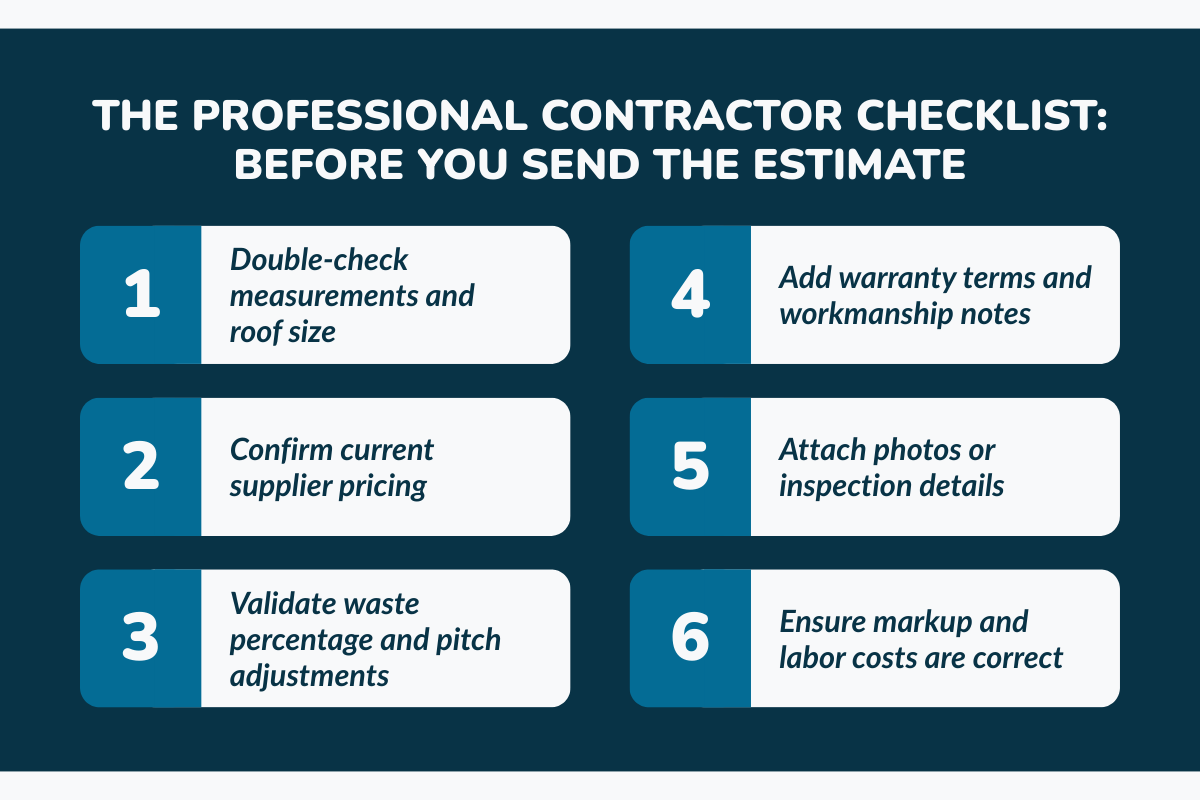
Before hitting send, taking a few extra minutes to review your estimate can save hours of callbacks, corrections, and uncomfortable conversations later. Follow this professional contractor checklist:
1. Double-check measurements and roof size: Make sure the square footage, roof pitch, and total area are accurate so materials and labor match the real job.
2. Confirm current supplier pricing: Verify that material prices reflect today’s rates, not last month’s list or an old quote from memory.
3. Validate waste percentage and pitch adjustments: Review waste factors and slope adjustments to be sure cutting loss and roof complexity are properly accounted for.
4. Add warranty terms and workmanship notes: Include clear warranty details so homeowners know what is covered after the installation is complete.
5. Attach photos or inspection details: Supporting images and notes help explain the scope and show homeowners you inspected the roof thoroughly.
6. Ensure markup and labor costs are correct: Double-check margins and labor rates to confirm the job protects profit and reflects the true effort involved.
This final review reinforces your professionalism, builds homeowner confidence, and greatly reduces callbacks and revisions later.
How RooferBase Supports Professional-Grade Roof Estimates?
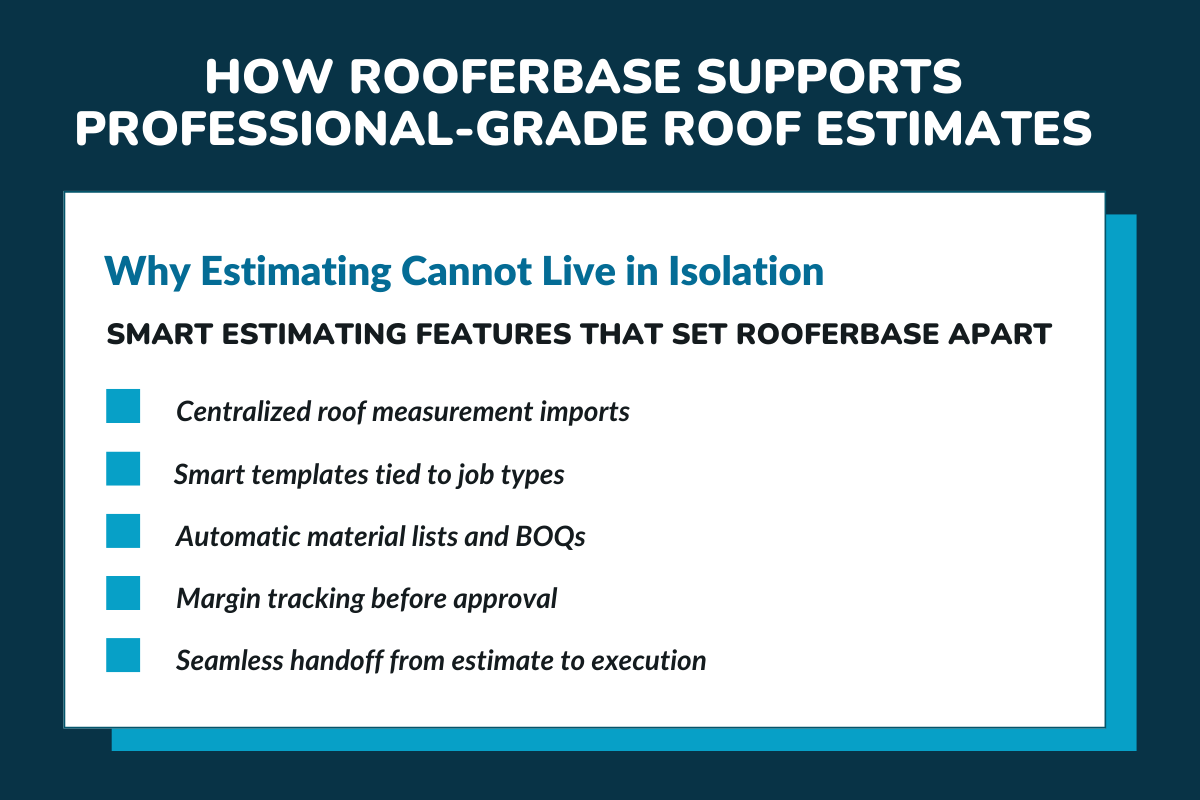
A great estimate does not stand alone. It connects to scheduling, materials, crews, and cash flow. When everything works together in one system, estimating becomes more accurate, faster, and far easier to manage from the first measurement to the final invoice.
Moreover, when estimates live in spreadsheets or disconnected tools, mistakes multiply. It then affects scheduling, material ordering, crew planning, and cash flow.
Smart Estimating Features That Set RooferBase Apart
RooferBase helps roofing companies bring everything together.
- Centralized roof measurement imports – Easily import measurements from your preferred roof-measuring tools and keep everything organized in one place, so you don't have to switch between platforms or re-enter data manually.
- Smart templates tied to job types – Use pre-built templates customized for different roofing jobs, ensuring consistent pricing, accurate line items, and faster estimate creation every time.
- Automatic material lists and BOQs – Generate detailed material lists and bills of quantities instantly based on measurements, reducing calculation errors and saving hours of manual work.
- Margin tracking before approval – See your projected profit in real time before sending the estimate, so you can adjust pricing confidently rather than guess.
- Seamless handoff from estimate to execution – Convert approved estimates directly into active projects, keeping crews aligned and preventing miscommunication between sales and operations.
This creates more control from the first measurement to the final payment.
Take Control of Roof Estimating and Maximize Every Project’s Profit with RooferBase
Turn every roof estimate into a profitable, well-managed project with RooferBase, giving you tighter margins, smoother execution, and homeowners who feel confident from quote to completion.
Book your demo today and run a more profitable roofing business, one estimate at a time.
FAQs:
1. What should a professional roof estimate include before starting a roof replacement?
A professional roof estimate should include measurements, materials, labor, disposal, permits, warranties, and contingencies for hidden damage to avoid surprises during the roof replacement.
2. How does roof decking condition affect a roof replacement estimate?
Damaged roof decking increases the roof replacement cost because repairs must be made before installing a new roof, so it should be included in the estimate upfront.
3. How is the total roof cost calculated when installing a new roof?
Roof cost is based on roof size, pitch, materials, labor, waste, disposal, permits, and overhead, all combined into a clear roof estimate.
4. Why does the roof replacement cost change after the old roof is removed?
Hidden water damage or rotted roof decking may be found after the tear-off, which can increase the final cost of the roof replacement.
5. How can homeowners compare roof estimates to choose the right roofing contractor for a new roof?
Homeowners should compare scope, materials, warranties, and clarity, not just price, to choose the right roofing contractor and avoid future problems.