March 23, 2026
There are dozens of roof measuring apps on the market right now. Some use satellite imagery, others promote drone-level precision. A few still rely on manual sketches and field measurements.
And almost all of them claim to be the most accurate, the fastest, and the most affordable option available.
But here is the real question roofing contractors should be asking in 2026: Is this app actually making my estimating process smoother and protecting my margins?
Because features alone do not grow a roofing business, what really matters is how quickly you can measure, how easily everything integrates with your estimating workflow, and how confident you are in the numbers.
The right tool saves time, reduces costly mistakes, and helps you close more jobs. The wrong one slowly drains your time, profit, and momentum.
Roof Measurement Apps in 2026: What Roofing Contractors Should Really Look For
AI is changing how roof measurements are captured, calculated, and delivered. In 2026, roof measurement apps will no longer be just digital tape measures. They are becoming intelligent estimating assistants.
If you are a roofing contractor, you have probably noticed how crowded the market has become. Every platform promises faster reports, better accuracy, and fewer site visits. But choosing the right roof measurement app is not about chasing the newest feature.
It is about finding a solution that actually fits into your estimating workflow, protects your margins, and helps you move from measurement to signed contract without friction.
Because at the end of the day, accurate numbers build confident estimates. And confident estimates close jobs.
Key Takeaways
- An inaccurate roof measurement tool can erase 3 to 5 percent of profit on large roof replacement projects.
- Slow report turnaround can cost you more jobs than you realize.
- The best roof measurement apps improve your entire sales process, not just measurements.
- In 2026, integration with roofing software matters as much as raw accuracy.
- Choosing the right tool comes down to three pillars: Accuracy, Workflow, and Profitability.
Ready to Upgrade Your Roof Estimating Process?
If your current roof measurement app is slowing you down, costing you margin, or forcing you to enter data twice, it is time to rethink your system. Book a demo today and discover how much time, accuracy, and profit you could be leaving on the table.
Why Choosing the Wrong Roof Measuring App Costs You Money?
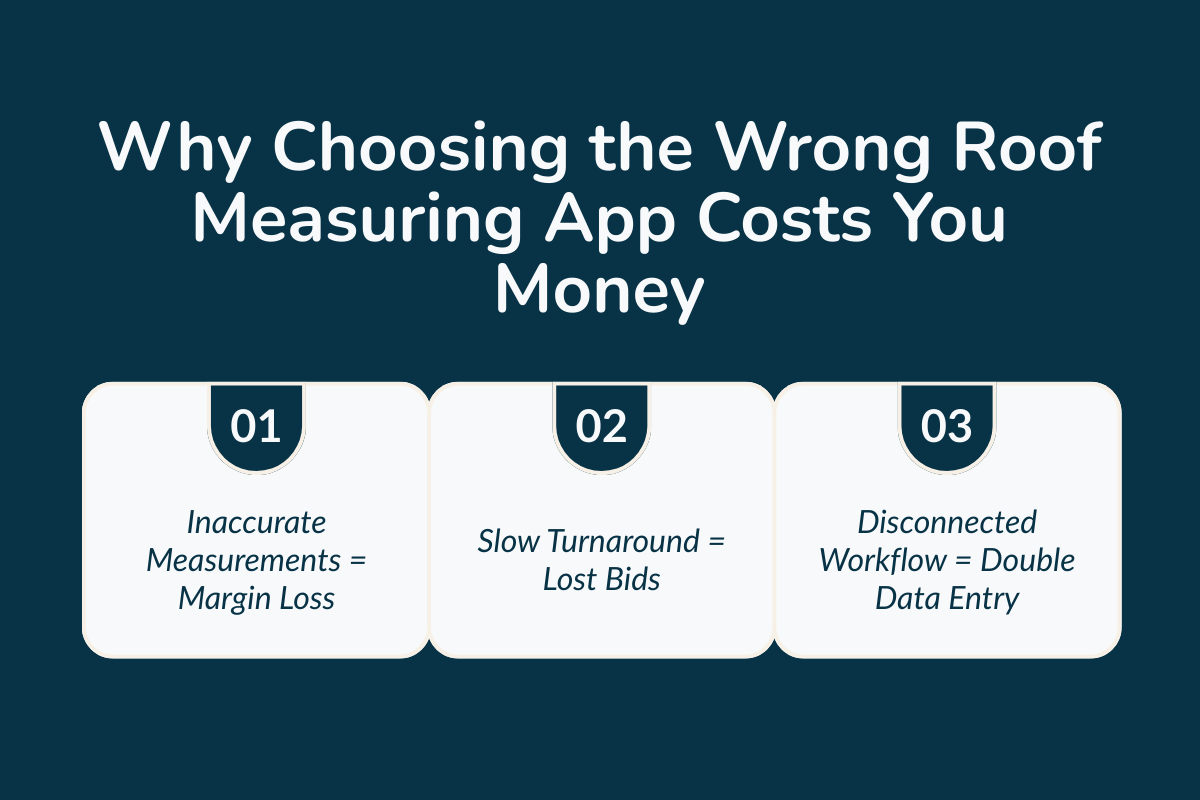
A roof measuring app directly impacts your cost structure, speed, and ability to win more deals. Let’s look at where things go wrong:
1. Inaccurate Measurements = Margin Loss
Suppose you are bidding on a 40-square residential roof replacement. If your total roof area is off by just 4 percent, that is more than a square and a half of materials. Add shingles, underlayment, starter, ridge caps, gutter measurements, and waste calculation table adjustments, and that small error starts to hurt.
On large roofing jobs, a 3 to 5 percent measurement error can wipe out the entire profit margin.
Accurate measurements are not about being perfect. They are about protecting the margin. A truly accurate roof means:
- Precise slope and pitch
- Proper accounting of multiple layers
- Clear separation of secondary structures, like garages or porches
- Correct end caps and ridge lengths
If your measurement reports are inconsistent, you are gambling with materials and labor costs.
2. Slow Turnaround = Lost Bids
Speed matters more than most contractors admit. If your competitor delivers instant estimates within 24 hours, and you take 72 hours because you are waiting on a third-party report order, guess who the customer signs with?
Homeowners rarely compare line by line. They compare confidence and responsiveness. A roof measurement tool that takes two hours to generate a detailed report may be acceptable, but one that takes two days is not.
Faster remote measurements mean:
- Quicker professional estimates
- Faster follow-up
- Higher win rates
- More deals are closed monthly
3. Disconnected Workflow = Double Data Entry
The frustration many small crews face is that they get measurement reports, then they have to manually re-enter the data into roofing software.
Then recreate line items in the estimate, and then adjust materials again. All that is double work. A disconnected system wastes hours weekly, and hours equal cost.
Mini Example:
A six-person roofing company reduced bid turnaround time from three days to one after switching to automated roof reports integrated into their CRM. They did not hire more users, they did not increase ad spend, they simply removed friction. That is what the right solution should do.
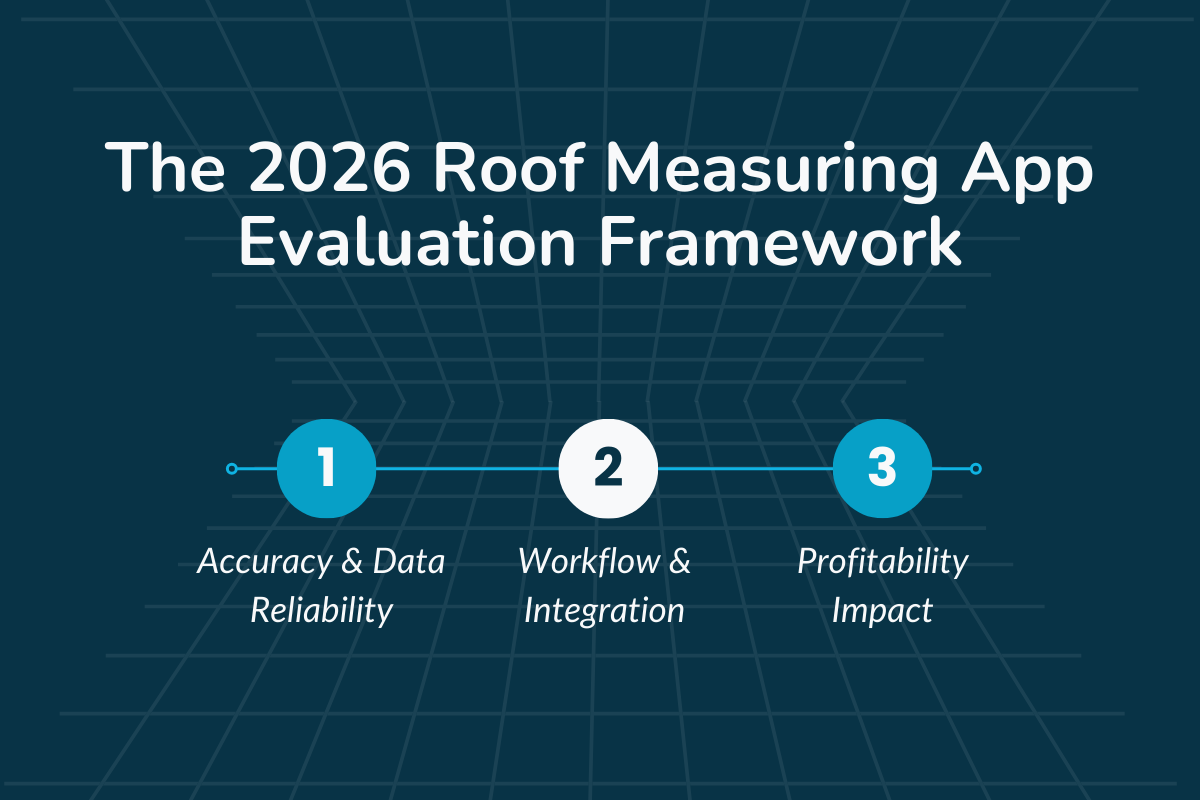
The 2026 Roof Measuring App Evaluation Framework
Instead of asking, “Which roof measuring app is the best?”, a better question is:
“Which roof measuring app improves my estimating workflow and margin?”
In 2026, successful roofing contractors evaluate technology based on how it affects real business outcomes—not just features. The most effective way to assess a roof measuring tool is through three practical pillars:
- Accuracy and Data Quality
- Workflow Integration
- Profitability Impact
Let’s explore how each pillar affects the way roofing companies estimate, bid, and close projects:
Pillar 1 - Accuracy & Data Reliability
Accuracy is the foundation of any roof measurement system. If the measurements are wrong, every estimate, material order, and labor calculation that follows becomes unreliable.
1. Satellite vs Drone vs Manual Sketch
Modern roof measurement tools typically rely on three main methods: satellite imagery, drone-based measurements, or manual sketching. Each approach has its own strengths, limitations, and ideal use cases depending on the type of project.
- Satellite Measurement: Satellite-based tools use aerial imagery to measure roofs remotely. This method is fast and convenient, especially for standard residential homes. However, accuracy depends on image resolution and the quality of the data provider.
- Drone Measurement: Very accurate when calibrated properly. Excellent for complex roofs, multiple layers, steep pitch, and detailed roof measurements. Requires equipment and a site visit.
- Manual Sketching: Manual roof sketches are still used by some contractors. While experienced estimators can produce decent results, the process is slow and heavily dependent on individual skill. Under time pressure, the risk of human error increases significantly.
For many roofing contractors, satellite imagery combined with a strong workflow is the sweet spot. For commercial properties or complex structures, drone-based data adds value.
2. Measurement Tolerance Levels
Even the best roof measurement tools allow for a small margin of error. When the error range becomes larger than this threshold, waste calculations and material planning can quickly become inaccurate. This can result in either ordering excess materials or running short during the installation process.
An accurate roof measurement tool should clearly state:
- Tolerance range
- Pitch detection method
- How secondary structures are calculated
- How gutter measurements are derived
If a provider cannot clearly explain how its accuracy is determined, contractors should treat that as a potential red flag.
3. Slope & Pitch Detection Accuracy
Roof pitch plays a major role in determining both material requirements and labor costs. If the pitch is underestimated, contractors often underprice the labor required to complete the job, which directly reduces profit margins.
On the other hand, overestimating pitch can inflate the price of a proposal and make it less competitive in comparison with other bids.
Make sure your roof measuring app can:
- Automatically detect pitch
- Adjust the total roof area accordingly
- Separate steep and low-slope sections
- Generate a detailed breakdown of roof measurements
These capabilities are particularly important for roof replacement projects involving multiple roof angles and structural variations.
4. Diagram & Blueprint Clarity
Accurate data is only useful if it can be easily interpreted by the estimating team. Roof measurement reports should present information in a clear format that allows contractors to quickly understand roof dimensions, slopes, and structural details.
When diagrams are cluttered or difficult to read, estimators often spend extra time verifying the information manually. Clean and well-organized diagrams reduce the need for repeated checks and allow teams to generate professional estimates more efficiently.
Here is a simple comparison:
| Method | Speed | Accuracy | Best For |
|---|---|---|---|
| Satellite Measurement | Fast | High, varies by provider | Standard residential |
| Drone Measurement | Moderate | Very high if calibrated | Complex roofs |
| Manual Sketching | Slow | Depends on skill | Small jobs |
While accuracy is critical, the most precise measurements still lose value if they disrupt the overall estimating workflow.
Pillar 2: Workflow & Integration
Roof measurement apps perform well in terms of data accuracy but fail to integrate smoothly with the tools contractors use every day.
When measurement data cannot flow directly into estimating and CRM systems, teams often end up duplicating work and slowing down the sales process.
1. CRM & Estimating Software Integration
When evaluating roof measurement software, consider its ability to connect with existing roofing management tools.
For example, an effective system should allow contractors to:
- Sync measurement data directly into their CRM
- Transfer roof totals automatically into estimating templates
- Export material lists to suppliers such as ABC Supply
- Generate branded measurement reports with company details
If your team still copies measurement data from PDF reports into spreadsheets or estimating tools, the software is not fully supporting your workflow.
2. One-Click Report Export
Roof measurement tools should simplify the process of generating reports so contractors can create professional documents without spending extra time formatting information.
A reliable roof measuring app should allow users to quickly produce detailed PDF reports that include material lists, pitch and slope summaries, gutter measurements, and waste calculation adjustments.
When all of this information can be generated in a single click, contractors are able to deliver clear and complete estimates to homeowners much faster, helping maintain momentum in the sales process.
3. Field-to-Office Sync
Can your sales rep use a mobile device on-site and sync data immediately?
Modern roof measurement apps should allow remote measurements before a site visit. A rep can stand in front of a property, confirm the address, pull aerial imagery, and create estimates from their phone.
That changes the entire sales process and allows estimates to be created during or immediately after the inspection rather than hours or days later.
4. Mobile App Experience
If the app is clunky, your users will not adopt it. Before adopting a tool, check the review feedback in the Apple App Store or Google Play Store to identify common usability issues. Look for complaints about slow loading times, crashes, or confusing interfaces that can signal potential adoption challenges.
A roofing company with multiple users needs something simple enough that small crews can use it without training sessions that last all afternoon.
Here is how workflow features impact speed:
| Feature | Why It Matters | Impact on Speed |
|---|---|---|
| Auto Material Calculations | Reduces manual math | Saves 15 to 30 mins per bid |
| CRM Integration | Eliminates double entry | Prevents admin errors |
| Instant Report Delivery | Faster estimates | Win more bids |
| Cloud Storage | Centralized access | Better team coordination |
Now let’s talk about what contractors actually care about:
Pillar 3: Profitability Impact
Ultimately, roofing contractors evaluate tools based on one question: Does this technology increase profitability?
1. Time Saved Per Estimate
If a roof measuring tool saves approximately 30 minutes per estimate, the time savings can add up quickly. A roofing company completing 20 estimates per month would recover nearly 10 hours of productive time.
Those extra hours can be used to follow up with additional leads, refine proposals, and pursue more opportunities. In many cases, the time saved in estimating translates directly into additional closed jobs.
2. Increased Bid Volume
Faster turnaround means more proposals sent, and more proposals mean better win rates. A roofing business that delivers instant estimates often outperforms slower competitors, even if pricing is similar.
3. Reduced Material Overages
Accurate roof measurements reduce waste. If you order materials based on inflated square counts, you tie up cash. If you under-order, crews wait. Both cost money.
A precise measurement tool helps you:
- Order materials correctly
- Plan labor costs more accurately
- Avoid overestimating pitch adjustments
Roof Measuring App Comparison (Feature-Focused View)
Here is a simplified feature comparison contractors often evaluate:
| Feature | RooferBase | EagleView | Hover | RoofSnap | iRoofing |
|---|---|---|---|---|---|
| Measurement Method | Satellite imagery + built-in estimating workflow | High-resolution satellite measurement reports | Smartphone 3D capture with AI modeling | Satellite imagery + manual editing tools | Mobile capture + aerial imagery integration |
| Measurement Accuracy | High, workflow-validated calculations | Very high, third-party engineered reports | Good for pitch and layout, depends on scan quality | High with manual refinement | Good to high, depending on capture method |
| Turnaround Time | Instantly within the platform workflow | 24 to 48 hours is typical | Near-instant after scan | Fast report generation | Fast, depending on the data source |
| Auto Material Calculations | Full material lists, waste factors, and pitch adjustments | Material calculations are included in the report | Basic surface calculations | Yes, customizable settings | Yes, built-in material tools |
| CRM Integration | Built-in CRM + estimating pipeline | Limited direct CRM integration | Limited, requires export | Varies by plan | Limited native CRM integration |
| Estimating Integration | Fully integrated estimating and proposal flow | Report export to estimating software | Export-based workflow | Integrates with estimating tools | Proposal and presentation tools built in |
| Mobile Field Use | Designed for sales reps and canvassing teams | Primarily office-based | Strong field-first tool | Moderate mobile usability | Strong mobile presentation focus |
| Report Customization | Custom-branded reports and proposals | Standardized professional reports | Basic customization | Moderate customization | Strong visual customization |
| Best Use Case | End-to-end roofing sales and operations | Third-party verified measurements | Quick homeowner estimates on-site | Sales teams need adjustments | Sales-driven presentations and visuals |
| Ideal Contractor Type | Growing roofing companies want workflow integration | Contractors needing formal measurement documentation | High-volume sales reps | Mid-sized sales-focused teams | Contractors prioritizing homeowner engagement |
The key is not which name sounds impressive. It is the right solution that fits your roofing business model.
What Small vs Growing Roofing Teams Should Prioritize?
Roofing teams at different stages of growth need different types of tools and capabilities. What works well for a small crew managing a few jobs each week may not support a larger team handling multiple inspections, proposals, and projects simultaneously.
Teams with 1 to 3 Sales Representatives
Focus on:
- Speed: Small teams cannot afford delays. Faster measurements and instant report generation help reps respond quickly and stay ahead of competitors.
- Simplicity: With fewer people handling multiple tasks, the tool must be easy to learn and use. Complicated systems slow momentum and create unnecessary friction.
- Instant Reporting: Generating reports on the spot builds homeowner confidence and significantly shortens the sales cycle.
- Easy Phone Access: Sales reps spend most of their time in the field, so seamless mobile access is essential for capturing measurements and sending estimates on the go.
Small crews benefit most from tools that prioritize efficiency and speed rather than complex feature sets.
Teams with 5 to 15 Sales Reps
Prioritize:
- Integration with CRM: At this stage, measurements must flow directly into your CRM and estimating system to avoid double entry and missed follow-ups.
- Standardized Measurement Reports: Uniform report formats ensure every rep presents consistent, professional documentation to homeowners.
- Centralized Cloud Data: All roof measurements and project files should be stored in one shared cloud system so managers can monitor progress in real time.
- Multiple Users Under One Account: The platform should support team access with permissions, making collaboration easier while maintaining control.
Commercial Focus
Roofing companies that handle commercial projects often require more advanced measurement capabilities. Commercial properties frequently include roof layouts, multiple layers, and structural elements that basic measurement tools struggle to capture accurately.
In these situations, drone-based measurements can provide higher levels of precision, especially for large or irregular structures.
Detailed pitch breakdowns and blueprint-style reports are also important because they allow estimators to analyze every section of the roof more carefully.
Worth noting, commercial properties often include multiple layers and secondary structures that basic apps struggle with.
Red Flags When Evaluating Roof Measuring Apps
Keep this simple:
- Hidden per-report fees – Some platforms charge for every measurement report generated. These costs can quickly add up if your team produces multiple estimates each week.
- Long report turnaround times – Waiting hours or even days for measurement reports slows the estimating process and causes contractors to lose momentum with homeowners.
- No integration options – Tools that cannot connect with CRM or estimating software force teams to manually copy data, increasing the risk of errors and wasted time.
- Poor customer support – When technical issues arise, slow or unresponsive support can disrupt operations and delay estimates during critical sales moments.
- Overly complex user interface – If the software requires long training sessions just to measure a basic roof, it will slow down your team instead of improving efficiency.
If you need two hours of training just to measure a basic roof, it is not the right tool.
How to Narrow Down Your Options (3-Step Filter)?
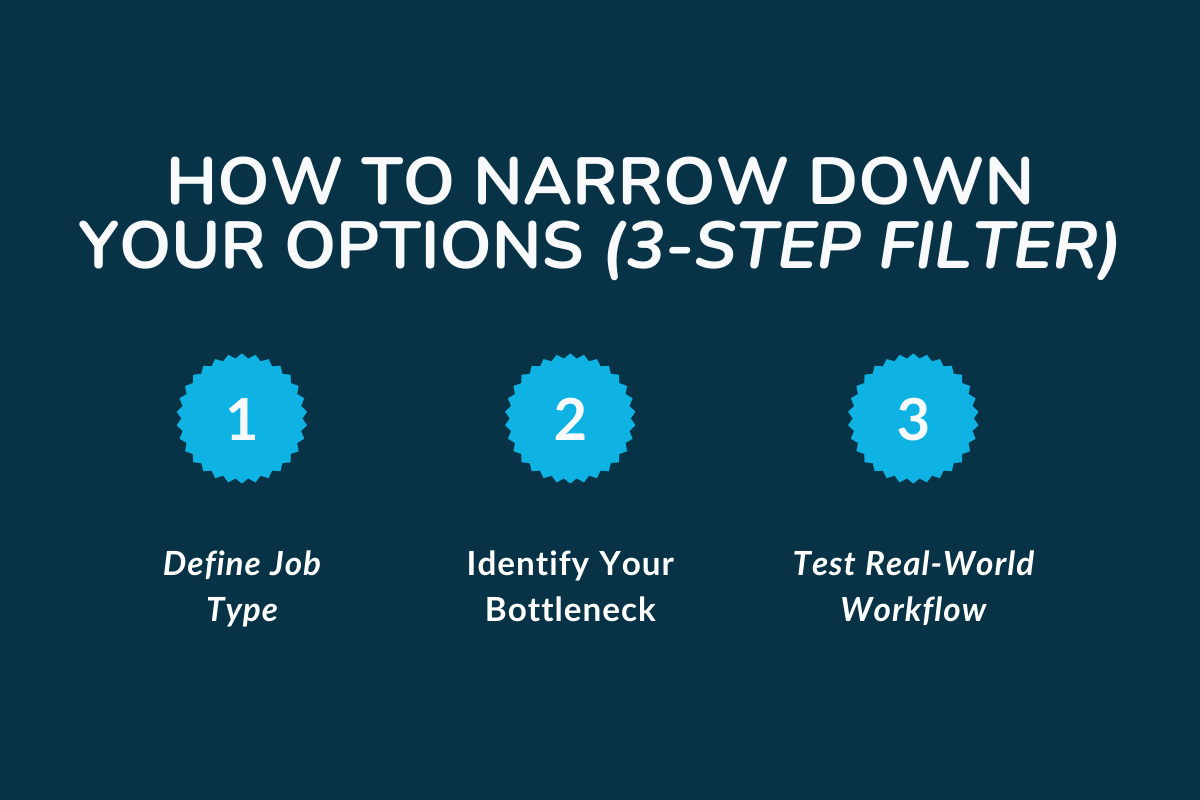
Step 1: Define Your Job Type
Are you mostly residential or commercial?
Residential projects often require fast turnaround and homeowner-friendly reports, while commercial jobs demand higher precision, complex layouts, and detailed documentation.
Do you need remote measurements or frequent site visits?
If you rely heavily on remote estimates, strong satellite or aerial accuracy is essential, but if your team visits sites often, mobile-friendly field tools become more important.
Step 2: Identify Your Bottleneck
- Speed issues – If estimates take too long to deliver, your team may be losing opportunities to contractors who respond faster.
- Accuracy problems – Frequent measurement revisions or disputed estimates usually indicate that small errors are affecting material planning and cutting into profit margins.
- Integration gaps – When tools do not connect with each other, teams end up copying data manually, which slows the entire workflow and increases the risk of mistakes.
Focus on solving the largest operational friction point first, rather than trying to optimize everything at once.
Step 3: Test Real-World Workflow
Do not rely on polished demo screenshots. Use real property addresses to generate reports and create estimates. See how long it actually takes from measurement to signed contract; that is the real test.
How RooferBase Approaches Roof Measurement Workflows?
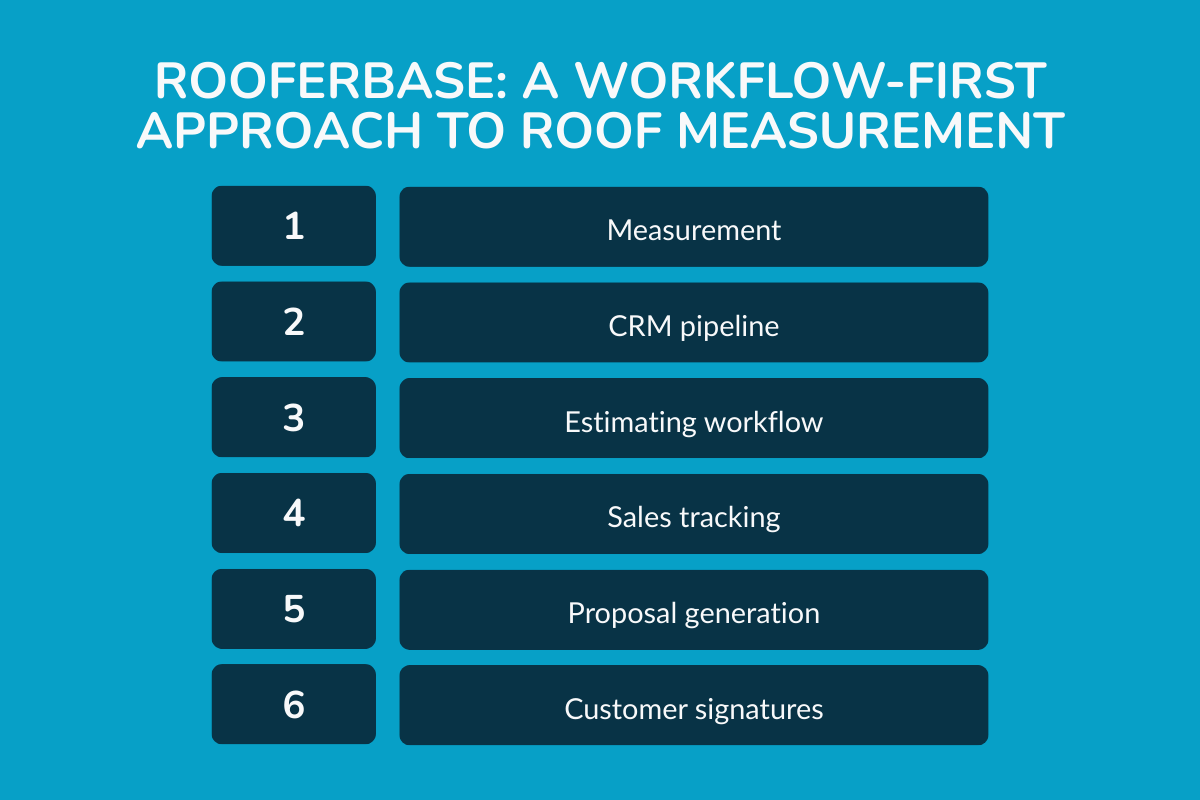
RooferBase approaches roof measurement as part of a larger operational workflow rather than treating it as a standalone task.
The platform is designed to connect measurements with estimating, sales tracking, and customer management so roofing teams can move smoothly from inspection to proposal without switching between multiple tools.
Built Around Workflow, Not Just Measurement
RooferBase takes a broader approach by linking measurement data directly with other stages of the roofing sales process.
RooferBase connects:
- Measurement: Accurate roof measurements flow directly into the system, including pitch, total roof area, and material calculations, so nothing needs to be re-entered.
- CRM Pipeline: Leads move through a structured pipeline where you can track every customer from first contact to signed contract.
- Estimating Workflow: Measurement data automatically feeds into estimating templates, helping you generate professional estimates faster and with fewer errors.
- Sales Tracking: You can monitor win rates, deal stages, and rep performance to see exactly how your sales process is performing.
- Proposal Generation: Create clean, detailed proposals with pricing, scope, and your company logo in just a few clicks.
- Customer Signatures: Clients can review and sign digitally inside the platform, speeding up approvals and helping you close more jobs quickly.
Because measurements, estimates, and proposals exist within the same environment, contractors can progress from inspection to finalized proposal without exporting files or recreating information in multiple systems.
Why Integration Matters More Than Raw Accuracy
Modern roof measurement tools already provide a strong level of accuracy. The bigger difference between platforms in 2026 is how efficiently they support the entire sales process.
Contractors should consider how quickly they can move through the sequence of:
Measurement → Estimate → Proposal → Signed contract
If a measurement tool only provides dimensions but does not support the next steps in the workflow, teams still face delays caused by manual data transfer or disconnected systems.
Roofing companies that scale successfully usually focus on building connected systems rather than relying on isolated tools.
Final Conclusion:
Accuracy protects your margins, speed helps you win bids, and integration allows you to scale operations. The goal is not more features, but fewer workflow gaps.
When evaluating a roof measuring app in 2026, think beyond roof measurements. Think about your entire roofing business, about how quickly you can generate professional estimates, send reports with your company logo, order materials confidently, and close more deals.
The right tool helps you measure roofs accurately, save time and reduce costs, and create a smoother experience for every customer. And that is what ultimately drives growth.
Stop Measuring Roofs the Old Way. Start Closing Jobs Faster.
If your measuring process still means waiting on reports or re-entering data, you are losing time and deals.
The right roof measurement app does more than just calculate square footage. It protects your margins, speeds up estimates, and helps you move from measurement to signed contract without friction.
Book a demo today and see how much faster your team could close jobs with the right system in place.
FAQs:
Which is the most accurate roof measuring app in 2026?
Most leading roof measurement apps offer high accuracy within a 2-3% tolerance. The difference often comes down to the quality of satellite imagery and the integration features.
Can I measure roofs without visiting the site?
Yes. Many tools use aerial imagery and satellite imagery to allow remote measurements before a site visit.
Are drone measurements worth it?
For complex roofs or commercial properties, yes. For standard residential roof replacement, satellite-based tools are often sufficient.
How much should a roof measurement tool cost?
Cost varies by provider. Watch for per-report fees and account limits. The real measure of cost is how much time and margin it saves.
Do roof-measuring apps work on mobile devices?
Most modern apps are designed for phone and tablet use, allowing sales teams to measure and generate estimates on-site.