April 20, 2026
Many roofing jobs look profitable when the estimate is sent. Materials are priced, labor is accounted for, and the expected margin looks healthy.
But by the time the job is complete, additional material orders, labor overruns, missed scope items, outdated pricing, or unplanned overhead can reduce that margin significantly.
The problem is rarely one dramatic estimating mistake. More often, several small gaps between the estimate and the actual job cost accumulate during production.
Understanding where those gaps come from — and which parts of the estimating process software can standardize — is the first step toward protecting profit on each roofing job.
Roofing Estimating Software: How Contractors Prevent Costly Estimating Errors
Roofing estimating software helps contractors reduce costly estimating errors by automating roof measurements, material calculations, and proposal generation.
These tools utilize digital, aerial, or drone measurements for precise, rapid takeoffs, ensuring accurate project pricing and protecting profit margins.
By improving measurement accuracy, organizing costs, and speeding up proposal delivery, roofing estimating software helps contractors protect profit margins and respond to leads more efficiently.
You will understand why small estimating errors silently reduce roofing profit margins and how those gaps occur in real projects.
This blog also discusses how roofing estimating software improves accuracy, speeds up proposals, and helps contractors protect margins on every job.
Key Takeaways
- Small estimating gaps can significantly reduce the profit expected from a roofing job.
- Measurement errors, outdated material pricing, missing overhead, and unplanned labor or material costs are common sources of margin loss.
- Several small cost overruns during production can turn an apparently profitable estimate into a much lower-margin job.
- A consistent estimating process helps contractors account for more of the job cost before work begins.
- Estimating software can standardize measurements, material calculations, pricing, and proposal workflows.
The Invisible Leak: Why Expected Roofing Margins Shrink During Production
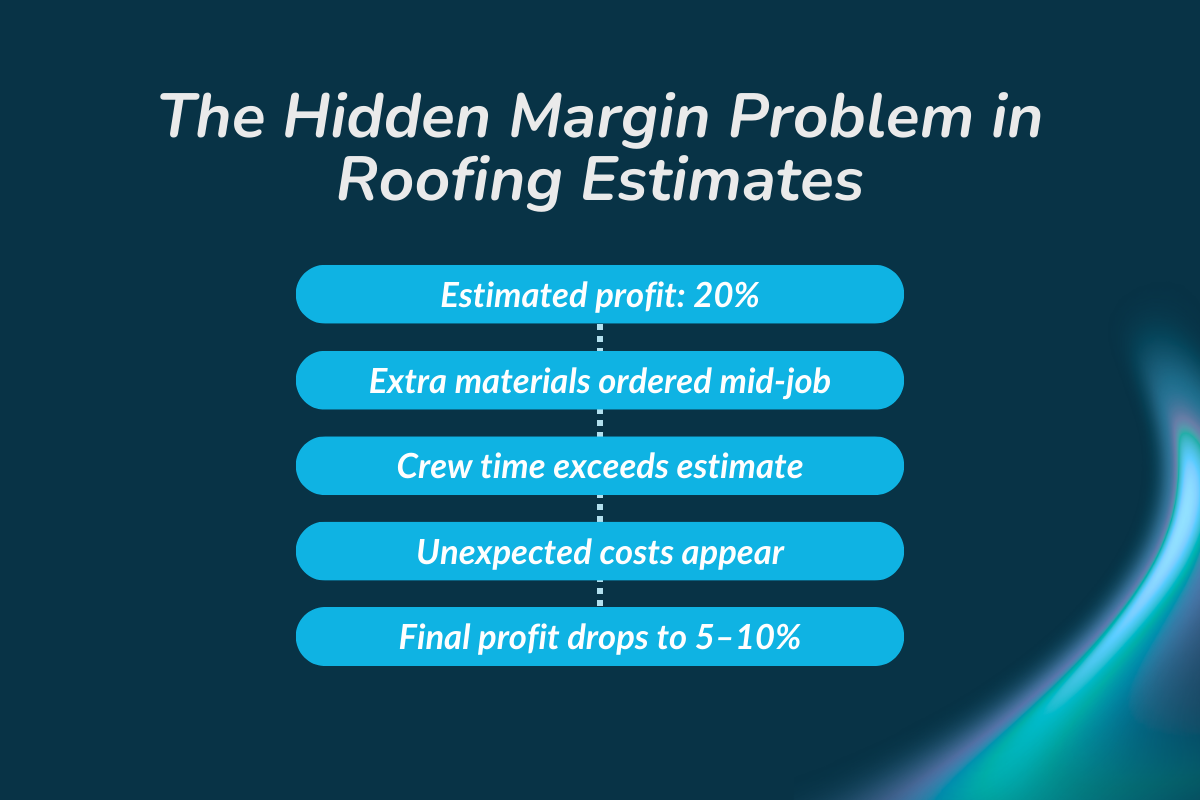
A roofing estimate can look profitable when the job is sold and still produce a much smaller margin once the work is complete.
The difference usually does not come from one major mistake. Instead, several small costs that were not fully accounted for in the original estimate can accumulate during production.
Estimate Creep
Estimate creep happens when costs that were not included, or were underestimated, in the original bid begin appearing after work starts.
Common examples include additional materials ordered during installation, longer crew time than expected, and scope adjustments discovered after tear-off or inspection.
Individually, these costs may not seem significant. Together, they can reduce the profit originally planned for the job.
Example: How Additional Costs Reduce Roofing Margin
Consider a residential reroof sold for $20,000 with a planned 20% profit margin.
That estimate projects approximately $4,000 in profit.
During production, however:
- Additional shingles are required because material waste is higher than estimated.
- The crew needs an extra day because the original measurements underestimated the work involved.
If those unexpected costs total $2,000, the projected profit falls from $4,000 to $2,000.
On a $20,000 job, that means the margin has fallen from 20% to 10%.
The project may still be completed successfully, but half of the originally expected profit has disappeared. Across dozens of roofing jobs, repeated estimating gaps like these can have a significant effect on overall profitability.
Over dozens of projects per year, these small estimate gaps can significantly impact the overall profitability of a roofing business, and that's why it's essential to build a professional roofing estimate.
What are the 4 Profit Killers Hiding in Your Estimating Process?
Your roofing estimate might look professional when you send it, but the problem appears later. The issues usually don't come from one big mistake but smaller ones that compound over time. Some of these are:
1. The "Close Enough" Measurement Trap
Manual estimating often relies on quick visual judgments or basic tape measurements. But even slight differences in roof pitch or square calculations can affect the amount of shingles, underlayment, and accessories required.
By the time your crews begin installation, you may realize the material order was underestimated.
Common causes include:
- Incorrect roof pitch calculations
- Inaccurate square counts
- Missing roof elements such as dormers, valleys, or complex edges
The result is a familiar scenario: additional materials must be ordered mid-project, and the extra cost comes directly out of the contractor’s margin.
2. Volatile Material Pricing & Delayed Bids
Roofing materials rarely stay at the same price for long. Supplier costs for shingles, underlayment, and flashing can change depending on inventory levels, seasonal demand, and distribution costs.
When estimates are created manually, the process often takes time, measuring the roof, calculating materials, and preparing the proposal. If that process stretches across several days, the numbers used in the estimate may already be outdated.
Two things can happen during that delay:
- Material prices change before the job is sold
- Another contractor sends a proposal first and wins the project
In both cases, the contractor who prepared the slower estimate loses the advantage.
3. Forgetting the Unforgettable Overhead
Material and labor costs usually receive the most attention during estimating. However, smaller operational costs often get overlooked, even though they impact profitability across every job.
Commonly missed costs include:
- Fuel surcharges for transporting materials and crews
- Permit and inspection fees required by local authorities
- Disposal or dumpster costs for removing old roofing materials
- Equipment maintenance and depreciation
These expenses may seem minor individually, but when they are missing from the estimate, the project margin shrinks quickly.
The challenge with manual estimating is that these costs must be remembered and added every time. Without a consistent system, they are easy to overlook.
4. Using the Same Labor and Waste Assumptions for Every Roof
Two roofs with similar square footage can require very different amounts of labor and material.
Pitch, valleys, dormers, tear-off layers, access limitations, flashing details, and overall roof complexity can all affect installation time and waste.
Using the same waste percentage or labor assumption for every project can underprice more complicated jobs and reduce the margin expected from the estimate.
These four issues—measurement inaccuracies, delayed pricing, missing overhead, and unrealistic labor or waste assumptions—are some of the most common reasons roofing estimates lose money. Understanding where these profit leaks occur is the first step toward fixing them.
How Roofing Estimating Software Helps Reduce Profit Leaks
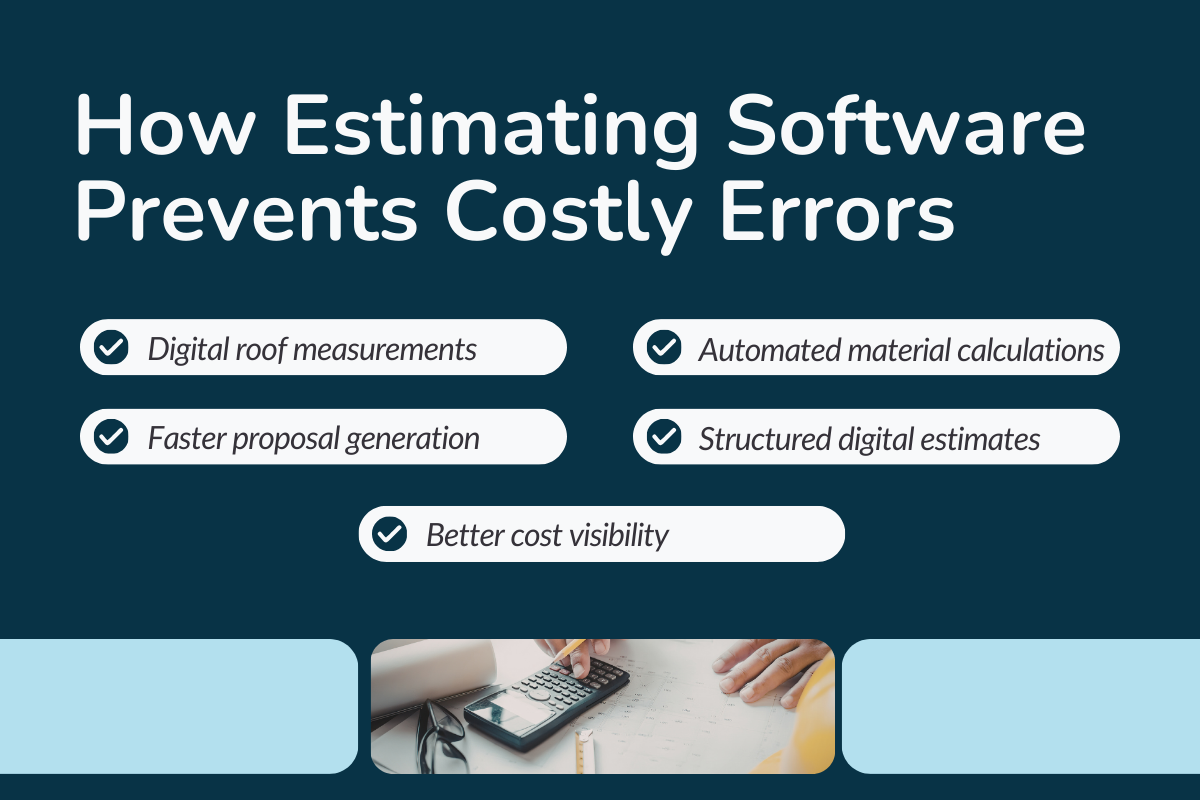
Once contractors understand where profit leaks occur, the next step is fixing the estimating process itself. Modern roofing estimating software platforms reduce risks by automating measurement, pricing, and proposal generation.
Instead of relying on manual calculations or repeating multiple measurements, estimating systems use digital data and automation to produce consistent bids. Many tools combine roofing takeoff capabilities with pricing databases so contractors can build estimates faster and with fewer mistakes.
Below is how software changes the estimating process compared to traditional methods.
1. Measurement Accuracy
Manual roof measurements often introduce errors that affect material quantities and labor planning. Even a small miscalculation can increase waste costs and reduce margins during installation.
How Software Helps: Aerial measurement tools and integrated takeoff software can help contractors capture roof dimensions and use that data when building estimates. These systems are particularly useful for complex structures where manual measurements may miss important details.
What’s the Impact: Digital measurement tools help contractors capture accurate roof measurements for estimating, which improves material planning and reduces unexpected waste costs once the project begins.
2. Material and Cost Calculations
If measurements were taken manually, material and cost calculations are more prone to error. You might miss components like underlayment, ridge caps, or flashing, which can lead to increased project costs.
These smaller errors become difficult to manage as your roofing company begins handling larger commercial roofing jobs.
How Software Helps: Estimating platforms automatically generate material lists and cost calculations based on roof dimensions and project details. Instead of manually building estimates, you can create structured bids using predefined assemblies and pricing databases.
What’s the Impact: Automated calculations can help you produce accurate roof estimates while reducing the risk of missing materials or underestimating labor requirements. This gives you better visibility into expected project costs and margins before work begins.
3. Faster Speed to Lead
In competitive markets, the first contractor to send a professional proposal often has the advantage.
You already know that preparing a complete estimate manually often involves multiple steps, from measuring the roof, calculating materials, pricing components, and writing the proposal. This process can take hours or even days.
During that time, another contractor may reach the customer first, and this costs you another project.
How Software Helps: Estimating platforms automate many of these steps so sales teams can prepare and share bids faster, including while they are still at the job site.
What’s the Impact: Faster proposal delivery allows you to respond to opportunities sooner and secure more jobs without sacrificing estimate accuracy.
4. Professional Proposal Delivery
Handwritten notes or simple spreadsheets can make it difficult for customers to understand estimates. And if you somehow missed the project scope, materials, or pricing, then that can make it harder for customers to understand the proposal and compare options.
How Software Helps: Estimating platforms generate structured digital proposals that organize pricing, materials, and project scope into a clear format. This can help you present projects professionally.
What’s the Impact: Clear, professional proposals can make estimates easier for customers to understand and help contractors present different roofing options more effectively.
> Why Estimating Accuracy Matters
You might find your competition or rising material costs to blame for shrinking margins. But in many cases, the real issue is the accuracy of the estimate.
When measurements, material calculations, and proposals are automated, you gain clearer visibility into project costs before work begins, and this helps in creating roofing estimates that win more jobs.
What Estimating Software Features Help Protect Roofing Margins?
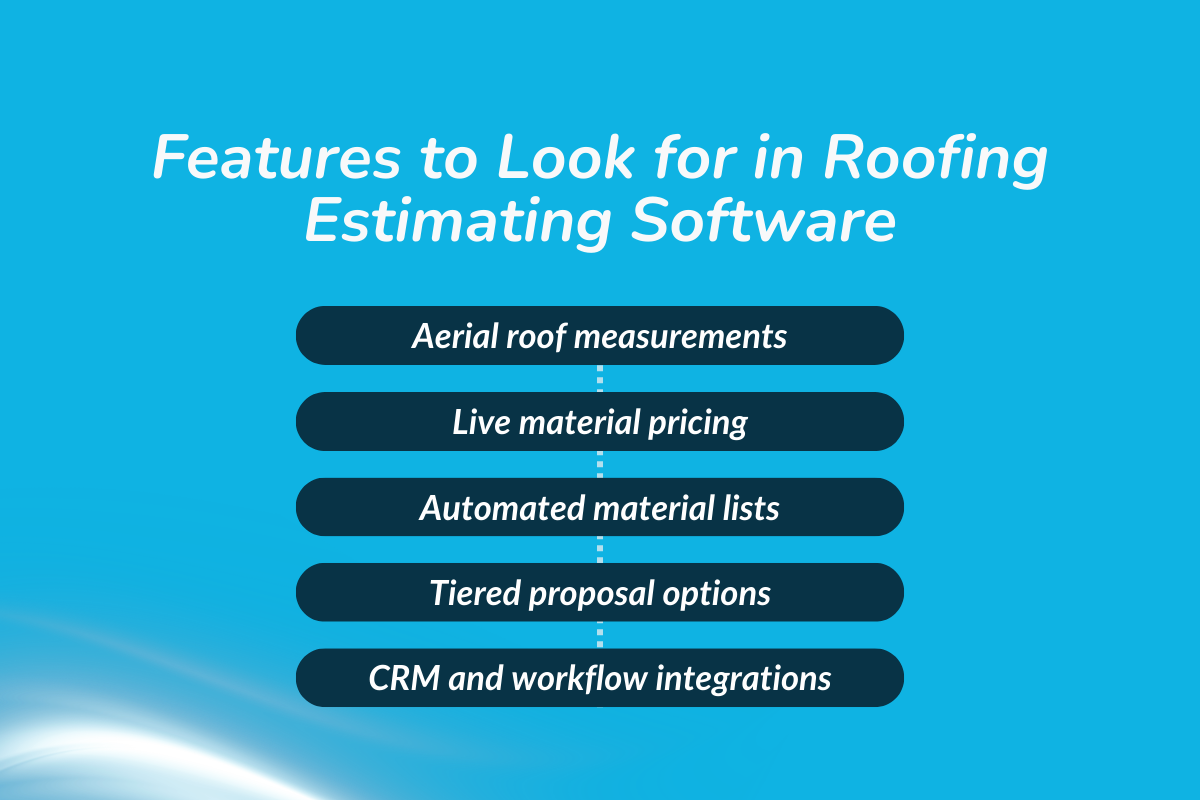
Choosing the right estimating platform is about more than generating quotes. The most effective solutions help contractors improve estimating accuracy, streamline project workflows, and reduce costly errors before work begins.
When evaluating commercial roofing estimating software, contractors should focus on features that improve measurement accuracy, pricing consistency, and sales efficiency.
Below are the core capabilities that modern roofing businesses should look for:
1. Core Measurement & Takeoff Tools
Estimating begins with measurements. If the initial measurements are incorrect, every cost calculation that follows will also be inaccurate.
Depending on the platform, estimating software may include tools such as aerial measurements, 3D roof models, and manual adjustment options.
Key capabilities include:
- Aerial and satellite integrations that allow contractors to measure roofs without climbing the structure
- 3D visualizations that provide a clearer view of roof structures, slopes, and complex layouts
- Manual override tools so estimators can adjust measurements when needed
These tools help contractors generate accurate measurements for both residential and commercial roofing jobs, reducing the likelihood of material shortages or cost overruns during installation.
2. Dynamic Estimating & Material Databases
Once measurements are captured, the estimating system should automatically convert them into reliable project costs.
Advanced estimating platforms include dynamic pricing and material databases that simplify material calculations and keep bids consistent.
Important features include:
- Supplier pricing integrations or regularly updated material pricing
- Customizable assemblies for common roofing systems and installation configurations
- Labor and waste logic that automatically calculates crew hours and material overage
These capabilities help contractors build estimates faster while maintaining consistency across projects.
3. Professional Sales & Proposal Generation
Estimating is also a sales process. The ability to present clear, professional proposals can influence whether a contractor wins or loses a job.
Modern estimating platforms allow contractors to create polished proposals that improve trust and help close projects faster.
Features to look for include:
- Tiered pricing structures that present multiple options to homeowners
- Branded proposals with electronic signatures to simplify approvals
Some systems also enable contractors to deliver instant estimates, allowing sales teams to respond quickly while still on the job site.
4. Integrated Workflow & CRM Capabilities
Estimating does not happen in isolation. The most effective platforms connect estimating with customer management and project tracking.
Integrated workflow features help ensure that leads, estimates, and job progress stay aligned across the business.
Key capabilities include:
- CRM synchronization for managing leads and customer communication
- Mobile field access so crews and sales teams can update information from anywhere
- Accounting integrations that connect estimates to invoicing and financial reporting
Connecting estimating with CRM, field, and accounting workflows can reduce duplicate data entry and make estimated costs easier to compare with actual job performance.
Choosing the Right Roofing Estimating Software
The right estimating platform depends on your workflow, team size, and the level of measurement, pricing, proposal, and operational support you need.
If you are comparing specific platforms, see our Best Roofing Estimating Tools for 2026 guide for a side-by-side breakdown of features, pricing, use cases, and limitations.
How RooferBase Fits Into Your Roofing Estimating Workflow
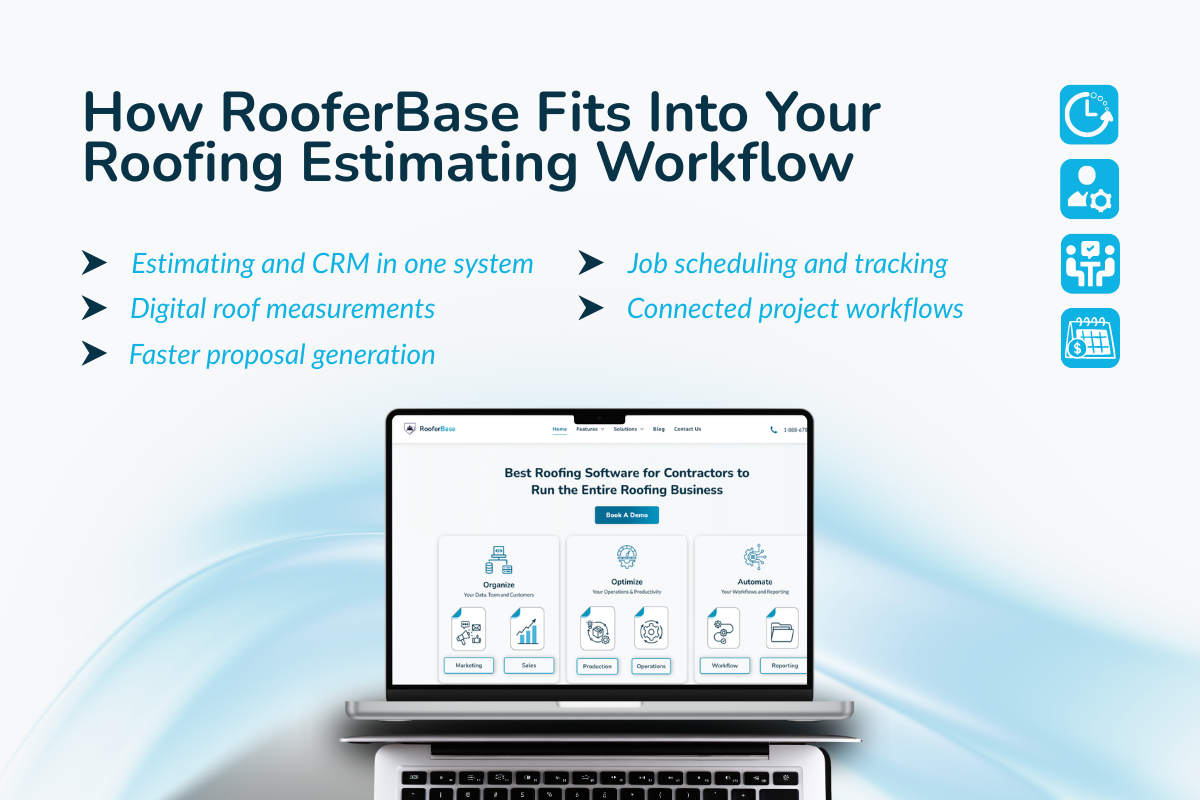
For many contractors, estimating is where operational problems start. RooferBase is designed to simplify that process by bringing estimating, sales, and job management into one connected system.
Instead of switching between multiple tools, you can manage the entire workflow, from the first estimate to the final job update, in one place.
Because the system connects roof measurement data, pricing, and project workflows, teams can build estimates faster while keeping material, labor, and scheduling information connected across the job.
Key Advantages of RooferBase
- Roof measurement support and estimating: RooferBase can use aerial, satellite, or digital measurement data within the estimating workflow, while automated calculations help account for materials, labor, waste, tax, overhead, markup, and margins.
- Faster proposals and roof estimates: Contractors can generate professional proposals quickly, helping sales teams respond faster to leads and move jobs forward without long delays.
- Built for growing roofing businesses: The platform connects estimating with scheduling, project tracking, invoicing, and communication so teams can manage every stage of a roofing project from a single system.
By combining estimating, project management, and customer workflows into one platform, RooferBase helps you reduce errors, speed up proposals, and maintain better control over roofing projects as your business grows.
Final Takeaway
Roofing jobs rarely lose margin because of one dramatic mistake. More often, profit shrinks because measurements, material quantities, labor assumptions, pricing, or overhead were not fully accounted for before work began.
A more consistent estimating process gives contractors better visibility into expected job costs before the project reaches production.
Roofing estimating software can support that process by improving measurement workflows, standardizing calculations, organizing job costs, and helping teams prepare professional proposals faster.
Protect Your Roofing Job Margins with RooferBase
Manual estimating mistakes can reduce your profit on every project. This is where RooferBase can help you generate accurate estimates, update material pricing in real time, and send professional proposals faster.
See how RooferBase can simplify estimating and protect your margins.
Book a quick 15-minute demo today.
FAQs
What causes roofing estimates to lose money?
Roofing estimates can lose money when the original bid does not fully account for material quantities, labor requirements, waste, overhead, price changes, or job complexity. Several small estimating gaps can reduce the expected margin once production begins.
How does roofing estimating software improve accuracy in roofing estimates?
Roofing estimating software helps improve accuracy by automating measurements, calculating material quantities, and factoring in labor costs. Many platforms use aerial measurement data and predefined formulas to reduce human error in calculations.
Can roofing estimating software prevent every estimating error?
No. Software can reduce manual calculation and data-entry errors, but it cannot correct incomplete inspections, unrealistic labor assumptions, outdated pricing, or missing scope information automatically. Contractors still need to review estimate inputs and compare estimated costs with actual job results.
Can roofing estimating software create professional roofing proposals?
Yes, roofing estimating software can create professional proposals that include project pricing, scope of work, and warranty details. Many platforms also allow contractors to generate branded proposals that can be shared digitally with customers.