August 11, 2026
A storm rolled through the city on Tuesday, leaving several roofs damaged. By Thursday, three different roofing companies had knocked on the same doors. Yet only one of them managed to turn those conversations into signed contracts.
The difference was not luck or a more persuasive sales pitch. It was the technology stack behind the sales process.
The days of blindly walking neighborhoods after a hailstorm are dead. Today, if you aren't knocking on a door with satellite damage data already in your hand, you've already lost the job. Winning storm restoration projects requires a connected workflow, which can be a game-changer.
It will help you move seamlessly from identifying storm-affected neighborhoods and qualifying leads to scheduling inspections, generating accurate estimates, and securing digital signatures.
Key Takeaways
- Responding instantly to storm-damaged areas can win more jobs, and the best roofing CRM integrated with D2D sales software can help achieve this.
- Integrating lead capture, inspection, estimation, proposal generation, and automated follow-up into a single platform eliminates workflow gaps and accelerates sales.
- The modern tech stack must include instant proposal generation, route optimization, and e-signatures to shorten the sales cycle and eliminate administrative bottlenecks.
Storms will not wait, and neither should your sales team.
Discover how RooferBase roofing CRM software helps you identify storm-damaged properties, streamline inspections, and turn every storm event into more qualified leads and signed contracts.
How the Right Roofing Tech Stack Converts Storm Leads into Signed Contracts
Storms can generate a surge of roofing leads overnight, but converting those opportunities into signed contracts depends on how quickly a company responds.
If sales representatives fail to identify affected neighborhoods, engage homeowners promptly, and maintain consistent follow-ups, leads quickly grow cold and are often won by faster-moving competitors.
The best roofing CRM solves this challenge by bringing together storm intelligence, canvassing, mobile CRM, roof measurements, estimating, proposals, and automated follow-ups into a single platform integrated with the canvassing software for door-to-door sales teams, playing a key role at the front end of the funnel.
This blog explores how roofing software streamlines inspections, estimating, proposal generation, and automated follow-ups to create a connected sales workflow that helps contractors close more deals and maximize revenue during every storm season.
Why the First Roofing Contractor to Respond Often Wins the Job After a Storm?
A severe storm can damage hundreds of roofs within a matter of hours, creating a sudden spike in demand for roofing services.
Most homeowners need to search for help immediately, making the first 48–72 hours the most critical window for lead generation and customer acquisition.
Roofing companies that respond quickly with emergency mitigation services such as roof tarping, temporary repairs, and securing damaged openings to prevent further water intrusion stand out from competitors.
By helping homeowners minimize additional damage before permanent repairs begin, they establish credibility and trust from the very first interaction.
Fast response times also matter beyond emergency services. Companies that answer calls promptly, schedule roof inspections without delay, and dispatch sales representatives to storm-affected neighborhoods quickly are far more likely to secure appointments before competitors arrive.
During storm recovery, homeowners value speed, clear communication, and professional guidance as much as the repair itself.
In storm restoration, the company that reaches the right homeowners first, provides immediate assistance, and delivers a seamless customer experience is often the one that wins the contract.
Legacy CRMs vs. Modern Roofing Tech Stacks
Legacy CRMs focus heavily on generic data entry and pipeline tracking, whereas modern roofing tech stacks connect specialized, mobile-first tools to handle the unique workflow of a roofing contractor.
| Feature | Legacy CRMs | Modern Roofing Tech Stacks |
|---|---|---|
| Accessibility | Office-only or limited mobile access | Cloud-based with real-time access from any device on any job site |
| Field Usability | Manual forms and delayed updates | Mobile-first app with offline capture, photos, voice notes, and geo-tagging |
| Follow-Ups | Manual reminders and spreadsheets | Automated emails, SMS, task assignments, and workflow triggers |
| Data Entry | Duplicate entry across multiple systems | Single data capture synced across estimating, CRM, and production |
| Integrations | Limited or standalone tools | Native integrations with aerial measurements, HailTrace, NOAA, estimating, accounting, and e-signatures |
Stages From Storm Damage to Signed Contracts
Contractors do not lose revenue because they deliver poor roofing work; it happens when the job stages from lead capture to customer conversion fail.
Let us explore the key stages every roofing company must cover to generate leads and convert them into signed proposals, and how modern door-to-door canvassing fits into the process.
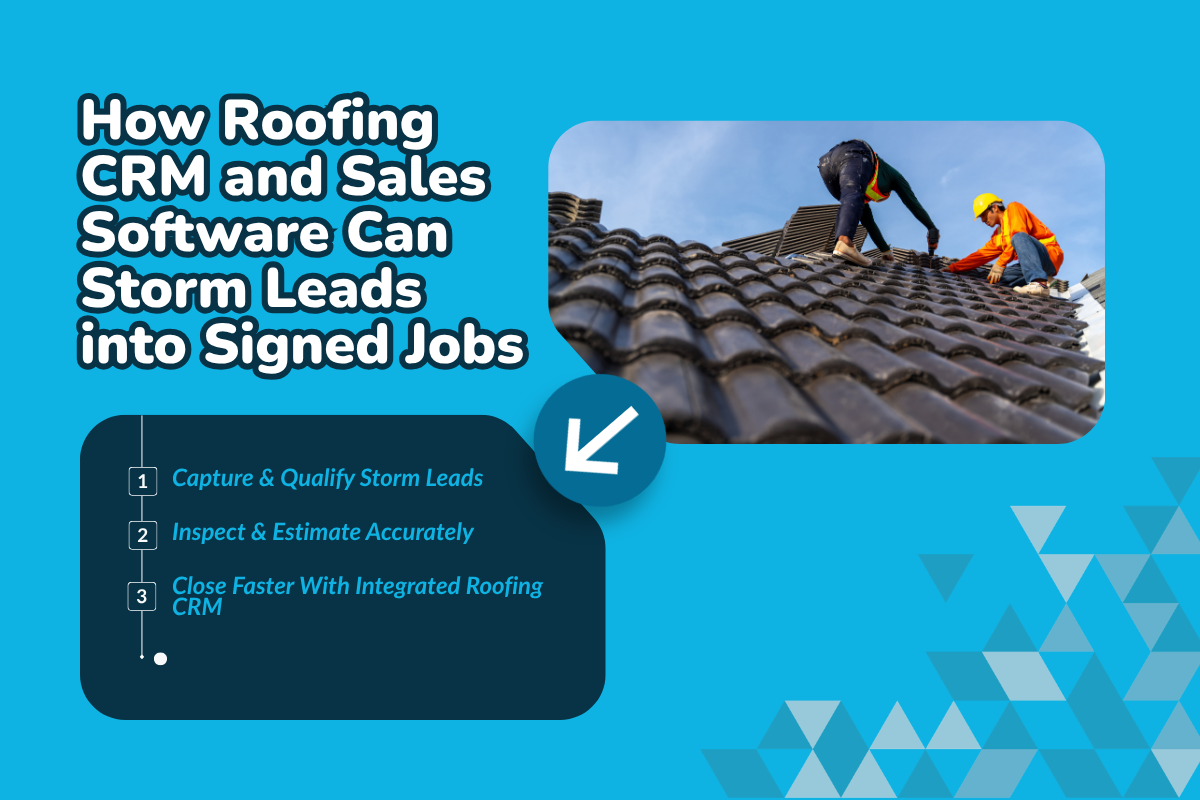
Stage 1: Storm Lead Capture and Qualification
Successful storm response starts with accurate territory identification. Using live hail, wind, and weather data helps contractors prioritize neighborhoods where roof damage is most likely before dispatching sales teams.
1. Identifying Storm-Affected Territories Before the Knock
Roofing CRM software is the foundation for spotting high-damage areas and prioritizing the warmest leads using the built-in HailTrace integration that tracks severe storm paths in real time to identify hardest-hit regions. Integrating these storm overlays directly into Knockbase canvassing software allows field reps to pinpoint impacted neighborhoods instantly on their mobile map.
How to achieve this:
- Cross-verify storm data: Validate affected areas using official NOAA storm reports alongside hail maps.
- Evaluate property data: Filter individual homes by roof age, home value, and insurance claim history to assess lead quality.
- Layer your analysis: Combine HailTrace data with property insights to target high-probability neighborhoods and boost conversion rates.
Takeaway: This step ensures no canvassing effort is wasted and helps gain a better competitive advantage in storm seasons.
2. Capturing Every Roofing Lead in Real-Time
A roofing CRM enables field representatives to capture critical property data through a mobile CRM app. Here is how it adds to your workflow efficiency:
- Comprehensive data capture: Log roof age, materials, visible damage, homeowner concerns, insurance info, photos, and voice notes on-site.
- Instant office syncing: Upload field data in real time so estimators and office managers can see customer updates instantly.
- Automated engagement: Trigger marketing automation tools to send immediate emails, SMS reminders, and follow-up tasks
Fact Check: Real-time lead capture helps companies connect with inbound leads within five minutes, increasing conversion rates by up to 21x.
3. Scheduling Roof Inspections Before Leaving the Property
Use a mobile CRM to check live calendar availability and schedule inspections directly from the driveway, reducing missed opportunities.
You must automatically geo-tag every lead and sync it with the office in real time, giving managers complete visibility into covered territories, open leads, and field activity.
Stage 2: From Inspection to Accurate Estimate
Roofing inspections are the foundation of data collection. Every project estimate, material takeoff, insurance claim, and installation plan depends entirely on their initial accuracy.
Standardizing this transition through templates reduces calculation errors, accelerates proposal generation, and helps contractors win more deals.
1. Capturing Complete Inspection Data the First Time
Advanced roofing platforms automatically log critical field data, including roof pitch, material types, square footage, geometry, ridges, valleys, flashing, and ventilation components.
How the right roofing CRM ensures accuracy:
- Geo-tagged photography: Attaches high-resolution, location-verified photos to every digital inspection report.
- Visual proof for claims: Uses clear digital documentation to validate storm damage, support insurance claims, and back up estimate lines.
- Single-visit execution: Provides estimators, adjusters, and project managers with complete data right away, eliminating the need for costly secondary site visits.
2. Turning Inspection Data Into Accurate Estimates
By integrating aerial measurements and satellite imaging, roofing software can instantly calculate exact roof dimensions, material quantities, waste factors, and project costs based on real-time pricing.
Let us explore how inspection data can be converted into accurate roofing estimates using essential features in roofing CRM software :
- Error reduction: Minimizes manual calculation mistakes that lead to incorrect material orders and blown project budgets.
- Seamless conversion: Automatically pushes drone or field measurements directly into polished professional proposals without manual entry.
- Faster turnaround: Generates quotes rapidly so sales teams can present agreements to homeowners while their purchase intent is highest.
3. Standardizing Estimates Across Every Sales Representative
Utilizing automated estimating tools with pre-built templates ensures that every field rep builds proposals using uniform pricing, labor rates, and material costs.
How integrated sales tools protect your margins:
- Pricing consistency: Eliminates conflicting quotes between sales reps and prevents accidental underquoting or overbidding.
- Brand trust: Delivers clean, transparent, and professional digital contracts that build immediate homeowner confidence.
- Accelerated onboarding: Empowers new sales hires to produce accurate, company-approved proposals from their very first day in the field.
4. Where Estimating Workflows Usually Break Down
Many retail roofing companies still use separate, disconnected tools for inspections and estimating. A unified roofing CRM bridges this gap by merging both steps into a single, cohesive workflow.
Measurable contractor benefits:
- Zero duplicate entry: Connects field inspection notes straight to the final quote, cutting out manual data transfers and quantity errors.
- Live supplier pricing: Links estimate templates to real-time local supplier costs to protect your net profit margins.
- Centralized storage: Houses field measurements, aerial drone reports, and damage photos in one central cloud file for instant verification.
- Automated version control: Tracks every proposal revision automatically, ensuring the office, the field rep, and the production crew always look at the exact same draft.
Stage 3: From Estimate to Signed Contract
1. Presenting a Proposal That Wins on the First Visit
Winning the job often depends on the quality and speed of your proposal. The best roofing CRM helps contractors gain speed, accuracy, and quality to create an excellent first impression that counts towards better sales conversion.
2. Digital Signatures and Real-Time Proposal Tracking
Most homeowners compare quotes from multiple roofing contractors before making a final choice, and any delay gives competitors a chance to win the project.
A mobile roofing CRM with built-in e-signatures allows field reps to generate, send, and close digital proposals directly from the job site.
This immediate turnaround eliminates paperwork delays, keeps the momentum going, and helps sales teams secure signed agreements before leaving the driveway.
3. Managing Insurance-Related Storm Jobs Efficiently
Insurance claims require clear inspection photos, roof measurements, and detailed damage records.
A roofing CRM stores every document in a centralized portal, making it easy to share accurate information with adjusters.
It provides aerial measurements, photos, and inspection notes to reduce disputes and speed up approvals with detailed documentation.
How Connected Roofing Software Eliminates Workflow Gaps?
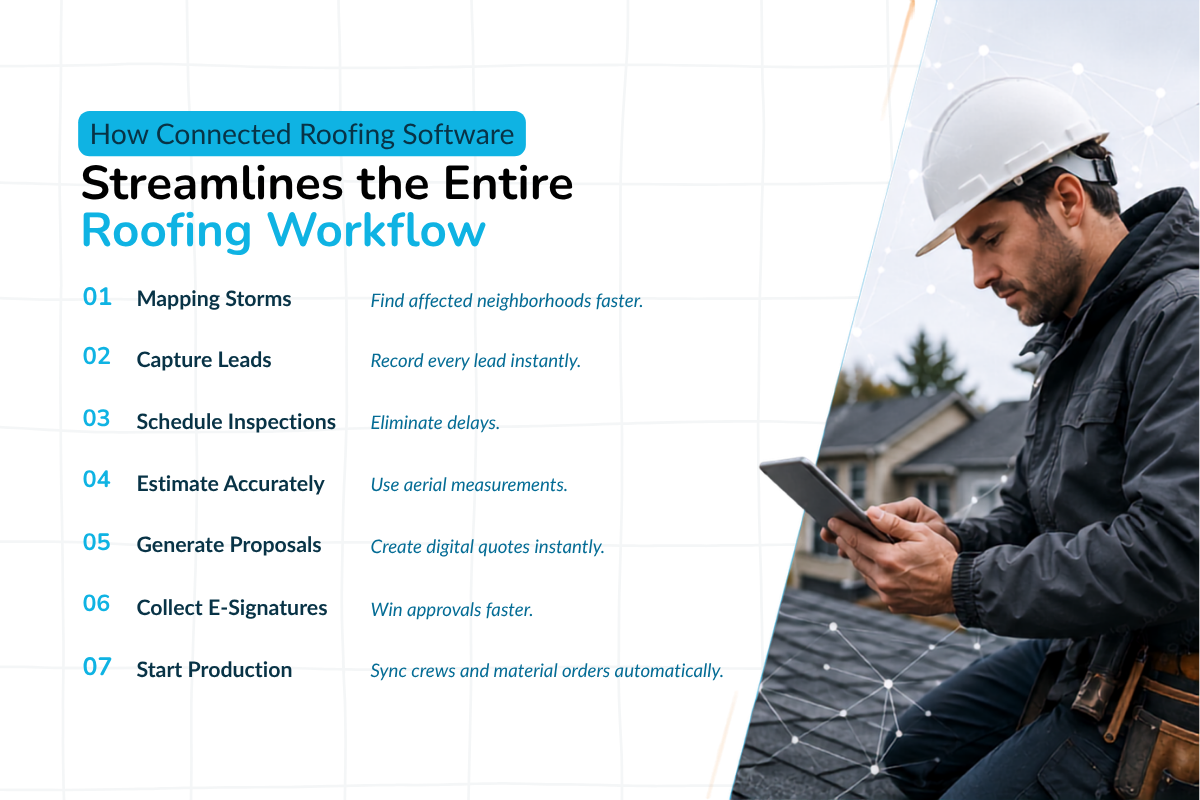
| Workflow Stage | Common Workflow Gap | Business Impact | Benefit of Connected Roofing CRM Software |
|---|---|---|---|
| Storm → Territory Mapping | Storm areas identified late | Missed 'warm' and hot' lead opportunities | Imports storm data and assigns sales territories automatically. |
| Territory Mapping → Canvassing | Sales Rep overlap in same areas or misses key neighborhoods | Lower productivity and lower conversion rate | Optimizes routes to prevent territory overlap. |
| Canvassing → Lead Capture | Lead details recorded manually | Lost follow-ups | Captures leads, photos, and notes in a single tool |
| Lead Capture → Inspection | Scheduling delays | Slower response times | Automates inspection scheduling and reminders. |
| Inspection → Estimate | Missing photos or measurements | Inaccurate estimates and delays in insurance job claims | Uses aerial measurements for accurate measurements |
| Estimate → Proposal | Manual proposal creation | Longer sales cycle | Generates digital proposals instantly using live material pricing on standard templates |
| Proposal → Signature | Slow approvals | Lost deals to competitors | Collects e-signatures directly from the job site. |
| Signature → Production | Information not shared with crews | Project delays and reworks | Syncing of approved jobs with production, crew scheduling, and material orders to fasten job completion |
How RooferBase Fits the Modern Roofing Tech Stack
When one connected platform manages your entire roofing workflow from the first storm event to the final signed contract, the result is a faster sales process and higher revenue for the business.
Here's how Rooferbase helps roofing contractors close more deals by connecting every stage
- No duplicate data entry: Inspection photos, roof measurements, and customer details flow straight into your full CRM, so your team never has to enter the same information twice.
- Accurate estimates: Generate professional estimates using standardized labor, material, and live material pricing to keep every roofing job profitable.
- Professional proposals: Create branded digital proposals, collect e-signatures, and track when homeowners view or sign them to close more jobs.
- Smooth production handoffs: Once a proposal is signed, crew scheduling, material orders, and job management are initiated automatically.
- Complete job visibility: Track every job stage from the first site visit to project completion using a single platform with real-time visibility of the entire roofing business.
- Easy to Use: No steep learning curve or scattered tools that help you manage your entire roofing operation from one intuitive platform with seamless third-party integrations.
- Roofing-specific enterprise software: Built exclusively for roofing contractors, with industry-specific features designed to streamline every stage of roofing operations.
Bottom Line: Building Your 2026 Roofing Tech Stack
The best roofing companies in 2026 are not just working faster; they are working smarter.
Instead of relying on disconnected tools, they use a connected roofing CRM that brings lead management, inspections, professional estimates, digital proposals, job management, crew scheduling, and production tracking together on one platform.
The result is faster response times, stronger customer communications, fewer workflow gaps, and better coordination between multiple crews in the field and in the office.
With every stage connected, roofing contractors can close more deals, deliver a better homeowner experience, and stay ahead of the competition.
Storms create the opportunity. RooferBase helps you find the leads and turn them into signed contracts. Knockbase handles the door-to-door side of that same storm response. Speak with a roofing workflow specialist today for a 15-minute Tech Stack Audit.
Frequently Asked Questions (FAQ)
Q1. What is a Roofing CRM Used for During Storm Restoration?
Roofing CRM software centralizes the entire storm restoration process. It allows contractors to capture leads, store insurance documentation, automate scheduling, and generate accurate estimates from a single platform.
Q2. How Quickly Should Roofing Companies Respond after a Storm?
A roofing CRM software with HailTrace integration helps contractors identify high-prospect leads and reach affected homeowners within 24 to 48 hours after a storm. This enables roofing teams to respond to urgent repair needs quickly while scheduling non-emergency restoration work, such as repairing granule loss or replacing missing shingles within the first week. Early intervention helps prevent minor roof damage from escalating into more serious structural deterioration.
Q3. What is the difference between canvassing software and roofing CRM software?
Canvassing software is designed to manage door-to-door sales activities, including territory mapping, lead tracking, sales representative management, knock histories, appointments, and conversion tracking.
A roofing CRM is a specialized platform that manages the entire roofing sales process from lead generation and inspections to estimates, proposals, job scheduling, invoicing, and final payment collection.
It also integrates with industry-specific tools such as HailTrace for storm tracking, ABC Supply and SRS Distribution for supplier catalogs, and accounting software, enabling roofing contractors to manage their complete sales and project pipeline from a single platform.
Q4. Why do Roofing Companies Lose Deals Between Estimate and Signature?
Roofing companies often lose deals between the estimate and signed contract due to slow response times, unclear proposals, pricing concerns, inaccurate insurance claim estimates, and aggressive competition.
Homeowners are more likely to choose contractors who respond first, communicate clearly, and demonstrate the value of their services with transparent estimates and a professional sales process.
Q5. How does a Connected Roofing Tech Stack Improve Production?
An ideal roofing CRM should be an all-in-one platform that connects field operations with back-office workflows. It should manage canvassing, roof measurements, inspections, crew tracking, and job scheduling while also supporting invoicing, material ordering, supplier management, accounting, and payment collection from a single system.
Q6. How long does it take field sales reps to adopt a modern roofing tech stack?
Most mobile-first roofing CRMs are designed for intuitive field execution, allowing sales reps to learn basic lead logging, inspection photo uploads, and contract generation in under a week. Standardized pricing templates inside the platform also help new sales hires produce accurate, company-approved estimates from day one.