November 10, 2025
If you’re a roofing contractor looking for software to manage measurements, proposals, leads, jobs, materials, and payments, Roofr is one of the roofing-specific platforms you’re likely to come across.
Roofr combines aerial roof measurements and estimating tools with CRM, proposals, job management, material ordering, invoicing, payments, automation, reporting, and field workflows.
The bigger question is whether its pricing structure, measurement workflow, CRM capabilities, and plan limits fit the way your roofing business actually operates.
This review looks at Roofr’s current features, pricing, strengths, limitations, user experience, and alternatives so contractors can decide whether it is the right fit in 2026.
Roofr Software Review 2026: Features, Pricing, Strengths, and Limitations
Roofr is roofing business software built around a connected workflow from lead capture and roof measurements through proposals, job management, material ordering, invoicing, and payment.
Its current platform goes well beyond its original measurement-report focus, with CRM tools, calendars, automations, supplier workflows, reporting, and higher-tier crew and job-costing capabilities.
Key Takeaways
- Roofr combines roof measurements, CRM, proposals, job management, material ordering, invoicing, payments, and automation in one roofing-focused platform.
- Its current plans are Starter, Measure+, Essentials, and Scale, replacing the older Free, Pro, Premium, and Elite structure.
- Starter is free, while paid CRM plans include Essentials at $249/month and Scale at $349/month with monthly billing. Measure+ provides lower report pricing and faster guaranteed turnaround.
- Roofr Reports cost $19 per report on Starter and $13 on paid plans, with ESX files available as an additional report option.
- Advanced capabilities such as crew management, job costing, performance reporting, QuickBooks integration, and role-based permissions are concentrated in the Scale plan.
- Roofr currently lists unlimited users across its plans, so fit depends more on required workflows and feature tiers than on per-seat limits.
What is Roofr Software?
Roofr is cloud-based roofing software that combines roof measurements, estimating, proposals, CRM, job management, material ordering, invoicing, payments, and workflow automation in one platform.
Its measurement tools remain a major part of the product, but Roofr now supports a much broader workflow.
Contractors can capture leads, organize jobs on visual boards, order roof reports, build proposals, create material orders, send invoices, collect payments, and track job activity without moving between multiple systems.
The platform is built specifically for roofing contractors and connects tools such as Roofr Reports, Instant Estimator, Proposals, Material Ordering, Payments, Calendar, and CRM job boards around the same customer and job record.
Roofr also offers a free Starter plan, making it accessible to contractors who want to begin with measurements and basic job-management tools before moving to more advanced CRM features.
Roofr’s Core Tools: Everything in One Software
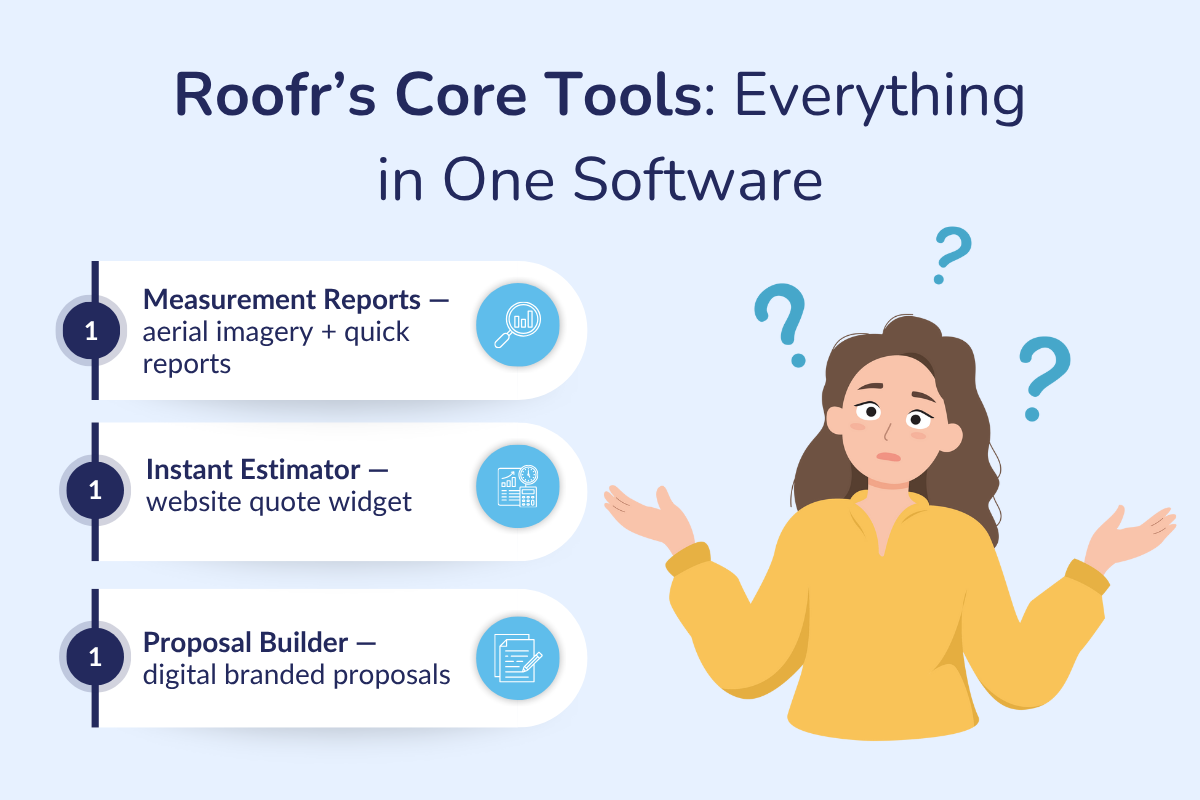
Roofr connects measurement and estimating tools with CRM, job management, material ordering, payments, scheduling, and automation. The exact capabilities available depend on the selected plan.
1. Roof Measurement Reports
Roofr Reports use aerial imagery to provide roof measurements including area, pitch, ridges, hips, valleys, and other roof dimensions.
Contractors can order professional measurement reports or use Roofr’s DIY measurement tools when they want more control over the takeoff process. Paid plans also include lower per-report pricing and faster turnaround options.
2. Instant Estimator
Roofr’s Instant Estimator lets homeowners enter their address through a contractor’s website and receive a preliminary roofing estimate based on pricing configured by the contractor.
It can help capture and qualify leads before a salesperson follows up. Instant Estimator is offered as a paid add-on and can be added even to the free Starter plan.
3. Proposals
Roofr converts measurement and estimating data into digital proposals that contractors can send for electronic signature.
Teams can use reusable templates, company branding, images, custom pages, pricing options, discounts, markup, and Good-Better-Best packages to tailor proposals to different customers.
4. CRM & Job Management
Roofr’s CRM uses job boards to track leads and projects through different stages of the roofing workflow.
Teams can manage customer records, tasks, documents, job activity, calendar events, and automated actions from the same job record. Higher-tier plans add more customizable boards, permissions, reporting, and workflow controls.
5. Material Ordering
Signed proposals can be converted into material orders, with quantities and products carried into the ordering workflow instead of being entered again manually.
Roofr also integrates with roofing suppliers including ABC Supply, QXO, and SRS, allowing contractors to check supported supplier information and submit orders from within the platform.
6. Invoicing, Payments & Scheduling
Contractors can create invoices from job information, track outstanding balances, and accept supported online payment methods.
Roofr’s calendar connects appointments and job events with customer records, while automations can handle tasks such as status changes, reminders, emails, and other routine workflow actions.
Roofr Pricing Breakdown in 2026: Starter, Measure+, Essentials, and Scale
Roofr currently offers four base-plan options: Starter, Measure+, Essentials, and Scale. All plans support unlimited users, but feature access, measurement pricing, automations, reporting, and workflow controls vary by tier.
| Plan | Best For | Monthly Price | Key Features | Notes |
|---|---|---|---|---|
| Starter | Contractors testing Roofr or mainly ordering measurements | $0/month | 1 basic job board, 10 trial proposals/invoices/work orders, 5 automations, material ordering, calendar, unlimited users | Roofr Reports cost $19 each; estimated delivery within 24 hours |
| Measure+ | Contractors focused mainly on faster, lower-cost roof measurements | $109–$169/month | $13 reports, faster guaranteed delivery, material calculations, waste factors, CSV downloads, branding, unlimited users | Reports are still charged separately; 2- or 6-hour options available |
| Essentials | Roofing teams that need the core CRM from measurement through payment | $249/month | Unlimited proposals, invoices and work orders, payments, e-signatures, SMS, 10 automations, 1 flexible job board, unlimited users | Roofr Reports cost $13 each with guaranteed delivery in 2 hours |
| Scale | Growing teams needing more workflow, crew and reporting control | $349/month | 7 customizable job boards, crew management, 25+ automations, performance reporting, job costing, QuickBooks, role permissions | Most complete CRM tier; unlimited users |
Roofr’s Starter plan provides a free entry point with basic job-management tools and pay-per-report measurements. Contractors that need faster reports, full CRM workflows, or advanced crew and reporting features can move to Measure+, Essentials, or Scale.
How Roofr Helps Roofing Contractors Grow Their Business
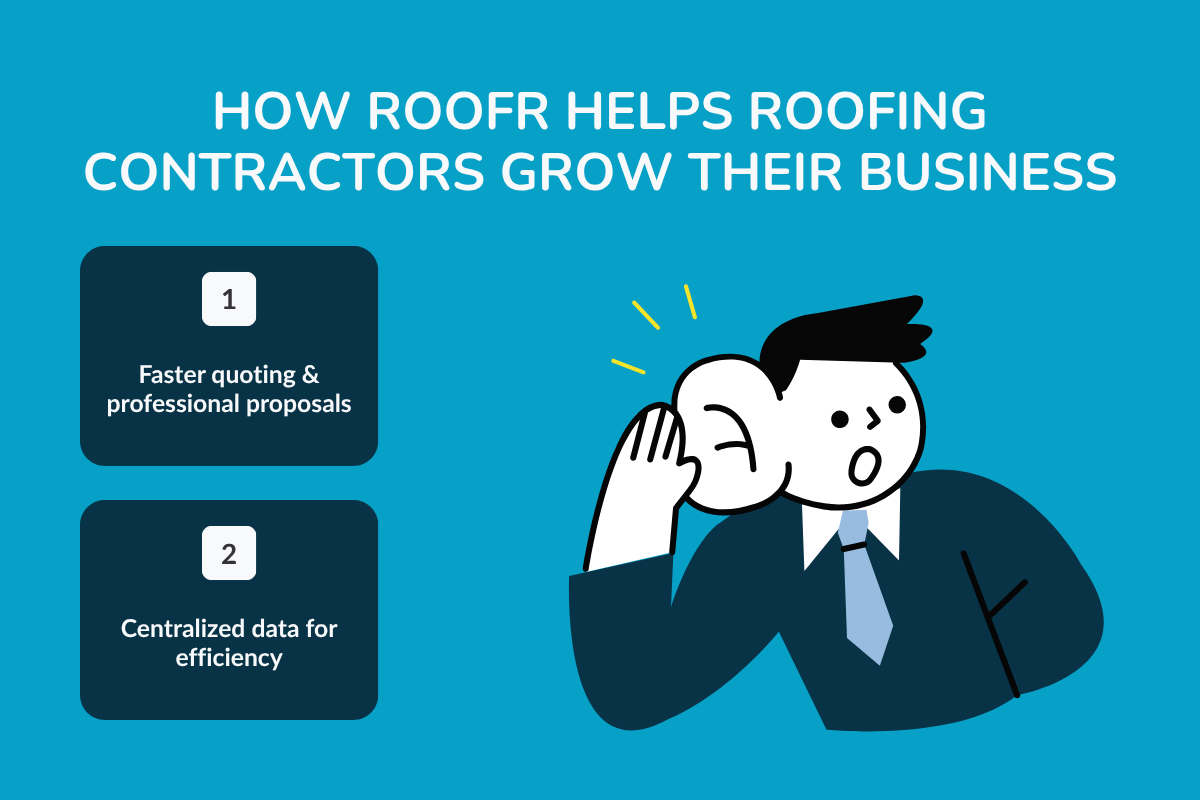
Roofr’s appeal for roofing businesses comes down to one simple promise to let you quote faster, reduce manual work, and present like a professional.
For contractors who spend too many hours measuring roofs, creating proposals, and tracking jobs, Roofr offers tangible shortcuts.
1. Speeding Up Estimates & Proposals
One of the clearest wins for roofers is Roofr’s measurement-to-proposal workflow. Contractors can order a measurement report (or self-measure) using aerial imagery, import the numbers into the system, add pricing, and send a branded proposal, all in one session.
Users say this helps them show up with meaningful numbers during a site visit rather than starting from scratch. Because fewer steps are involved, estimators and sales team members spend less time doing admin and more time building the pipeline.
2. Better Presentation, More Jobs
Roofr enables contractors to send digital, branded proposals that include measurement data, payment options, and e-signatures.
One current G2 reviewer commented that their business “doubled” after adopting Roofr, thanks to the streamlined process, which helped convert more leads.
3. Centralizing Key Data
Roofr connects measurements and proposals with broader CRM and job-management workflows, helping contractors keep customer, project, material, scheduling, and payment information in one system.
For example, teams can use shared calendars, supplier integrations, work orders, job costing, invoices, and job boards without rebuilding the same information across separate tools.
4. Real-World Contractor Fit
Roofing contractors interviewed or surveyed tend to highlight three consistent benefits:
- Less time spent measuring roofs manually or climbing structures.
- More professional, polished proposals that improve homeowner trust and close rates.
- Lower overhead for admin/estimating when compared to older systems or manual processes.
Roofr is especially well-suited for residential roofing businesses or small-to-mid-sized teams that close a decent volume of jobs but don’t yet have enterprise-level operations.
Its speed and ease of use are strong selling points for contractors seeking to scale without adding a full estimating department.
Real-World Challenges Roofers Still Face
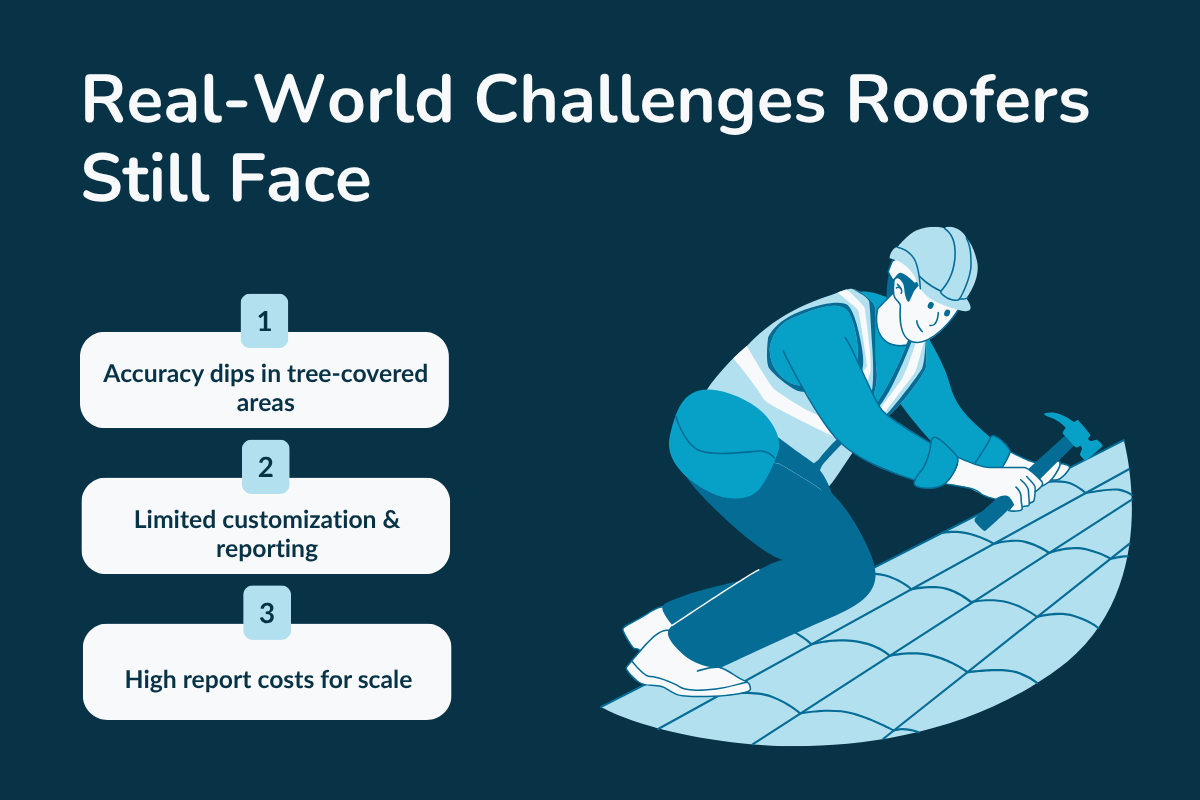
Roofr covers much more of the roofing workflow than it did a few years ago, but contractors should still consider a few trade-offs before committing.
1. Measurement Accuracy Still Needs Verification
Roofr itself recommends double-checking measurements before ordering materials because no measurement service is 100% accurate.
Some users also report occasional issues with roof pitch or measurement accuracy, particularly on more complex properties. Contractors should therefore treat aerial measurements as a strong estimating tool rather than a substitute for job-site verification when accuracy is critical.
2. Per-Report Costs Can Add Up
Roofr Reports are charged separately from the monthly subscription.
Starter users currently pay $19 per report, while paid plans reduce the cost to $13 per report.
For contractors ordering a high volume of measurements, those per-report fees should be included when calculating the true monthly software cost.
3. Advanced CRM Features Are Concentrated in Scale
Roofr’s lower plans cover a substantial portion of the sales and job workflow, but several more advanced capabilities are reserved for Scale.
These include crew management, job costing, role-based permissions, broader reporting, and more customizable job boards and automations.
Teams should compare their required workflow against plan limits before choosing based only on the base subscription price.
4. Mobile Works Differently From a Traditional App
Roofr launched an updated progressive web app in 2026 that allows contractors to manage jobs, send proposals, and update job information from a phone without downloading a traditional iOS or Android app.
That gives teams mobile access, but contractors who strongly prefer a native App Store or Google Play application should test the mobile experience before committing. Some user reviews have also mentioned mobile usability limitations.
5. Reporting Is Better, but Depth Depends on the Plan
Roofr now provides Performance Dashboards for job, lead, team, and lost-opportunity reporting, making the old claim that reporting is limited outdated.
However, the strongest reporting and job-costing capabilities are concentrated in the Scale plan, so contractors on lower tiers may have less operational visibility than teams using Roofr’s full CRM package.
Roofr’s Customer Support & Community Feedback
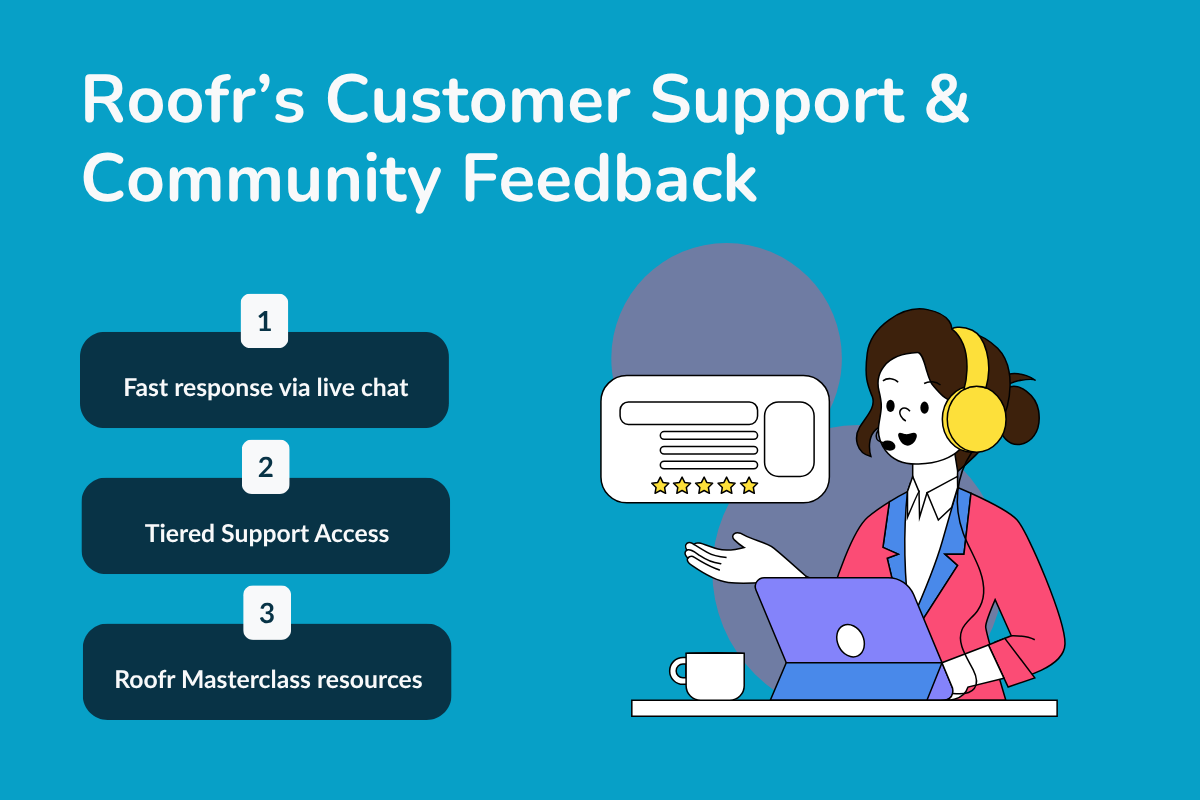
1. Responsiveness & Availability
Roofr’s support team earns solid marks for speed and accessibility. Most users report getting a response within a few hours through live chat, especially on paid plans.
Tickets tied to measurement errors or report delays are typically resolved the same day, which helps maintain project momentum.
2. Onboarding & Account Support
Roofr provides onboarding and account-support resources for subscribed customers. According to Roofr, subscription plans include account-configuration support, training for teams, and access to a dedicated account manager.
Onboarding packages can vary by plan, and Roofr also has implementation teams that can help with setup tasks such as adding materials, creating proposal templates, and configuring team access.
3. Learning Resources
Roofr invests heavily in education through its Roofr Masterclass series, providing short, practical sessions that show how to get more from the platform.
Topics range from proposal workflows to ABC Supply integrations, helping contractors troubleshoot proactively rather than waiting for one-on-one support.
> Overall Impression
Contractors describe the experience as efficient and structured, aligning with Roofr’s overall product philosophy: make help easy to reach and solutions easy to apply.
It’s not white-glove support, but it’s consistent, and that reliability matters when you’re handling estimates and proposals on a tight schedule.
Roofr Alternatives to Consider in 2026
Roofing software platforms differ widely in how they handle measurements, CRM, project management, field operations, workforce management, and pricing. Here’s how Roofr compares with several common alternatives.
1. JobNimbus
JobNimbus is a roofing and exterior contractor CRM focused on customizable workflows, project management, automations, supplier integrations, payments, and reporting.
Best suited for: Contractors that want established CRM functionality, flexible workflow boards, and a broad third-party integration ecosystem.
Pricing: Quote-based across Essentials, Pro, Premium, and Enterprise, with a 14-day free trial available.
2. AccuLynx
AccuLynx is roofing business management software built around CRM, estimating, production, financial tracking, scheduling, and supplier workflows.
Best suited for: Roofing companies that need deeper operational, financial, and production-management tools.
Pricing: Custom quote-based pricing across Pro and Elite plans.
3. Hover
Hover focuses on roof and exterior measurements, 3D modeling, takeoffs, and visualization rather than broader roofing-business operations.
Best suited for: Contractors that prioritize property measurements and visual selling tools, particularly for exterior remodeling workflows.
4. RooferBase
RooferBase connects CRM, estimating, proposals, D2D canvassing, project management, field workflows, HR, payroll, and reporting within one roofing operations platform.
Best suited for: Growing roofing teams that want sales, field, production, and workforce operations managed within the same system.
If you’re specifically comparing the two platforms, see our full
RooferBase vs Roofr comparison for a direct feature-by-feature breakdown.
Where RooferBase Comes In: One Connected Roofing Platform
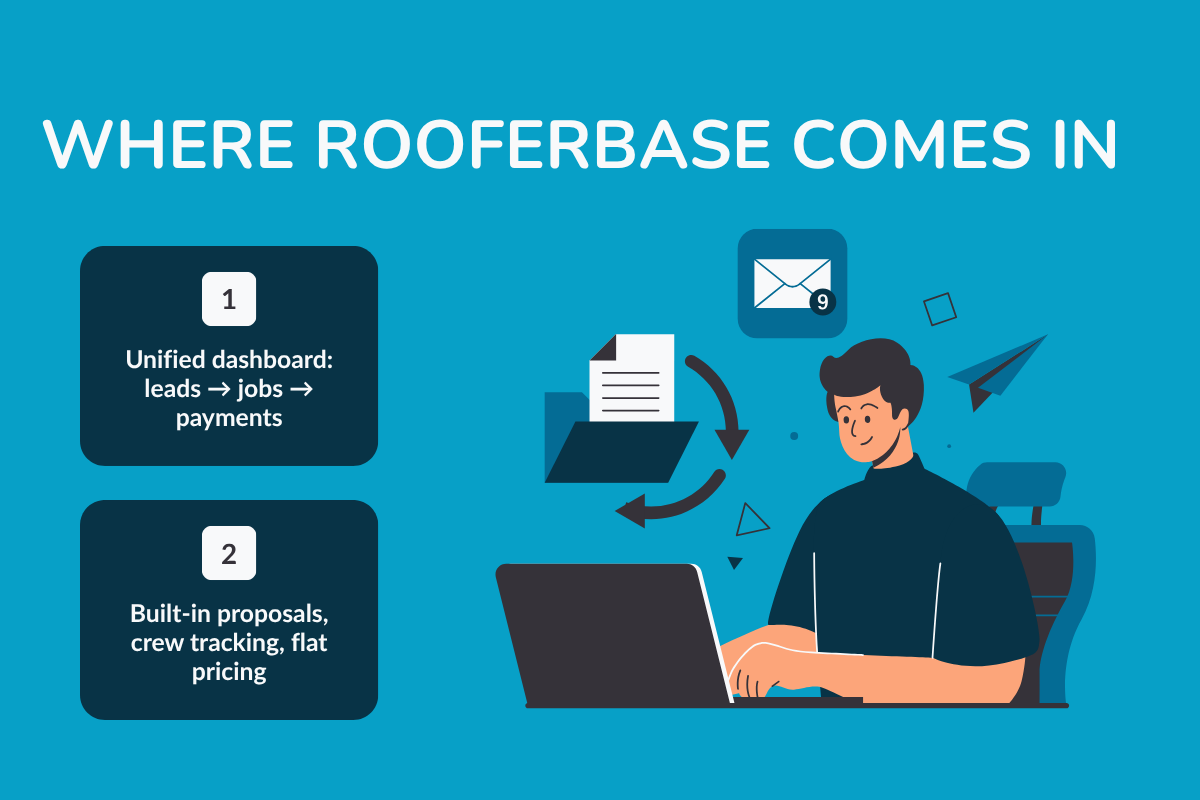
Roofing companies often end up using separate tools for lead capture, estimating, scheduling, production, field activity, payments, payroll, and reporting.
RooferBase is built to connect more of those workflows inside one roofing-specific platform, so information can move from the first lead through estimating, proposals, scheduling, production, and reporting without being rebuilt across different systems.
What RooferBase Covers
- D2D canvassing and CRM: Capture leads in the field, manage territories, track canvasser activity, book appointments, and move those opportunities directly into the CRM.
- Estimating and proposals: Connect roof measurement data with material, labor, waste, overhead, markup, and proposal workflows.
- Production and field operations: Schedule jobs, coordinate crews, track progress, manage tasks, and keep field updates connected to each project.
- HR and workforce management: Manage employee records, GPS time tracking, payroll activity, onboarding, attendance, and compliance workflows.
- Storm-restoration workflows: Connect HailTrace storm intelligence with territory targeting, lead data, and canvassing activity.
- Reporting and analytics: Track sales, profitability, production activity, crew performance, and operational metrics from one dashboard.
Real-World Fit
RooferBase is designed for roofing companies that need sales, production, field, and workforce workflows connected as the business grows.
Pricing starts at $63 per user/month, with final pricing depending on team size, selected capabilities, integrations, and implementation requirements.
Conclusion: Is Roofr Worth Considering in 2026?
Roofr has become a practical option for contractors who want measurements, proposals, CRM, and job-management tools in one roofing-specific platform without a high barrier to entry.
Its strongest appeal is still the measurement-to-proposal workflow, especially for contractors that value transparent pricing, a free starting tier, and native roof reports. The tradeoff is that more advanced operational features sit higher in the product stack, and report costs can become meaningful at volume.
For roofing companies with relatively straightforward sales and job-management needs, Roofr can be a good fit. Businesses with more complex field operations, workforce management, canvassing, payroll, or storm-restoration workflows may want to compare it with broader roofing platforms before deciding.
Take the Next Step with RooferBase
If you’re ready to stop switching between apps and start managing your roofing business from one dashboard, it’s time to see what RooferBase can do.
Measure roofs, send proposals, track crews, and get paid, all in one platform built for contractors who want fewer tools and faster results. Schedule your demo today!
See how RooferBase simplifies every job: Explore RooferBase.
FAQs
1. What do Roofr users say about their experience?
Recent Roofr reviews are generally positive, particularly around ease of use, proposal creation, onboarding, and customer support.
Some users still mention occasional measurement or pitch inaccuracies, mobile usability limitations, and concerns about pricing as their usage grows. As with any roofing software, contractors should test the workflows they rely on most before committing.
2. How does the Roofr Proposal Tool work?
Roofr can pull measurement data, material quantities, and labor information into a digital proposal.
Contractors can customize proposals with branding, cover pages, images, PDFs, pricing options, discounts, profit margins, markup, and Good-Better-Best packages, then send them for electronic signature. Proposals can also be created and sent from a mobile device.
3. Does Roofr include material calculations with its measurement reports?
Yes. Roofr says that material calculations and a recommended waste factor are automatically included with Roofr Reports on its paid plans.
These calculations can then be used in estimating and proposal workflows, reducing the need to manually transfer measurement data into a separate estimate.