January 16, 2026
Measuring roofs used to feel like a chore nobody ever enjoyed: climbing ladders, pacing tape measures, eyeing pitches, guessing angles, sweating in the sun, and then still having to revise your numbers back at the office.
For a roofing company trying to win more jobs, slow, manual roof measurements cost time and money, undermine your sales process, and stress out even the most seasoned teams.
Today, because of roof measuring apps, roof measurements are faster, more accurate, and available right on your mobile device. Teams can generate detailed measurement reports, instant estimates, and professional estimates from anywhere, and that’s a huge advantage in an industry where accuracy, speed, and trust often determine whether you win a bid or lose a lead.
Let’s walk through what’s new in 2026, what actually matters when you choose a roof measurement app, and how the right tools can help you measure roofs, save time, and win more jobs in a competitive roofing business.
What Are the Best Roof Measurement Apps in 2026 for Accuracy, 3D Tools, and Reports?
Roof measurement apps are modern roofing software tools that help contractors and property owners capture accurate roof measurements using aerial images, 3D modeling, and satellite data.
These apps streamline measuring jobs, generate detailed roof measurement reports, and provide instant estimates, making them an invaluable tool for the roofing industry.
Accurate measurements save time, reduce material waste, and improve bid precision, all critical for winning jobs and running a profitable roofing business. Features like 3D visualization, integration with company logos, and fast report order delivery (sometimes in as little as two hours) make these apps a great alternative to manual tape measures or site visits.
This blog reviews the best roof measurement apps of 2026, highlighting accuracy, 3D tools, and reporting features, and explains how these solutions help roofing teams measure, plan, and win more jobs efficiently.
Key Takeaways
- Teams using modern roof measurement apps consistently outpace older, manual workflows because they gain accurate roof data, remote measurements, and detailed roof measurements without climbing onto every roof.
- Accuracy isn’t just a buzzword; EagleView’s measurements have been independently verified at nearly 99% accuracy, meaning errors, wasted materials, and rework go down.
- The best tools combine aerial imagery, 3D visualization, and measurement reports that convert directly into proposals and order materials flows.
- Whether you run a small crew or a larger operation, choosing the right measurement tools like RooferBase influences your bidding process, sales process, win rates, and bottom line.
How the Best Roof Measuring Software Feeds Your Bottom Line
Measuring a roof accurately from drone or satellite imagery is only half the battle. To turn those raw dimensions into revenue, top contractors rely on tools that instantly translate lengths and squares into line-item quotes. If you want to see how these automated aerial measurements turn into field-ready bids without manual re-keying, explore our core roofing estimation software platform.
Why Traditional Roof Measurements Are Holding Roofing Teams Back?
Manual roof measuring relies on ladders, tape measures, and site visits, which slows teams down and adds risk. As job volume increases, these delays start to affect bids, margins, and overall efficiency.
1. What Goes Wrong With Tape Measures and Ladders
Physical roof measurement has been the default for decades, but it’s slow and risky:
- Safety hazards and liability concerns: sending teams up means risk of falls and insurance claims.
- Lost time on site: the longer you spend on the rooftop, the less time you have for more jobs.
2. How Inaccurate Roof Measurements Affect the Bidding Process
Hand‑measured numbers often lead to:
- Over‑ordering or under‑ordering materials, which eats into your profit.
- Slow turnaround on estimates, which lets competitors get in front of clients faster.
3. The Hidden Cost of Rework Caused by Poor Measurement Reports
Inconsistent or missing data can lead to client dissatisfaction, returned materials, and unexpected expenses, all things that make a roofing business less competitive.
What Is a Roof Measuring App and How Does It Work?

A roof measuring software lets roofing teams measure roofs remotely using aerial imagery or mobile data, reducing the need for manual site visits and guesswork. The goal is faster, safer, and more consistent roof measurements.
Here’s a closer look at how these apps turn images into usable measurements.
1. From Satellite Imagery to 3D Roof Measurements
Modern roof measurement apps typically start with aerial satellite imagery, high‑resolution photos, or drone data to create precise roof maps. Some services layer these into 3D models so you can see slopes, pitches, ridges, and valleys before ever setting foot on the property.
This level of data is critical for detailed measurement reports that are useful to both office staff and crews on the ground.
2. Using a Mobile Device Measurement Tool in the Field
These tools let you tap an address, confirm a location, and measure roofs from your phone or tablet. You can instantly access roof measurement reports and share them with sales teams, operations, or even directly with homeowners on the spot.
3. What’s Included in Professional Roof Measurement Reports
A good report includes:
- Total roof area
- Broken‑out measurements by slope and direction
- Designs for secondary structures, gutters, and related areas
- A breakdown of square footage that feeds into material lists
This detail is what sets professional estimation apart from rough guesstimates.
Accuracy in Roof Measurements: What’s Realistic in 2026?
Accuracy is the first thing roofing managers care about, because every bad measurement shows up later as wasted materials, delayed installs, or awkward conversations with customers. In 2026, roof measurement apps have matured enough that accuracy is no longer a guessing game, but it’s still important to understand what “accurate” really means in practice.
1. How Accurate Are Modern Roof Measuring Apps Today?
Most leading roof measurement apps now rely on high-resolution aerial images, satellite data, and AI-assisted calculations rather than manual tracing alone. At the high end, tools powered by EagleView Technologies have been independently validated to reach ~98.77% accuracy compared to ground-truth measurements
That level of precision is more than sufficient for:
- Confident bidding and estimating
- Ordering materials without large buffer margins
- Reducing rework caused by measurement errors
For most residential roofs, this accuracy is reliable enough to replace first-site visits entirely, saving hours per job.
2. What Actually Affects Roof Measurement Accuracy?
Even the best roof measuring apps don’t operate in a vacuum. Accuracy depends on how clearly the roof can be “seen” and interpreted by the system.
Key factors that influence results include:
- Tree cover and obstructions that hide roof edges or planes
- Complex roof geometry, such as multiple dormers, valleys, or steep pitch changes
- Older or layered roofs, where edges aren’t visually distinct in aerial imagery
Modern apps compensate with smarter algorithms and manual adjustment tools, but understanding these limits helps teams use the software more intelligently instead of blindly trusting every number.
3. When Does Double-Checking Still Make Sense?
For most standard residential jobs, aerial measurements alone are enough. However, experienced teams still verify measurements when:
- Working on large or commercial properties
- Roofing is heavily obscured by trees or adjacent structures
- The job involves high material costs or tight margins
In these cases, a quick on-site validation adds confidence without slowing the entire workflow, a balance that smart roofing managers increasingly rely on.
The Rise of 3D Tools in Roof Measurement Apps
If accuracy is about getting the numbers right, 3D roof measurement tools are about truly understanding the roof before anyone climbs a ladder. In 2026, 3D visualization will become the standard for serious roofing teams.
1. Why 3D Roof Measurements Are Becoming the New Standard
Flat, 2D measurements tell you how big a roof is. 3D models show you how it actually behaves.
With 3D tools, teams can clearly see:
- How individual roof planes connect and intersect
- Where valleys, ridges, gutters, and penetrations sit in relation to each other
- How pitch and elevation changes affect material needs
This added context reduces surprises during installs and makes estimates far more realistic.
2. How 3D Models Improve Planning for Roofing Managers
For managers and team leads, 3D tools go beyond measurements; they support better operational decisions.
They help with:
- Crew planning, by understanding roof complexity before assigning teams
- Material staging, so shingles, underlayment, and gutters arrive in the right quantities
- Time forecasting makes it easier to estimate job duration accurately
Instead of reacting to problems on-site, managers can plan proactively using visual clarity.
Real-World Impact of 3D Tools on Job Completion
Roofing companies using 3D measurement tools consistently report:
- Less time spent re-measuring on-site
- Fewer mid-job material shortages
- Faster proposal approvals because customers understand the scope visually
When teams know exactly what they’re walking into, jobs move faster, margins stay healthier, and office staff spend less time fixing preventable issues.
What to Look for in a Roof Measurement App?
1. Speed vs Accuracy: Finding the Right Balance
Instant measurements are great for initial estimates and qualify leads faster. But for final proposals or material ordering, you want precise measurements and detailed reports that crews and suppliers can trust.
2. Must‑Have Features for Roofing Business Managers
Look for tools that offer:
- Comprehensive roof measurement reports
- Easy sharing with sales or estimating platforms
- Integration with order materials workflows
- Compatibility with tablets and phones, so crews can use them on the job site
3. Why Mobile‑First Tools Win With Younger Roofing Teams
Teams under 35 love anything that:
- Has a low learning curve
- Works offline or in the field
- Cuts down admin time
According to industry trend data, nearly 90% of contractors now expect on‑site measurement capture via mobile apps rather than manual methods.
Top 5 Best Roof Measurement Apps in 2026
The “best” roof measurement app depends on how your roofing business actually operates, how fast you need measurements, whether you rely on 3D visuals, and how tightly measurement data needs to connect with estimates, proposals, and the sales process.
Below is a manager-friendly breakdown focused on who each tool is best for, what it does well, and where it fits in real workflows.
1. RooferBase: Measurement + Workflow in One Place
RooferBase takes a broader approach by combining roof measurements with estimating, sales process tools, and job workflows. Instead of treating measurements as a standalone step, it connects them directly to how roofing teams quote, propose, and close jobs.
Best for: Small to mid-size roofing companies that want to reduce tool sprawl. Especially useful for teams that want measurements, estimates, proposals, and customer management tied together rather than jumping between multiple apps.
Key features:
- Roof measurement tools designed to flow directly into estimates: Roof measurements are not treated as isolated reports; they feed straight into estimates so teams can move from measurement to pricing without rework or manual data transfer.
- Detailed measurement reports usable by both sales and operations: Measurement outputs are clear enough for sales conversations and precise enough for operations, reducing miscommunication between quoting and execution.
- Integrated sales process and proposal workflows: Estimates connect seamlessly to proposals and follow-ups, helping teams present professional quotes and move prospects through the sales process faster.
- Centralized account and customer data: All customer information, job history, and proposal details live in one place, eliminating the need to search across multiple tools or spreadsheets.
- Designed for faster handoff between office teams and field crews: Information moves smoothly from sales to operations, so field teams start jobs with accurate scope, measurements, and expectations already aligned.
Pricing: Generally positioned as flexible and scalable, with pricing based on team size and feature needs rather than per-report fees.
Why teams choose it: It removes friction between measuring jobs and winning them. For managers, it’s less about chasing files and more about keeping everything in one system.
2. Acculynx: Strong CRM with Measurement Integrations
AccuLynx is widely used in the roofing industry as a CRM and project management platform. While it doesn’t focus exclusively on roof measurements, it integrates well with third-party measurement providers.
Best for: Established roofing contractors who already rely heavily on CRM workflows and want measurements to plug into scheduling, estimates, and production tracking.
Key features:
- Robust CRM built specifically for roofing companies: AccuLynx is designed around roofing-specific sales and production workflows, helping teams manage leads, customers, and jobs without relying on generic CRM tools.
- Job tracking from lead to completion: The platform supports end-to-end visibility, allowing teams to track jobs from the initial inquiry through estimating, production, and final completion.
- Estimate and material ordering workflows: Estimating and material ordering are tied directly to job workflows, helping contractors coordinate pricing, suppliers, and production timelines more efficiently.
- Integration with aerial measurement providers: Instead of offering built-in roof measurement tools, AccuLynx integrates with external aerial measurement services, allowing teams to import reports into their existing CRM and estimating process.
Pricing: Typically higher than lightweight tools, reflecting its depth as a full roofing CRM. Common reported range around USD 249–299/month, starting, often scaling to USD 1,000+/month with more users and add‑ons.
Why teams choose it: It’s reliable for managing roofing jobs at scale, especially when paired with external measurement services.
3. Jobnimbus: Flexible CRM That Pairs Well with 3D Tools
JobNimbus is known for its flexibility and customization. Like AccuLynx, it relies on integrations for roof measurements and 3D modeling rather than offering them natively.
Best for: Roofing businesses that want control over how their workflows are structured and are comfortable connecting multiple tools together.
Key features:
- Highly customizable CRM and project management: JobNimbus allows teams to customize pipelines, fields, and workflows to match how their roofing business actually operates, rather than forcing a rigid process.
- Integrates with Hover, EagleView, and other measurement apps: Roof measurements and 3D models can be imported from external providers, making it easy to connect accurate roof data with estimates and job records.
- Strong reporting and pipeline visibility: Built-in dashboards and reports help managers track lead status, job progress, and sales performance across teams in real time.
- Balanced support for sales and operations: The platform offers tools for both closing deals and managing production, helping teams maintain continuity from estimate to installation without switching systems.
Pricing: Mid-range, with plans that scale based on users and feature depth.
1. Official model (vendor site):
- Plans: Early, Growing, Established; separate SMS/texting add‑ons.
- Pricing is “talk to sales” no public per‑month figures on the official pricing page.
2. Indicative 2025 pricing (review/teardown sources):
- Base CRM tiers (per account, before seats):
- Growing plan: about USD 199–225/month in 2025 sources.
- Established plan: about USD 499–550/month.
3. Practical range: reviewers report ~USD 300–1,000+ per month total once you include seats and texting add‑ons, even for small–mid teams.
Why teams choose it: It adapts well to different business models, especially for teams that already use external measurement tools.
4. Eagleview: Industry Benchmark for Measurement Accuracy
EagleView is often considered the gold standard for aerial roof measurements. Its strength lies in precision, consistency, and professional-grade reports used across the roofing industry.
Best for: Roofing companies where measurement accuracy directly impacts margins, including insurance work, large residential projects, and complex roofs.
Key features:
- High-precision aerial roof measurements: EagleView provides accurate roof dimensions using advanced aerial imagery, reducing the risk of costly measurement errors and rework.
- Interactive 3D roof views: Contractors can visualize roof geometry, slopes, and facets in detail, making it easier to understand complex roof structures before estimating or installing.
- Detailed measurement reports for estimating and material ordering: Reports include roof area, pitch, ridges, hips, valleys, and waste calculations, helping teams build precise estimates and order the right amount of materials.
- Trusted data sourced from high-quality aerial imagery: EagleView’s measurements are generated from professionally captured aerial data, which is widely accepted by insurance carriers and suppliers for verification and claims.
Pricing: Typically priced per report, which can add up for high-volume users.
- Under 20 squares: about USD 35/report.
- 20–40 squares: about USD 55/report.
- Over 40 squares: about USD 75/report.
- Commercial roof report: about USD 85–100/report in many guides.
Why teams choose it: Confidence. Independent evaluations show EagleView measurements exceed 98% accuracy, making it an invaluable tool for reducing risk in the bidding process.
5. Roofr: Fast, Affordable Measurement Reports
Roofr focuses on speed and accessibility. It offers both DIY roof measuring tools and professionally generated reports, making it a practical option for smaller crews or growing businesses.
Best for: Roofing contractors who want quick measurements without waiting days, especially useful for fast estimates and competitive residential markets.
Key features:
- Roof measurement reports delivered in hours: Roofr provides fast turnaround times, allowing contractors to send estimates the same day instead of waiting days for measurement data.
- DIY measurement option using aerial images: Contractors can create their own measurements directly from aerial imagery, which is useful for quick quotes or early-stage estimates.
- Clear diagrams showing total roof area, pitch, and facets: Visual roof diagrams help sales teams explain measurements to homeowners and ensure estimates are based on clearly defined roof geometry.
- Affordable entry point compared to traditional services: Roofr’s pricing model makes it accessible for smaller teams or contractors who want reliable measurements without high per-report costs.
Pricing:
- Free plan: USD 0/month, reports USD 19 each.
- Pro: USD 99/month, reports USD 13 each.
- Premium: USD 169/month, reports USD 13 each with faster turnaround.
Why teams choose it: It’s a great alternative for teams that value speed and cost-efficiency without sacrificing usable detail.
How Roof Measurement Apps Help You Win More Jobs
Roofing has become faster and more competitive than ever. Customers expect quick responses, clear pricing, and confidence that the job will be done right. Roof measurement apps support all three by removing delays, reducing guesswork, and helping teams present themselves professionally from the very first interaction.
1. Faster Measurements Lead to Faster Bids
The biggest advantage of modern measurement tools is speed. Instead of waiting days for site visits or manual takeoffs, teams can move from an initial customer call to a ready estimate on the same day.
- Measurements can be generated remotely using aerial images
- Estimates are sent while competitors are still scheduling visits
- Faster responses often lead to higher win rates
In many markets, being first with a solid bid matters more than being the cheapest.
2. Using Accurate Roof Measurements to Price Confidently
Accurate data changes how teams price work. When measurements are consistent and reliable, pricing stops feeling like guesswork and starts feeling controlled.
- Reduced risk of under-quoting or over-ordering materials
- Better protection of profit margins
- Fewer pricing revisions after the job starts
Confident pricing also makes conversations with customers smoother and more transparent.
3. Turning Professional Reports Into Client Trust
Customers may not understand roofing, but they do recognize professionalism. A clean, detailed measurement report helps your proposal feel like a plan, not a rough estimate.
- Clear diagrams and roof breakdowns improve understanding
- Visual clarity builds confidence in your recommendation
- Well-structured reports shorten decision timelines
Trust is built when customers can see exactly what they’re paying for.
Roof Measurement Apps vs In-House Measuring Teams
Many roofing managers struggle with the same question: should measurements stay fully in-house, or is it time to rely more on digital tools? The answer usually depends on volume, seasonality, and risk tolerance.
1. Cost Comparison Over a Full Season
Manual measuring seems inexpensive at first, but over time, the costs add up.
- Labor hours spent traveling and measuring
- Fuel and vehicle expenses
- Safety and liability risks from roof access
Roof measurement apps reduce repeated site visits, lowering cost per job across an entire season.
2. Scalability During Peak Roofing Months
When demand spikes, measuring capacity often becomes the bottleneck. Hiring and training temporary staff isn’t always practical.
- Automated measurements scale instantly
- No delays caused by limited staff availability
- Faster intake during storm seasons or summer surges
This flexibility keeps pipelines moving when volume is highest.
3. Hybrid Models That Actually Work
Most successful teams don’t choose one approach exclusively. They blend speed with verification where it matters most.
- Use automated reports for standard residential jobs
- Perform site checks only on complex or high-value roofs
- Maintain quality without slowing down operations
This hybrid model balances efficiency and confidence.
What’s Next for Roof Measuring Apps Beyond 2026?
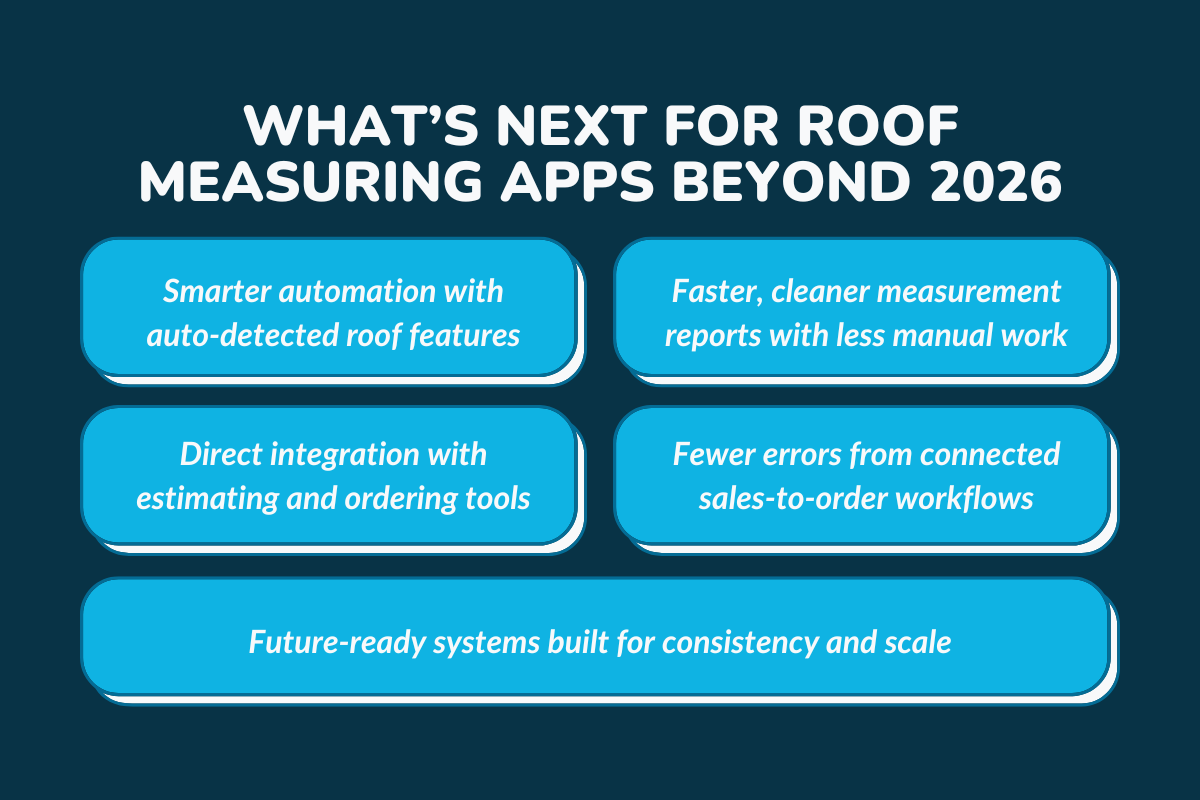
Roof measurement technology isn’t slowing down. The next wave focuses less on basic measurements and more on reducing manual work across the entire roofing workflow.
1. Smarter Automation in Roof Measurement Reports
Future tools will go beyond outlining roofs.
- Automatic detection of materials and roof features
- Faster creation of detailed roof measurements
- Less manual cleanup by sales or ops teams
This means more output without adding workload.
2. Deeper Integrations With Ordering and Estimating Software
Measurement data is becoming the foundation of the sales process.
- Measurements flowing directly into estimates and proposals
- Faster material ordering with fewer errors
- Reduced re-entry of data across systems
Connected workflows save time and prevent costly mistakes.
3. What Roofing Managers Should Prepare for Now
The biggest advantage won’t come from chasing every new tool; it will come from consistency.
- Standardize how measurement data is used
- Choose software that grows with your business
- Train teams to trust accurate data over assumptions
Teams that prepare now will adapt faster later.
Conclusion:
Roof measurement apps don’t replace your experienced crews; they amplify their impact. The right tool lets you measure, estimate, report, and win more deals with confidence.
Think about how much time, money, and risk you’d save if you didn’t have to climb every roof or double‑check every pitch manually. That’s why accurate, fast roof measurement reports and remote measurements are now table stakes for successful roofing businesses.
About RooferBase
RooferBase is built to help roofing teams unify measurement, estimation, and sales workflows in one place. Whether you’re starting with a quick measure on a phone or turning that into a professional estimate that wins the job, it’s designed to fit real day‑to‑day operations without distraction.
If you’re exploring ways to reduce manual work, respond faster to customers, and keep your team aligned from first measurement to signed contract, RooferBase is worth a closer look.
Curious if it fits how your team works today? Get in touch with the RooferBase team to see how it can support your current workflow without forcing a complete overhaul.
FAQs
1. How do I measure my roof with my phone?
You can measure your roof using a roof measuring app that works on a mobile device. Most apps use aerial images, satellite data, or smartphone photos to calculate roof dimensions remotely. You simply enter the property address, review the outline, and generate roof measurements without climbing a ladder or visiting the site.
2. What is the most accurate roof measuring app?
Accuracy depends on imagery quality and multiple layers of roof complexity, but tools using professional aerial imagery tend to perform best. Platforms powered by EagleView technologies often report accuracy levels above 98%. These tools are widely trusted in the roofing industry for estimating, ordering materials, and creating the right solution, professional measurement reports.
3. What software do roofers use for roof measurements and estimates?
Roofing contractors typically use a combination of roofing software for measurements, estimates, and job management. Common setups include roof measurement apps paired with CRM or estimating tools. Some platforms combine measurements, detailed reports, and the sales process in one account, helping teams move faster from measurement to signed customer approval.
4. How accurate are roof measurement apps compared to manual tape measures?
Modern roof measuring apps using aerial images and 3D modeling now approach 98% or higher accuracy. In many cases, they outperform manual tape measurements, which are prone to human error, missed sections, and safety limitations. Consistent accuracy across measuring jobs is what makes these tools an invaluable upgrade.
5. What’s the fastest turnaround time for a roof measurement report?
Some roof measurement services deliver detailed measurement reports in as little as a few hours. That speed helps roofing companies send instant estimates, qualify leads faster, and move quickly in competitive bidding situations. Faster reports often mean faster customer decisions and more jobs closed.