February 20, 2026
Roofing estimates shouldn’t feel like guesswork. Yet for many roofing businesses, estimating still means spreadsheets, handwritten notes, manual calculations, and double-checking numbers late at night.
Small errors slip in. Time gets wasted. Margins quietly shrink.
Roofing estimates are no longer just about getting a number on paper. Today, they decide how fast you close, how accurate your pricing is, and whether your margins survive rising labor and material costs. Yet many roofing businesses still rely on spreadsheets, manual measurements, and last-minute recalculations.
The result is familiar: slow turnaround, inconsistent pricing, and estimates that need revisiting after the job starts. In a market where homeowners compare quotes quickly and competitors respond faster than ever, manual estimating quietly becomes a disadvantage.
This is why more roofing contractors are turning to roof estimator tools, not to replace experience, but to deliver faster, more accurate estimates that reflect real project costs from the start.
How Roof Estimator Tools Deliver Faster, More Accurate Roofing Estimates
Roof estimator tools are digital tools that help roofing contractors calculate roof size, materials, labor costs, and total project cost faster and more accurately than manual methods. They use roof data, aerial measurements, and built-in formulas to reduce errors in roof replacement and roof installation estimates.
These tools matter because manual calculations often lead to inconsistent pricing, missed costs, and delays. Roof estimator tools are used by roofing business managers, team leads, and contractors to improve estimate speed, accuracy, and consistency. The main benefits include faster turnaround times, more accurate estimates, better cost control, and higher trust with homeowners.
This article breaks down how modern roof estimator tools help roofing teams move faster without sacrificing accuracy, and how to decide if it’s time to move on from manual estimating.
Key Takeaways
- Manual roof estimating often looks manageable on the surface, but over time, it leads to lost hours, pricing inconsistencies, and avoidable margin pressure.
- Digital roof estimator tools help roofing teams improve measurement accuracy, standardize pricing, and reduce the back-and-forth that slows down estimates.
- Faster, more reliable estimates don’t just save time; they improve follow-up speed, build homeowner trust, and increase close rates in competitive markets.
- The right roof estimator tool supports growth by simplifying workflows, not complicating them, making it easier for roofing businesses to scale without losing control.
Accurate estimates aren’t about working harder; they’re about working smarter.
If your team is spending hours recalculating numbers, revising quotes, or chasing missing details, it may be time to rethink the estimating process itself.
See how modern roof estimator tools streamline measurements, pricing, and workflows—so estimates go out faster, cleaner, and with fewer surprises.
Set-up Roof Estimator Tool within minutes. Book a demo with experts!
Where Roofing Estimates Still Lose Accuracy
1. The Measurement Misses Production Complexity
A roof measurement can be technically accurate and still fail to capture how difficult the job will be to produce.
Steeper slopes, height, complex geometry, existing layers, difficult access, and staging requirements can create higher labor costs as well as additional equipment and safety expenses.
The problem is not limited to manual measurements. A digitally measured roof can still produce an inaccurate estimate if the inspection, scope, or takeoff does not reflect the actual production conditions.
See how today’s innovative roof measurement tools make things easier for roofing contractors by eliminating guesswork, boosting accuracy, reducing rework, and increasing profits.
2. The Same Waste Factor Is Used for Every Job
A standard waste percentage may be useful as a starting point, but it should not be applied automatically to every roof. Actual waste depends on roof design, materials, and installation practices.
For a relatively simple gable roof, many roofing contractors use 10–15% as a starting waste allowance. A steep roof or more complex design may require substantially more, so the final factor should still reflect the specific job.
Waste assumptions should reflect the specific roof and installation method, not just a default setting in the estimating template.
3. Labor Costs Are Estimated Only by Roof Size
Per-square labor rates are simple to use, but two roofs with the same square count may require very different amounts of work.
A steep or high roof will not produce at the same rate as a low-slope, easily accessible roof. Factors like access, setup, and overall job complexity can all affect the actual hours required.
The estimate should account for expected crew hours and production conditions, not only total roof area.
When labor repeatedly runs over budget, the problem may not be the crew. The original production assumptions may have been unrealistic.
4. Roofing Materials and Scope Costs Are Missing or Outdated
Correct quantities do not guarantee correct costs. Prices change, and additional charges or services may not be included.
Common gaps include supplier-price changes, delivery charges, taxes, fuel surcharges, minimum orders, dump fees, equipment, subcontractor rates, permits, flashing, ventilation, cleanup, and detach-and-reset work.
The scope may also miss predictable work that should have been accounted for.
Each missing cost reduces the amount available to complete the job and protect the expected margin. Price books, assemblies, and scope templates should therefore be reviewed regularly rather than treated as fixed references.
5. Overhead, Markup, and Margin Are Miscalculated
Direct job costs are only part of what the selling price must recover. The estimate may also need to cover overhead costs such as administrative expenses, insurance, and equipment.
Confusion between markup and gross margin can create another pricing error. Markup is calculated against cost, while gross margin is calculated against the final selling price. A 30% markup therefore does not produce a 30% gross margin.
If overhead recovery and target margin are not built into the price correctly, the job may cover its direct costs while still earning less profit than expected.
6. The Estimate Changes During the Sales-to-Production Handoff
An estimate can be accurate when approved and become unreliable later if the final information does not reach production.
Production may receive an outdated scope, while sales notes or customer selections remain buried in messages. Material orders may use different quantities, revisions may not appear in the work order, or field teams may work from an older document version.
A reliable handoff should pass the final scope, quantities, and revisions into production without requiring teams to rebuild the job.
Why Accuracy and Speed Are Now Non-Negotiable For Estimates
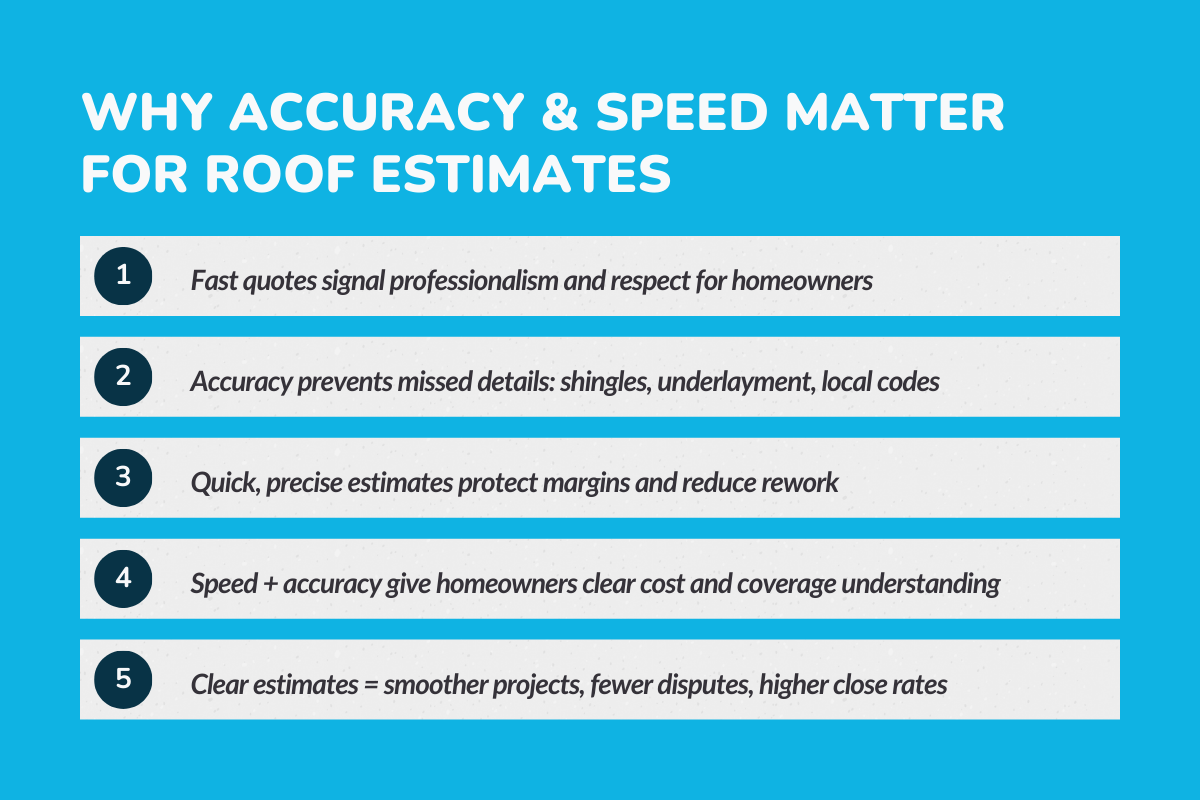
Roof estimating has shifted from a back-office task to a decision driver. Homeowners comparing roof cost or checking a roof replacement cost calculator expect a complete estimate fast, so they can move forward with confidence.
When two contractors quote similar numbers, the one who responds first often feels more reliable and wins the job.
1. Speed shapes first impressions
A fast turnaround signals:
- Clear internal processes
- Professionalism and readiness
- Respect for the homeowner’s time
This matters most when property owners are reviewing multiple bids at once.
2. Accuracy protects trust and margins
Estimates tend to break later when they overlook:
- Old shingles
- Roof removal scope
- Roofs underlayment
- Local building codes
- Higher labor costs
Even a roof that looks in good condition can create problems if key details aren’t addressed upfront.
3. Why both matter together
Accuracy and speed protect more than the final number. They help homeowners clearly understand:
- What they’ll pay
- What’s covered
- How the roof work on their house will be handled
That clarity leads to smoother projects, fewer disputes, and consistently higher close rates.
How to Measure Roofing Estimate Accuracy
Once a job is complete, estimate accuracy should be measured against the final job results. Looking only at whether the total cost was “close enough” can hide problems in labor, materials, disposal, or margin.
The most useful review compares the estimate with actual results at four levels: total cost, individual cost categories, labor performance, and gross margin.
1. Calculate Total and Category-Level Cost Variance
Start with the percentage difference between the estimated and actual job cost:
Cost Variance % = (Actual Job Cost − Estimated Job Cost) ÷ Estimated Job Cost × 100
For example, if a job was estimated to cost $20,000 but ultimately cost $22,000, the cost variance is 10%.
A positive result means the job cost more than estimated. A negative result means the job cost less.
However, regularly coming in below estimate is not automatically a good result. Consistent overestimation may make proposals less competitive or indicate that pricing assumptions are too conservative.
Break the total variance down into primary materials, accessory materials, labor, subcontractors, equipment, disposal, permits, commissions, and other job-specific costs.
A job may finish only 2% over the estimate overall while labor runs 15% over and materials come in below budget. Category-level variance exposes that difference.
2. Compare Estimated and Actual Labor Performance
Labor-cost variance alone does not show whether the problem came from wage rates, crew productivity, or an inaccurate estimate of the time required.
For each completed job, compare estimated crew hours with actual crew hours, then compare estimated labor cost with actual labor cost.
If the hours repeatedly exceed the estimate, the company may be using unrealistic production rates or failing to account for pitch, access, staging, tear-off difficulty, or roof complexity.
If the hours are close but labor costs still run over, the cause may be overtime, wage changes, crew composition, or subcontractor pricing.
3. Compare Estimated and Actual Gross Margin
A job can remain profitable while still missing its expected margin by a significant amount.
For example, a job sold at an expected 35% gross margin may finish at 24%. The company still earned a profit, but the estimate did not meet expectations.
Margin variance reveals whether the completed job delivered the profitability expected when it was sold, even when direct costs appear reasonably close.
4. Track Absolute Variance
Averages can make estimating performance appear more accurate than it is.
Suppose one job finishes 10% over the estimate and another finishes 10% under. Their average signed variance is 0%, but neither estimate was accurate.
Absolute variance measures the size of each error without allowing positive and negative results to cancel each other out. In this example, the average absolute variance is 10%.
Contractors should therefore track both signed variance, which shows whether estimates tend to run high or low, and absolute variance, which shows the typical size of the error.
5. Assign a Reason to Every Significant Variance
The variance shows where the estimate was wrong. A reason code explains why.
Common reasons include measurement errors, scope omissions, outdated pricing, incorrect waste assumptions, labor-productivity differences, hidden conditions, customer-requested changes, ordering mistakes, production deviations, and document-version errors.
How Roof Estimator Tools Improve Accuracy For Your Quotes
Accuracy issues in roof estimating rarely come from a lack of experience. They come from inconsistent measurements, rushed calculations, and assumptions made under time pressure. Roof estimator tools address these gaps by standardizing how scope, measurements, and coverage are determined from the start.
1. Digital measurements vs tape-and-ladder methods
Traditional tape-and-ladder measurements vary based on who’s measuring, roof access, and site conditions. Even small inconsistencies can affect the total roof cost.
Modern roof estimator tools use aerial measurements and roof diagrams to calculate total area more consistently, especially for:
- Steep or multi-level roofs
- Flat roofs with complex layouts
- Houses with multiple roof sections
By reducing measurement variance, teams start with a more reliable foundation before pricing is applied.
2. Built-in formulas that eliminate guesswork
Manual estimating often relies on mental math or spreadsheets to fine-tune details like pitch, waste factor, or material quantities. Roof estimator tools remove that uncertainty by applying standardized logic automatically.
This includes:
- Auto-calculation of pitch and slope adjustments
- Waste factor applied consistently across jobs
- Material quantities aligned with the complete scope
When formulas are built into the system, every estimate follows the same logic, regardless of who prepares it.
3. Fewer revisions, fewer disputes
Accurate estimates reduce downstream issues. When scope items like old shingles removal, roof underlayment, or local building codes are addressed upfront, there are fewer surprises later.
This leads to:
- Fewer callbacks and rework
- Fewer change orders
- Clearer expectations about what’s covered
Accuracy doesn’t just protect the estimate. It protects trust and margins.
Roofing teams that want this level of measurement consistency often rely on roofing estimation software designed specifically for real roof structures, not generic estimating tools.
How Roofing Estimating Tools Improve Speed Without Cutting Corners

Speed in estimating isn’t about rushing. It’s about removing steps that slow teams down without improving outcomes. Once accuracy is standardized, roof estimator tools naturally shorten turnaround time while keeping estimates complete and defensible.
1. From site visit to estimate in minutes, not days
Manual roof estimates often take hours, sometimes days, to complete, especially when measurements need to be double-checked or calculations revisited.
With estimator tools:
- Measurements are ready immediately
- Calculations don’t need to be rebuilt
- Estimates can be completed the same day
What once delayed follow-ups now supports faster decision-making.
2. Pre-built templates that keep estimates consistent
Templates ensure every estimate follows the same structure, regardless of volume or team size.
They help:
- Maintain consistent roof cost breakdowns
- Reflect current labor and material pricing
- Ensure nothing critical is missed when scaling teams
Consistency becomes especially important as higher labor costs and project volume increase.
3. Faster follow-ups build confidence and close more jobs
- The faster an estimate is delivered, the fresher the conversation is in the homeowner’s mind. Quick turnaround signals preparedness and professionalism, even before the price is evaluated.
- In competitive markets, this speed-to-quote advantage often determines who wins the job.
- Roof estimator tools don’t just save time. They help roofing businesses respond with confidence, clarity, and control.
How Do Better Roofing Estimates Help Contractors Win More Jobs?
Estimator tools can improve calculation accuracy and turnaround time, but homeowners still need to understand the quote and trust the proposed scope. A strong estimate turns measurement and pricing data into a clear, evidence-backed proposal that makes the buying decision easier.
1. Clear Scope Makes Pricing Easier to Trust
A lump-sum total gives homeowners little context for evaluating the price. A structured breakdown of materials, labor, tear-off, disposal, optional upgrades, and exclusions shows what the quote covers and shifts the conversation from the cheapest bid to overall value.
2. Visual Proof Supports the Recommended Work
Job-site photos, marked roof diagrams, and measurement data connect the proposed costs to actual roof conditions. For insurance-related jobs, clear documentation can also reduce questions, disputes, and approval delays.
3. Professional Proposals Make Approval Easier
Consistent branding, homeowner-friendly language, optional packages, electronic signatures, and clearly stated next steps reduce friction at the decision stage. When customers can understand and approve the scope without repeated clarification, the estimate becomes part of the sales experience rather than simply a price sheet.
For a complete breakdown of what a professional quote should include, explore these roof estimate best practices for professional contractors.
When Is the Right Time to Switch From Manual Estimating?
Manual roof estimating works until it doesn’t. Most roofing teams start noticing delays, inconsistent pricing, and frequent rework long before margins are affected. Knowing when and how to switch from manual estimating is key to keeping projects on track, crews aligned, and homeowners confident in their roof replacement cost.
Even experienced teams can hit a point where manual roof estimating slows growth and impacts margins. Watch for these warning signs:
- Estimates take too long to complete, delaying follow-ups
- Pricing varies between team members, creating an inconsistent roof cost
- Rework is becoming common due to missed details like old shingles, roofs' underlayment, or the removal scope
- Estimators are stretched thin, juggling multiple jobs and calculations
If any of these appear regularly, it’s time to consider a solution that fine-tunes the estimating workflow.
What changes after switching to a roof estimator tool?
- Faster estimates: Spend less time on spreadsheets and calculations, more time closing jobs
- More predictable margins: Accurate calculations on materials, labor, and disposal reduce surprises
- Better team alignment: Everyone follows the same logic and templates, minimizing inconsistencies
Switching doesn’t just save time; it safeguards trust with property owners and improves your roofing business’s operational efficiency.
How Roof Estimator Tools Support Growing Roofing Teams?
As roofing businesses grow, estimating becomes harder to manage manually. Roof estimator tools create structure, consistency, and visibility, without slowing teams down.
- Faster training for new estimators: Standardized estimating logic helps new hires learn faster. Built-in calculations for roof size, pitch, materials, and labor reduce early mistakes and shorten onboarding time.
- Consistent pricing across teams and locations: One system means one pricing structure. Estimates stay aligned across different team members and locations, reducing surprises and protecting margins.
- Clear visibility for managers: Managers can track estimated volume, turnaround time, and accuracy trends in one place. This data helps improve workflows, not just reporting.
For growing roofing teams, estimating tools turn scaling into a controlled process, rather than a source of risk.
What Data Says About Roofing Estimation Software?
Industry data consistently shows that roofing teams using digital estimating tools achieve significant efficiency gains. Roof contractors using software often close 35–50% more jobs just because they respond first with professional quotes, while the roofing estimating software market grows at 12.9% CAGR, valued at $1.1B in 2024, projected to hit $3.7B by 2033.
Source: DataHorizzon Research
1. Estimating Time Reduction
- Roofing teams using digital tools reduce estimating time by 40–60%, allowing faster quote delivery and shorter sales cycles.
- Contractors handle 2–3x more estimates without additional staff, freeing up time for sales and project management.
- Sales cycles shorten by 20–30%, as faster, more professional estimates improve customer confidence and decision-making.
2. Accuracy Improvements
- Digital tools result in fewer estimate revisions (down 60–75%) and reduced pricing disputes.
- Better cost control on labor and materials, with 15–25% improvement in profit margins due to accurate material takeoffs.
- Accuracy improves because experienced estimators are supported by reliable data, not replaced by it, combining human expertise with automated precision.
What Are the Key Features to Look for in a Roof Estimator Tool?

1. Measurement Accuracy and Roof Diagrams
Look for tools that handle:
- Complex roof shapes, pitches, and multi-level layouts
- Precise area calculations (square footage, waste factors)
- Automatic generation of professional roof diagrams for proposals and field teams
2. Material and Labor Cost Automation
The tool should calculate:
- Roofing materials (shingles, underlayment, accessories) with waste factors
- Labor costs based on regional rates and crew productivity
- Disposal and replacement costs
- Real-time pricing updates from supplier databases
3. Roofing-Specific Templates and Workflows
- Pre-built templates for common roofing scenarios (re-roof, new construction, repairs)
- Roofing-specific workflows that eliminate generic estimating delays
- Customizable templates for regional practices and material preferences
4. Mobile Access for On-Site Estimating
- Full mobile functionality for iOS and Android
- Drone/drone imagery integration for accurate roof measurements
- On-site estimate creation and client approval without returning to the office
5. Integration with CRM or Job Management Tools
- Seamless integration with CRM systems (lead tracking, proposal automation)
- Job management connectivity (scheduling, invoicing, project tracking)
- Accounting integration (QuickBooks, Sage) for financial accuracy
What Are Some Commercial Roofing Estimating Software In The Industry?
1. RooferBase - All-in-One Commercial Roofing Platform
Strength: Combines aerial measurements, estimating, CRM, and job management in one system
Feature:
- Aerial precision + auto-estimating with waste/disposal calculations: Uses aerial measurements to calculate roof size, pitch, waste, and disposal costs accurately from the start.
- Mobile-first for field verification and office-to-field handoff: Field teams verify details on-site while office teams see updates instantly, reducing handoff delays.
- CRM integration connects leads → estimates → signed contracts in one workflow to speed up follow-ups and reduce data loss.
Pricing: Pricing starts at $63 per user/month, with final pricing depending on team size, selected capabilities, integrations, and implementation requirements.
2. RoofSnap - Aerial Measurement Specialist
Strength: Industry-leading roof measurements from satellite/drone imagery
Feature:
- Fast aerial reports: It delivers detailed roof measurements and 3D diagrams, often within 24 hours.
- Basic estimating tied to measurements: Estimates are generated directly from measurement data, reducing manual calculations. However, pricing and workflows require additional tools.
- Limited CRM/job workflow capabilities: RoofSnap does not manage leads, scheduling, or project tracking. Teams usually pair it with separate CRM or job management software.
Pricing:
- Starting from: $13/One Time
- Monthly Subscription: $105 /mo/user
- Annual Subscription: $52 /mo/user
3. JobNimbus - Flexible CRM + Estimating Hub
Strength: Customizable CRM that integrates with measurement tools
Feature:
- Strong pipeline management and job tracking: JobNimbus helps teams track leads, estimates, and jobs through every stage. This keeps sales and operations aligned as projects move forward.
- Measurement imports from EagleView/Roofr: JobNimbus helps teams track leads, estimates, and jobs through every stage. This keeps sales and operations aligned as projects move forward.
- Better for office workflows than field estimation: It excels in managing paperwork and job flow from the office. Field estimating often relies on integrations rather than native tools.
Pricing: Starting from: $300/Per Month
4. AccuLynx - Roofing CRM Powerhouse
Strength: End-to-end roofing CRM with measurement integrations
Feature:
- Lead-to-production tracking: AccuLynx tracks jobs from initial inquiry through installation. This keeps sales, production, and office teams aligned throughout the project lifecycle.
- Material ordering and supplier connections: The platform supports material ordering and supplier coordination. This helps reduce delays and keeps projects moving once estimates are approved.
- Measurement integrations, but no native aerial tools: AccuLynx integrates with third-party measurement providers. However, it does not include built-in aerial measurement capabilities.
Pricing: Acculynx offers custom pricing.
Key Takeaway: RooferBase eliminates tool-switching with integrated aerial → estimating → CRM → job tracking at 1/3 the cost of fragmented solutions. Other tools
excel at single functions but require multiple subscriptions and data transfers.
A quick look:
| Feature | Why It Matters for Commercial Roofing | Top Tools (RooferBase Shines) |
|---|---|---|
| Aerial/Drone Measurements | Handles complex pitches, multi-level roofs, and large areas with 98%+ accuracy | RoofSnap, RooferBase (integrated aerial precision) |
| Material/Labor Automation | Calculates waste, disposal, and labor by region, and real-time pricing for large-scale bids | RooferBase (comprehensive automation) |
| Mobile On-Site Access | Field teams verify and finalize estimates instantly, reducing office trips | JobNimbus, AccuLynx, RooferBase (full mobile workflow) |
| CRM/Job Integration | Seamless flow from lead to project tracking, minimizing data entry | AccuLynx, RooferBase (end-to-end connectivity) |
| Custom Templates | Tailored for commercial specs like metal roofing, flat roofs, and high-volume materials | RooferBase (commercial-focused) |
Note: Tool examples are representative, not exhaustive. The right choice depends on workflow integration, accuracy requirements, and scalability.
Why Roofing Businesses Are Moving Toward All-in-One Estimating Platforms?
The choice to adopt a roof estimator tool isn’t about technology for technology’s sake. It’s about removing friction, improving accuracy, and freeing your team to focus on what matters: delivering timely, reliable estimates that homeowners trust. Roof estimating doesn’t happen in isolation. Modern roofing businesses are moving toward platforms that connect estimating with the full workflow:
Estimating as part of a bigger workflow
- Estimates link directly to proposals, scheduling, and job execution
- Reduces manual re-entry and avoids errors that arise from transferring data between tools
Connected systems reduce friction
- Fewer mistakes, more consistent roof replacement cost calculations
- Better visibility into labor, materials, and total project costs
- Helps roofing contractors stay compliant with local building codes and the covered scope
When estimating becomes part of a connected, all-in-one roofing platform, roofing teams can focus on what matters most, like completing projects on time and maintaining good-condition roofs for homeowners.
Why RooferBase Makes Roof Estimating Faster Without Sacrificing Accuracy?
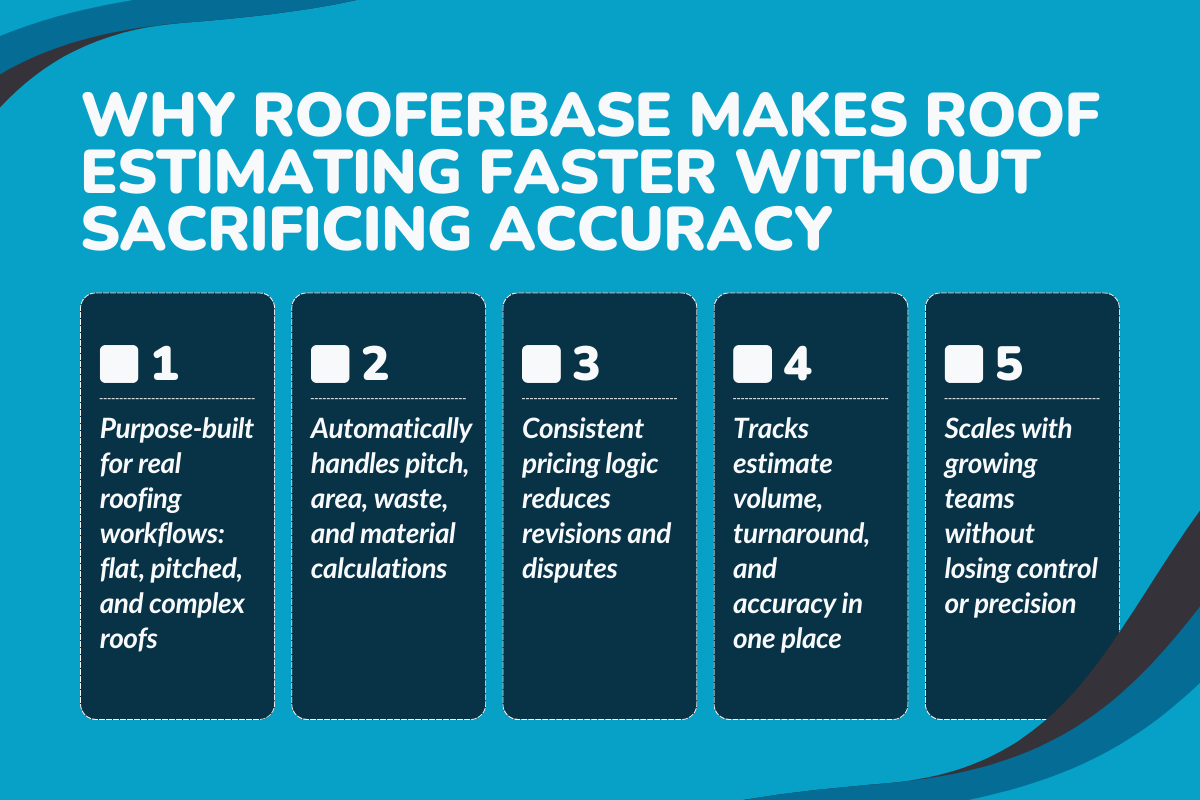
Most roofing teams don’t struggle because they lack experience. They struggle because manual estimating and disconnected tools slow everything down. RooferBase was built to remove that friction.
Unlike generic estimating software, RooferBase is purpose-built around real roofing workflows. It turns estimating from a bottleneck into a repeatable, reliable process, so teams can respond faster, price more confidently, and scale without losing control.
1. Built specifically for real roofing workflows
RooferBase handles the details that usually get missed or manually double-checked:
- Supports complex roof types, flat and pitched roofs, and varied roof shapes
- Accounts for roofs underlayment, old shingles, material removal, and disposal
- Adapts estimates based on roof size, pitch, and structure
This ensures every estimate is complete, not rushed.
2. A roof estimator that balances speed with precision
RooferBase automates the calculations that slow estimators down:
- Pitch, square foot, waste factor, and total area calculations
- Material and labor cost breakdowns tied to the roof replacement cost
- Consistent pricing logic applied across every estimate
The result: fewer revisions, fewer disputes, and estimates that feel professional at first glance.
3. Built-in visibility that helps managers stay in control
Instead of guessing where delays or errors come from, RooferBase makes estimating performance visible:
- Track estimate volume, turnaround time, and accuracy in one place
- Quickly spot inconsistencies across team members or locations
- Identify bottlenecks before they impact close rates
This turns estimating data into an operational advantage, not just reports.
4. Designed to scale with growing roofing businesses
RooferBase works just as well for small teams as it does for expanding operations:
- Simple workflows that don’t overwhelm new estimators
- Consistent processes that protect margins as volume increases
- Tools that help contractors fine-tune pricing and make better decisions on roof replacement cost
RooferBase doesn’t replace expertise; it amplifies it. For roofing businesses ready to move faster without sacrificing accuracy, it offers a clear next step toward better estimates, stronger close rates, and sustainable growth.
Final Verdict:
Manual estimating worked when timelines were loose and expectations were lower. Today, property owners expect fast turnaround, clear roof replacement costs, and confidence that nothing has been missed.
Roof estimator tools make that standard achievable. They eliminate manual calculation errors, speed up turnaround, and help teams deliver consistent, professional estimates without losing control. The payoff is fewer revisions, fewer disputes, and smoother projects from the first quote onward.
Choosing the right roof estimator isn’t about adding software. It’s about protecting margins, aligning teams, and pricing jobs with confidence as demand grows.
For roofing businesses focused on closing faster, scaling cleanly, and staying competitive, modern estimating tools aren’t optional anymore; they’re the smarter way forward.
About RooferBase
RooferBase is an all-in-one software built for roofing businesses that can’t afford slow estimates, pricing mistakes, or inconsistent numbers across jobs. While many contractors still rely on spreadsheets or manual takeoffs, RooferBase gives teams a faster, more controlled way to price roofs accurately, before competitors respond and win the job.
Every delayed estimate is a chance for another contractor to step in. RooferBase removes that risk by turning estimating into a repeatable, reliable system that protects margins and helps teams close faster.
If faster, cleaner estimates are deciding who wins jobs in your market, you can’t afford to sit this out. Book a RooferBase demo and see how quickly accurate estimates can actually move.
FAQs
1. Which is the best roof estimator tool?
The best roof estimator tool is one designed specifically for roofing, not generic construction. It should calculate roof replacement cost using aerial measurements, roof pitch, roof size, and material options like asphalt shingles or metal roofing. Roofing-focused tools also break down labor costs and replacement costs clearly, helping contractors deliver accurate, professional estimates faster.
2. How accurate are roof estimator tools?
Modern roof estimator tools are highly accurate when paired with professional judgment. They use aerial imagery, satellite data, and roof pitch calculations to measure roof size consistently. This reduces human error common in manual methods. While no tool replaces experience, digital estimators significantly improve accuracy for roof cost, materials, and labor planning.
3. Can roof estimator software replace manual calculations?
Roof estimator software replaces repetitive math, not expertise. It automates calculations for replacement cost, labor costs, and materials, while contractors still assess roof condition, old shingles, and job complexity. Think of it as a way to speed up estimating and reduce errors, while keeping decision-making firmly in professional hands.
4. How does a roof replacement cost calculator work?
A roof replacement cost calculator uses aerial measurements to estimate roof size and pitch, then applies average material and labor costs. Many tools provide instant ballpark figures for a new roof, helping homeowners budget early. Contractors can fine-tune details like materials, roof type, and removal needs for more accurate estimates.
5. What should a reliable roof estimate include?
A reliable roof estimate should be fully itemized. It must separate labor costs, materials, permits, and disposal of old shingles. For context, labor often accounts for around 60% of the total roof replacement cost. Clear breakdowns build trust, reduce disputes, and help homeowners understand exactly what they’re paying for.