December 3, 2025
In 2026, the landscape for roofing software is changing faster than ever. Material costs are climbing, labor shortages continue to challenge schedules, and competition among contractors is intense.
In this environment, roofing businesses can’t afford delays, guesswork, or inconsistent numbers. They need roofing estimating tools that deliver not just speed, but accurate estimates, seamless workflows, and real-time visibility into every project.
The best tools on the market go beyond simple number-crunching. They combine precise roof measurements, smart material calculations, and integrated project management features to help you streamline your entire process from takeoff to proposal to final invoice.
Roofing Estimating Software in 2026: Compare the Top Tools Feature-by-Feature
If you’ve been in the roofing business for even a few years, you’ve probably noticed how quickly everything’s changing. Material prices fluctuate every quarter, insurance claims are becoming more complex, and skilled labor is increasingly difficult to find.
In 2026, there’s no room for slow or inaccurate estimates. Every minute spent rechecking measurements or revising proposals is valuable time that could’ve been used winning more jobs.
That’s why roofing estimating tools have become essential for roofing contractors who want to stay competitive. They’re not just about crunching numbers anymore.
Modern roofing estimating software helps create accurate estimates, reduce waste, and speed up the entire process from roof measurement to proposal to project scheduling.
This guide breaks down the leading roofing estimating tools of 2026, comparing them feature by feature so you can find the right solution for your specific project requirements.
Key Takeaways
- Discover which tools are best for small remodelers, which scale for enterprise jobs, and which excel at fast, accurate measurements.
- Understand the three must-have features that set top-tier tools apart.
- Get a practical buyer checklist for product trials or demos.
Go From Guesswork to Game-Winning Estimates
Get Instant, Accurate Roofing Estimates. Click here to learn more about RooferBase and Win More Roofing Jobs!
Why Roofing Estimation Deserves a Dedicated Tool
If you’ve ever spent a long afternoon adjusting numbers on a spreadsheet, you already know how easy it is for human error to sneak in. A single miscalculated slope or missed line item can cost hundreds, sometimes thousands, in lost profit.
Manual takeoffs were once the norm, but today, accurate takeoffs are powered by roofing software that integrates aerial measurements, satellite imagery, and detailed material databases.
These tools don’t just improve accuracy; they completely reshape the workflow.
- Less material waste: When your measurements are correct, your material quantities align perfectly with orders.
- Faster project turnaround: Integrated estimating and scheduling mean you can move from proposal to production in just a few clicks.
- Higher customer confidence: Professional proposals featuring your company logo, financing options, and digital signatures enable you to close deals more efficiently.
The Buyer’s Feature Checklist: What Roofing Estimation Software Must Do in 2026
Before you evaluate any platform, run it against this list. These features are the baseline for a workflow that can compete in 2026.
1. Aerial Measurement Integration
This is the single most consequential capability on the list, and the one where the difference between "integrated" and "compatible" matters most.
A platform with true aerial integration pulls verified measurement data directly from EagleView or Hover and passes it into takeoff without a manual step in between. A platform that's merely "compatible" might give you a PDF report and expect your estimator to retype the numbers. That distinction is the entire gap between a two-hour workflow and a two-day one.
An independent study by CompassData, using drone and terrestrial LiDAR, found EagleView measurements to be 98.77% accurate for roof lines, 98.43% for roof area, and 98.49% for roof slope.
Questions you should ask the vendor:
- Does the platform have a native API integration with EagleView or Hover, or does it rely on manual PDF upload?
- Can you demonstrate the data flow from a measurement order to a completed takeoff without any re-entry?
- What happens when imagery is unavailable for a property? Does the workflow break or degrade gracefully?
2. Automated Takeoff
Automated takeoff is what converts a measurement report from a document into a working estimate. Done right, it means your estimator reviews numbers instead of generating them - and contractors using AI-assisted estimation widely report faster quote generation and measurable reductions in material waste. For a deeper look at the accuracy difference, see our manual vs. digital takeoff comparison.
When measurement data flows directly into takeoff, the platform applies your configured waste factors, pitch adjustments, and material quantities automatically.
The failure mode here is platforms that automate part of the takeoff but leave the rest to manual entry. If an estimator still has to cross-reference a report and manually calculate underlayment or drip edge from raw measurements, the automation isn't complete - it's just moved the manual step one level downstream.
Questions you should ask the vendor:
- Can you show me a takeoff generated from an EagleView report?
- Which fields are auto-populated and which require manual input?
- Can I configure waste factors and pitch multipliers, and do those apply automatically every time?
- What does the workflow look like if I need to adjust a measurement after the takeoff is generated?
3. Live Material Pricing
Live material pricing means the platform maintains a direct integration with supplier catalogs - ABC Supply, Beacon Roofing, SRS Distribution - and pulls current prices at the time the estimate is built.
The margin-protection case is straightforward: if you quote a job using pricing that's two weeks old and material costs have moved, you absorb the difference. Live pricing also changes the proposal conversation - when a contractor can show that a proposal reflects current supplier costs, it lends credibility a manually built quote can't match.
Questions you should ask the vendor:
- Which suppliers does your live pricing integration cover?
- How frequently does pricing update - real-time pull or periodic sync?
- If a supplier price changes between proposal and job start, how does the platform handle that?
- Can I layer my negotiated contract pricing on top of catalog rates?
4. Branded Digital Proposals
A branded digital proposal does three things a PDF can't: it delivers to the homeowner's phone instantly, it presents financing options interactively, and it gives them a way to sign without printing anything.
That last point matters more than most contractors realize. Every step between "homeowner reads proposal" and "homeowner signs contract" is friction, and friction is where decisions go to stall. Homeowners engage with and sign digital proposals at meaningfully higher rates than emailed PDFs - particularly when integrated financing lets them evaluate monthly payments instead of a lump sum.
Questions you should ask the vendor:
- Can I see a sample proposal as the homeowner would receive it?
- How are financing options presented - does the homeowner see monthly payment breakdowns inline?
- Is e-signature built into the platform, or handled by a third-party integration?
- Can I track when a proposal is opened so I can time follow-ups accurately?
5. CRM Integration or Native Pipeline Management
Contractors are increasingly consolidating onto platforms that span takeoff to invoicing — a signal that running multiple disconnected tools carries a real cost. Yet most roofing contractors still manage open bids through email, memory, and informal check-ins. That works when the pipeline is small and breaks the moment you're running more than a handful of active proposals.
A CRM integration - or a native pipeline module with essential roofing CRM features - gives every bid a status, an owner, and an automated follow-up sequence, so the system remembers what memory won't.
Questions you should ask the vendor:
- Does the platform have a native pipeline dashboard, or does CRM require a separate integration?
- How are follow-up tasks triggered - manually, or automatically by proposal status?
- Can I see which proposals are going cold and prioritize outreach from inside the platform?
- How does a won job move from proposal into production management?
6. Mobile Field Capability
Same-day proposal delivery isn't operationally feasible if the estimator has to return to the office to send it.
The estimator should be able to order a measurement report from the job site, review takeoff data when it's ready, build or approve a proposal, and send it before leaving the property. That sequence, completed in the field, collapses the multi-day manual workflow into hours.
The practical test isn't whether the platform has a mobile app, but whether the mobile app supports the complete end-to-end workflow. Many platforms offer mobile access to view data but require a desktop for proposal generation or approval - forcing estimators back to the office and reintroducing exactly the delay the software was supposed to eliminate.
Questions you should ask the vendor:
- Can you walk me through the complete estimation workflow on the mobile app, from measurement request to proposal send?
- Which capabilities require switching to a desktop?
- Does the app work with limited connectivity, or does it require a stable connection?
The Aerial Measurement Question: EagleView, Hover, QuickMeasure — and What Each Platform Uses
Not all aerial measurements are the same, and the source your platform pulls from determines the accuracy, speed, and defensibility of every estimate that comes out of it. Before evaluating platforms, know which source your job mix actually requires.
1. EagleView is the industry standard for insurance restoration and commercial work. When a claim goes to supplement or negotiation, EagleView data gives the contractor a third-party-verified measurement carriers can't easily push back on. For restoration-heavy operations, it's a requirement, not a preference.
2. Hover builds 3D models from smartphone photos taken by the contractor or homeowner. It's cost-effective for retail residential sales and produces visually compelling output for homeowner-facing proposals. The limitation is accuracy dependency: Hover's output is only as good as its photos. Poor lighting, incomplete angles, or difficult rooflines produce measurements that need field verification before supporting a final contract. For retail jobs where you control the photo process, it performs well; for restoration jobs where carrier acceptance matters, it's not the right tool.
3. GAF QuickMeasure delivers reports in under an hour for single-family homes and is integrated by several platforms. It sits between native aerial and EagleView on the speed/verification spectrum - fast enough for same-day retail quoting, though carriers still treat EagleView as the verification standard.
4. Native aerial — satellite-based AI measurement built into the platform - is fast and requires no third-party order. It's useful for preliminary quotes, ballpark figures, and initial outreach. The gap is precision: native aerial lacks the verified accuracy needed for final contract proposals or insurance documentation. Use it to move fast at the top of the funnel; don't use it to close jobs where material quantities and carrier verification matter.
And the restoration elephant: Xactimate. If you do insurance work, your estimation platform doesn't replace Xactimate - carriers price claims in it. What the right platform does is feed verified EagleView measurements into your scope and proposal workflow while your supplement process runs in Xactimate, so the two never require re-keying the same roof. Ask any vendor courting restoration contractors how their workflow coexists with Xactimate; a blank look is your answer.
The Integration Decision That Changes Platform Selection
The measurement-source question and the platform question are connected. Choosing a platform before answering which source your workflow depends on creates a mismatch no other feature can fix.
- If the majority of your work is insurance restoration, the platform must have native EagleView integration that passes report data directly into takeoff without re-entry. Non-negotiable. Ordering an EagleView report and retyping its figures into a separate estimating tool eliminates the speed advantage and reintroduces exactly the error points the software was supposed to remove.
- If the majority is retail residential, Hover integration or native aerial is likely sufficient. The per-report cost difference between EagleView and Hover is meaningful at volume, and Hover's accuracy level fits retail jobs where carrier verification isn't required.
- If your work is mixed, the platform needs to support multiple sources with the same downstream workflow. A platform that handles one cleanly and treats the other as a manual upload creates two-speed estimation: fast for one job type, slow for the other.
Note: Confirm the platform has true data-sync integration rather than mere "compatibility" that still requires manual typing.
Quick Comparison of Top Roofing Estimating Tools (2026)
Here’s a fast, side-by-side look at the leading roofing estimating tools of 2026 and what each one brings to the table.
1. RooferBase: The All-in-One Platform for Roofing and Solar Teams
If you’re looking for a complete operations platform rather than a single-purpose estimator, RooferBase brings everything under one roof, from measurements to scheduling.
Highlights
- Integrated Aerial Measurements: Pulls accurate roof measurements directly into the platform and connects them with your estimating tools for faster, cleaner workflows.
- Instant Proposal Generation: Creates professional proposals in seconds and automatically links them to your CRM and job schedule, so nothing falls through the cracks.
- Built for Roofing and Solar: Supports hybrid teams with tools that streamline estimating, production planning, and end-to-end project management.
- Pricing Tier: Pricing is not available publicly; please check their website for more information.
- Limitation: As a newer platform, it has fewer third-party integrations compared to legacy competitors.
2. AccuLynx: The Enterprise-Grade Powerhouse
AccuLynx is built for established roofing companies that need robust project management and deeper workflow capabilities that can scale with large teams.
Highlights
- Aerial Measurement Integrations: Works smoothly with major aerial measurement partners, while still giving teams the option to enter measurements manually when needed.
- End-to-End Project Control: Handles everything from estimating and scheduling to production tracking, making it easier for large crews to stay aligned.
- Optimized for Large Operations: Known for its reliability in multi-user, multi-location environments where many teams are working on the same projects.
- Pricing Tier: Pricing isn’t listed publicly; check their website for details.
- Limitation: Steeper learning curve for smaller contractors or first-time users.
3. JobNimbus: CRM Meets Estimating
JobNimbus bridges the gap between customer relationship management and estimating, making it a strong fit for roofing teams that want sales and operations working in sync.
Highlights
- Flexible Measurement Options: Supports both photo-based measurements and manual input, giving contractors multiple ways to build accurate estimates for each job.
- Mobile-First Field Communication: The mobile app keeps field reps connected with the office in real time, making it easy to share updates, photos, and progress notes on the go.
- Integrated CRM Workflow: Combines estimating with built-in lead tracking and task management, keeping sales pipelines, job follow-ups, and customer communication organized in one place.
- Pricing Tier: They offer a 14-day free trial. Pricing information isn’t available publicly; you’ll have to check their website for the details.
- Limitation: Estimating tools are less advanced than specialized takeoff solutions.
4. RoofSnap: Quick Estimates for Fast-Moving Sales Teams
When speed matters most, RoofSnap helps contractors build accurate estimates right on-site, making it a favorite for teams that value quick turnaround times.
Highlights
- Aerial and Photo Measurement Tools: Blends aerial imagery with photo-based measuring so contractors can complete fast, reliable takeoffs without waiting for third-party reports.
- Instant Proposal Templates: Comes with ready-made proposal formats that let you generate clear, professional quotes the same day, often within minutes.
- Built for Fast-Paced Roofing Teams: A great fit for door-to-door reps or retail-focused crews who need a lightweight, agile estimating tool they can use in the field.
- Pricing Tier: Pay-As-You-Go: $13/msmt order, Monthly Subscription: $152/mo/user, Annual Subscription: $52/mo/user. They also offer a 7-day free trial for a monthly subscription.
- Limitation: The project management features are primarily designed for estimating and proposals.
5. Roofr: Streamlined Measurement-to-Proposal Workflows
Roofr combines roof measurement, estimating, proposals, and job management in one platform, making it a strong fit for roofing contractors that want a streamlined sales workflow from measurement through payment.
Highlights
- Roof Measurement Reports: Offers measurement reports that contractors can use to move directly into estimates and proposals without manually transferring property data.
- Proposals and Job Management: Supports proposals, invoices, work orders, e-signatures, payments, and job boards for managing work beyond the initial estimate.
- Workflow Automation: Higher-tier plans add customizable job boards, automated actions, crew management, reporting, job costing, and QuickBooks integration.
- Pricing Tier: Starter is available at $0/month. Measure+ ranges from $109–$169/month, Essentials costs $249/month, and Scale costs $349/month when billed monthly. Measurement report fees may apply separately.
- Limitation: More advanced workflow customization, reporting, crew management, and job-costing capabilities are reserved for higher-tier plans.
| Software | Best For | Key Features | Pricing Tier | Limitation |
|---|---|---|---|---|
| RooferBase | Roofing & solar teams needing an all-in-one operations platform | Integrated aerial measurements, instant proposal generation, CRM + scheduling, end-to-end job management | Pricing not publicly listed | Fewer third-party integrations due to being a newer platform |
| AccuLynx | Large and established roofing companies | Aerial measurement integrations, full project control, multi-user, and multi-location support | Pricing not publicly listed | Steeper learning curve for smaller teams |
| JobNimbus | Roofing teams combining CRM with estimating | Photo-based or manual measurement, mobile-first field app, built-in CRM, and sales tracking | 14-day free trial; pricing not publicly listed | Estimating features are less advanced than dedicated takeoff tools |
| RoofSnap | Fast-moving sales teams and field reps | Aerial + photo measurement tools, instant proposal templates, lightweight field app | $13 per measurement (pay-as-you-go), $152/month/user, $52/month/user (annual); 7-day trial | Limited project management beyond estimating |
| Roofr | Small and growing roofing teams that want a streamlined measurement-to-proposal workflow | Roof measurement reports, estimating, proposals, job boards, e-signatures, payments, and workflow automation | Starter: $0/month; Measure+: $109–$169/month; Essentials: $249/month; Scale: $349/month; measurement fees may apply | Advanced reporting, crew management, job costing, and workflow customization require higher-tier plans |
Use-Case Driven Recommendations
Different roofing businesses have different estimating needs, so the best tool depends on your team size, workflow, and the type of work you handle.
Best for Small or Growing Roofing Teams
Roofr and RoofSnap are strong options for smaller teams that prioritize fast measurements, estimates, proposals, and straightforward field workflows
without needing a highly complex operations platform.
Best for Mid-Market Contractors
JobNimbus and RooferBase are better suited to growing roofing companies that need estimating to connect with CRM, job management, scheduling, and broader sales or operational workflows.
Best for Larger or Multi-Team Operations
AccuLynx and RooferBase are stronger fits for established roofing companies managing higher job volumes, multiple crews, and more complex workflows across sales, estimating, production, and project management.
What Makes RooferBase a Strong Choice for Roofing Teams
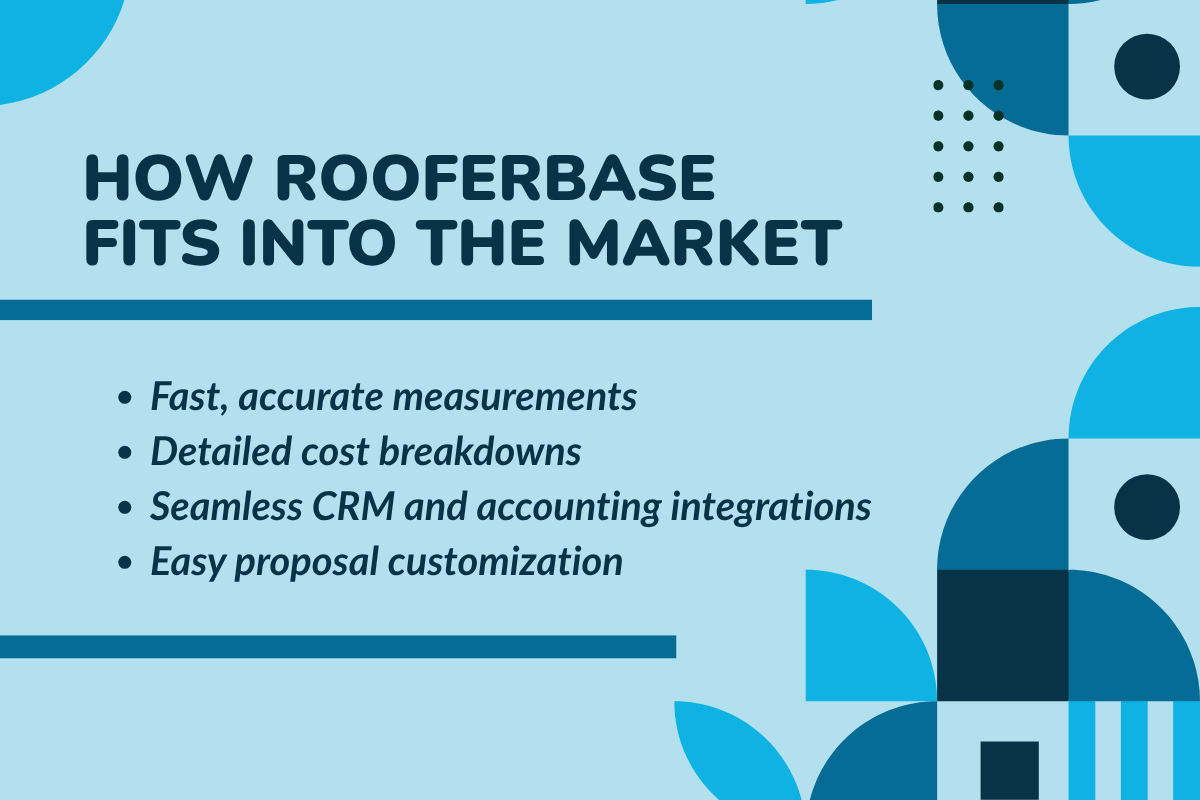
RooferBase positions itself as an end-to-end estimating and project management platform that streamlines the entire process: measure, estimate, propose, schedule, and source materials.
For roofing contractors, that means:
- Fast, accurate measurements that cut out guesswork and keep your takeoffs consistent from one job to the next.
- Detailed cost breakdowns that show precisely where your material, labor, and overhead costs are allocated.
- Seamless CRM and accounting integrations so your leads, jobs, and invoices all stay in sync without double entry.
- Easy proposal customization that lets you send clean, branded quotes that actually help you win more jobs.
Best-fit customer: Medium to large roofing companies that need a unified workflow without juggling multiple logins.
By combining estimating, scheduling, and communication tools, RooferBase helps contractors reduce turnaround time and focus more on closing jobs than managing spreadsheets.
Implementation Checklist: 30/60/90 Day Plan After Purchase
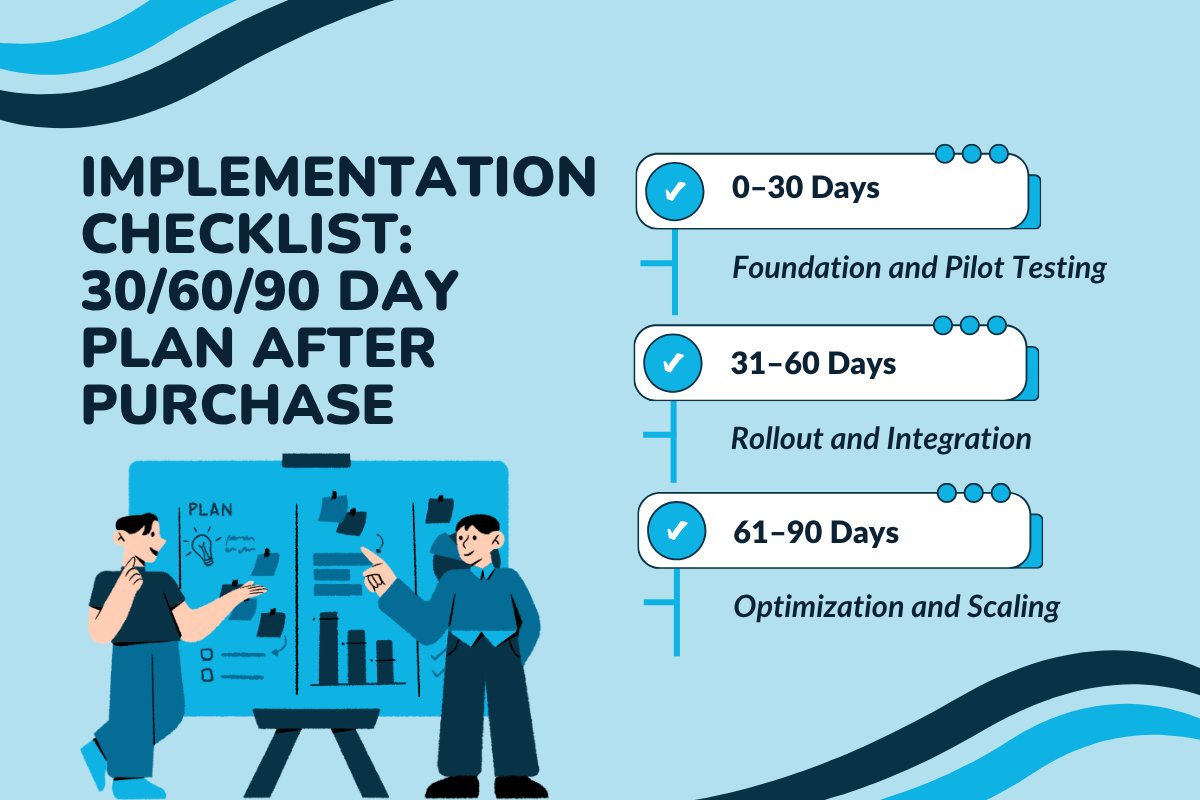
Rolling out new estimating software is easier when you follow a structured plan. This 30/60/90-day checklist helps your team adopt the tool smoothly and start seeing tangible ROI fast.
0–30 Days: Foundation and Pilot Testing
- Import project templates and historical data so your team starts with familiar pricing structures and past job benchmarks.
- Run a pilot job with a small team to test real workflows without overwhelming the entire staff.
- Adjust pricing databases and templates to match your current material costs, labor rates, and margins.
31–60 Days: Rollout and Integration
- Expand to field use by getting your installers and sales reps comfortable with mobile tools and on-site estimating.
- Sync CRM and accounting systems to eliminate duplicate entry and keep sales, production, and finance aligned.
- Begin tracking the estimated turnaround time to measure how much faster estimates are being delivered.
61–90 Days: Optimization and Scaling
- Review KPIs like bid-to-win ratio, material waste, and job delays to see where the new software is making an impact.
- Evaluate ROI improvements and user adoption to identify what’s working and where training may be needed.
- Create internal training materials for new hires so the system becomes part of your company’s long-term workflow.
ROI Metrics Every Buyer Should Track
Tracking success after implementation is crucial. Here are key metrics to monitor:
- Bid-to-win ratio: Higher accuracy means more accepted proposals.
- Estimate turnaround time: How quickly can your team deliver quotes?
- Material waste reduction: Accurate measurements reduce leftover inventory.
- Install scheduling lag: Measure the time it takes for jobs to transition from estimate to production.
- Cost variance per project: Fewer surprises mean better profit margins.
Conclusion
Choosing the right roofing estimating software in 2026 isn’t just about price but about picking a platform that fits your workflow, project scale, and growth goals.
Whether you prioritize speed, accuracy, or full workflow integration, today’s roofing estimating tools give contractors every advantage to save time, win more jobs, and maximize profit.
So before your next bid, take a step back and ask: Is your estimating process helping you close deals or holding you back? The right tools could make all the difference.
Ready to Transform Your Roofing Estimates?
Experience how RooferBase can streamline your workflows, boost estimate accuracy, and help you win more jobs all in one easy-to-use platform.
Visit RooferBase now to explore features and book a personalized demo.
FAQs
1. What is roofing estimating software, and how does it work?
It connects measurement, takeoff, pricing, and proposals into one system. Instead of manual calculations and spreadsheets, it uses aerial measurements and your configured rules to generate accurate estimates quickly.
2. How accurate are software-generated roofing estimates?
When powered by verified measurement reports and configured correctly, highly accurate - independent testing has found EagleView aerial data accurate to within roughly 1.5% on roof area and slope. The biggest improvement comes from eliminating manual re-entry errors and applying consistent waste calculations to every job.
3. What's the difference between estimating software and takeoff software?
Takeoff converts measurements into material quantities; estimating adds pricing, labor, margin, and proposal generation on top. Modern platforms combine both - see our manual vs. digital takeoff comparison for the accuracy breakdown.
4. Can roofing software help with insurance claims and storm restoration work?
Yes. Many U.S. contractors use estimating software to support insurance documentation, including pitch reports, diagrams, and photo uploads for claims. Tools with advanced measurements help create reliable claim-ready reports.
5. How do I switch from spreadsheets or another platform without losing data?
Most modern platforms import leads, contacts, and job history from CSV exports, and the major CRMs support standard exports. Plan a 1–4 week transition: audit and de-duplicate your data first, run both systems in parallel for one pipeline cycle, and confirm during the demo who performs the migration - you or the vendor - and whether it's included or billed.
6. Do I still need Xactimate for insurance jobs?
Yes - carriers price claims in Xactimate, and estimating software doesn't replace that. What it replaces is the manual re-entry between your measurement data, your customer-facing proposal, and your pipeline, so you never retype the same roof twice.
7. How much do measurement reports cost, and who pays?
EagleView reports typically run $25–$45 each; Roofr's run $13 on paid plans; some platforms (like iRoofing's DIY model) charge no per-report fee. Report fees are billed to the contractor on top of the subscription - at quoting volume, they're often the larger line item.
8. How long does implementation take?
The learning curve varies by platform - comprehensive systems like AccuLynx reward longer setup; lighter tools deploy in days. Most teams switching from manual methods generate professional estimates within the first week.
9. How can I calculate ROI before investing in roofing estimating software?
Start by measuring your current estimate turnaround time, bid-to-win ratio, material cost variance, and the amount of time your team spends creating and revising estimates. You can then compare those baseline metrics after implementation to see whether the software is reducing estimating time, improving accuracy, or helping your team manage more bids efficiently.